Why might I need another procedure after LASIK surgery? Some patients may need an enhancement procedure after LASIK if a small amount of spectacle power remains, their vision changes during healing or a refractive error returns over time. An enhancement involves additional laser treatment to improve suitable residual myopia, hyperopia or astigmatism. However, blurred vision …

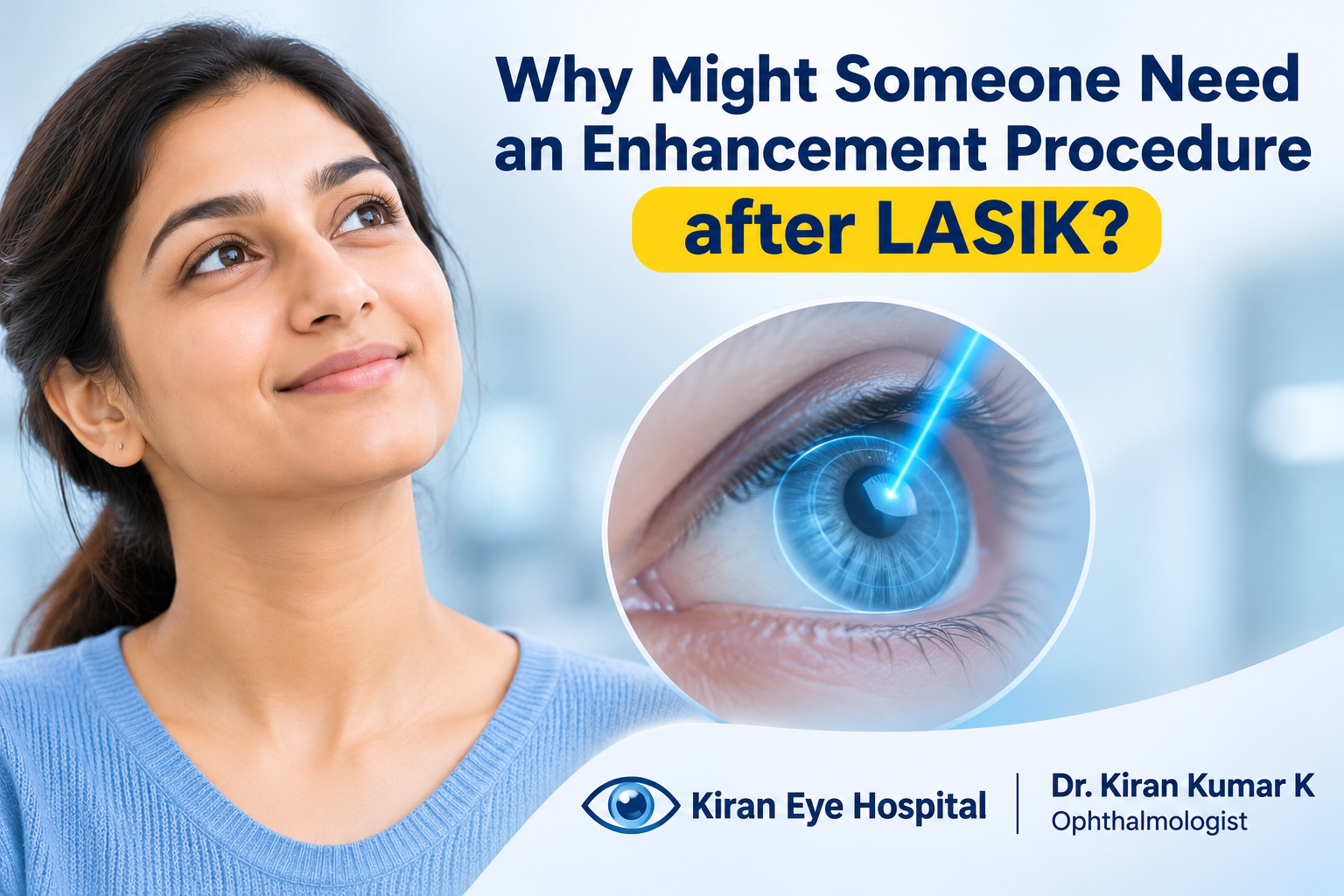
Why might I need another procedure after LASIK surgery?
Some patients may need an enhancement procedure after LASIK if a small amount of spectacle power remains, their vision changes during healing or a refractive error returns over time. An enhancement involves additional laser treatment to improve suitable residual myopia, hyperopia or astigmatism.
However, blurred vision after LASIK does not automatically mean another operation is necessary.
Patients researching LASIK Enhancement surgery Bangalore should understand that retreatment is considered only after identifying the cause of reduced vision and confirming that the eyes are suitable.
At Kiran Eye Hospital, JP Nagar, Bengaluru, Dr. Kiran Kumar K and the ophthalmology team evaluate postoperative vision before discussing further treatment.
Does needing an enhancement mean my first LASIK surgery failed?
Not necessarily.
LASIK reshapes the cornea to correct refractive errors, but the final result can vary because of individual healing responses and other optical factors.
Some patients retain a small amount of spectacle power despite experiencing considerable visual improvement.
Others initially see clearly but notice changes months or years later.
These situations do not automatically indicate that the original procedure was performed incorrectly.
The important question is whether the remaining refractive error significantly affects everyday activities and whether additional treatment would provide a reasonable benefit.
Why can spectacle power remain after LASIK?
Residual refractive error occurs when some myopia, hyperopia or astigmatism remains after surgery.
Factors that may contribute include higher original spectacle power, individual healing responses and differences between planned and achieved correction.
Patients may notice:
- Blurred distant road signs.
- Difficulty reading television subtitles.
- Persistent cylindrical spectacle power.
- Eye strain during visually demanding tasks.
- A need for glasses while driving.
However, dry eyes and other postoperative conditions can cause similar complaints.
The ophthalmologist must determine whether the remaining prescription is responsible before recommending another procedure.
Can spectacle power return several years after LASIK?
Yes. Some patients experience refractive regression, meaning part of the previous prescription returns after initially successful correction.
Changes in corneal healing or curvature may contribute.
However, vision changes years after LASIK can also result from natural ageing, presbyopia or cataract development.
For example, a patient in their forties may begin needing reading glasses because the natural lens loses focusing ability.
This does not necessarily mean that LASIK correction has reversed.
Similarly, a developing nuclear cataract may cause a shift towards nearsightedness.
A thorough examination helps identify the actual cause.
How long should I wait before considering LASIK enhancement?
An enhancement should not be planned while spectacle power is still changing.
Many patients achieve refractive stability around three months after uncomplicated LASIK, although some require longer.
The US FDA advises that eye measurements should be consistent across two consecutive visits at least three months apart before reoperation.
Depending on the amount of correction, healing and clinical findings, the surgeon may recommend waiting longer.
The decision should be based on repeated measurements rather than a particular anniversary of the original procedure.
Which tests determine whether another LASIK procedure is safe?
A comprehensive reassessment is essential.
Visual acuity and refraction testing: Identify remaining spectacle power and confirm stability.
Corneal topography: Maps corneal curvature and identifies irregularities.
Corneal tomography: Evaluates corneal structure and screens for conditions such as ectasia.
Pachymetry: Measures corneal thickness and helps assess whether further tissue removal is appropriate.
Tear film assessment: Checks for significant dry eye disease.
Slit-lamp examination: Evaluates the corneal flap, ocular surface and natural lens.
Additional imaging, including anterior segment OCT, may be recommended to assess the corneal layers.
The ophthalmologist also reviews the original LASIK records whenever available.
Is LASIK enhancement performed by reopening the original flap?
Sometimes.
One enhancement approach involves carefully lifting the original LASIK flap and performing additional laser correction beneath it.
Another approach is surface laser treatment, such as PRK, without reopening the flap.
The choice depends on corneal thickness, the original surgical technique, time since LASIK and the risk of complications.
Flap lifting can carry risks such as epithelial ingrowth, while surface treatment may involve greater early discomfort and a slower visual recovery.
Neither method is automatically preferable for every patient.
Can I undergo LASIK enhancement if my cornea is thin?
Not always.
LASIK removes corneal tissue, so any additional treatment must preserve adequate structural strength.
Patients with insufficient residual corneal thickness or suspicious corneal changes may not be suitable for retreatment.
Further laser treatment can increase the risk of corneal instability or ectasia in susceptible eyes.
In some cases, spectacles or contact lenses may be safer than another surgical procedure.
The surgeon should explain the expected benefits and potential risks before proceeding.
Will enhancement surgery correct glare, halos or dry eyes?
Not necessarily.
LASIK enhancement primarily addresses suitable residual refractive errors.
Glare or halos may arise from dry eyes, higher-order optical aberrations or corneal irregularities.
If the underlying problem is tear film instability, additional laser treatment may not help and could worsen symptoms.
Treatment may instead involve lubricating eye drops, management of ocular surface disease or other appropriate measures.
Patients should not undergo another laser procedure solely because they experience postoperative halos without first identifying their cause.
Can I choose to wear glasses instead of undergoing enhancement?
Yes.
A small remaining prescription does not always justify additional surgery.
Some patients are comfortable using glasses for night driving or particular visual tasks.
Others may prefer contact lenses when clinically appropriate.
The decision should consider the severity of symptoms, everyday needs, corneal health and personal preferences.
An enhancement is an elective option for selected patients, not an automatic requirement whenever a small refractive error remains.
When should I seek medical attention after LASIK?
Arrange an ophthalmic examination if vision becomes progressively blurred, spectacle power changes or visual symptoms interfere with daily activities.
Seek urgent medical attention for sudden deterioration in vision, significant pain, increasing redness, marked light sensitivity or discharge.
These symptoms may indicate complications that require treatment rather than elective enhancement surgery.
Avoid self-medicating or using leftover postoperative eye drops without medical advice.
Where can I discuss LASIK enhancement options in Bangalore?
Patients searching for LASIK Surgery in Jayanagar or nearby South Bengaluru can consider refractive surgery evaluation at Kiran Eye Hospital, located in JP Nagar, Bengaluru.
Dr. Kiran Kumar K, Medical Director and Chief Surgeon, holds MBBS, MD (AIIMS, New Delhi), DNB, FAICO (Cornea), FAICO (Refractive Surgery) and MNAMS qualifications.
His documented expertise includes LASIK, PRK, SMILE and corneal surgery.
A consultation with Dr. Kiran Kumar K or the ophthalmology team can help determine whether LASIK Enhancement surgery Bangalore is appropriate or whether spectacles, ocular surface treatment or another approach would be preferable.
Learn more about the hospital’s LASIK surgery and PRK surgery services.
Frequently Asked Questions About LASIK Enhancement
1. Is LASIK enhancement common after the first surgery?
Some patients require additional correction after LASIK, but many do not. The likelihood depends on the original prescription, healing response and long-term refractive changes. Enhancement is considered only when clinically appropriate.
2. How many months after LASIK can enhancement be performed?
The timing depends on documented prescription stability and corneal health. Many patients stabilise within a few months, but surgeons may recommend waiting longer. Repeat measurements are necessary before considering retreatment.
3. Is LASIK enhancement more risky than the original surgery?
Enhancement involves additional risks, including corneal thinning, dry eye symptoms, flap-related complications or epithelial ingrowth. The individual risk depends on the chosen technique and eye examination findings.
4. Can LASIK enhancement be performed several years after the first procedure?
Possibly. Some patients may be candidates years later, but the ophthalmologist must exclude cataracts, ectasia and other causes of visual change before recommending additional laser treatment.
5. Will I achieve perfect vision after LASIK enhancement?
Not necessarily. Enhancement may improve suitable residual refractive errors, but outcomes vary. Complete spectacle independence, perfect vision and resolution of glare or halos cannot be guaranteed.
Book a Consultation
It’s easy and free!