What is a cortical cataract, and why does night vision become difficult? A cortical cataract develops when the outer layer of the eye's natural lens becomes cloudy, forming wedge-shaped or spoke-like opacities. These cloudy areas scatter incoming light and can cause glare, halos around headlights and reduced contrast, especially during night driving. People researching Cortical …

What is a cortical cataract, and why does night vision become difficult?
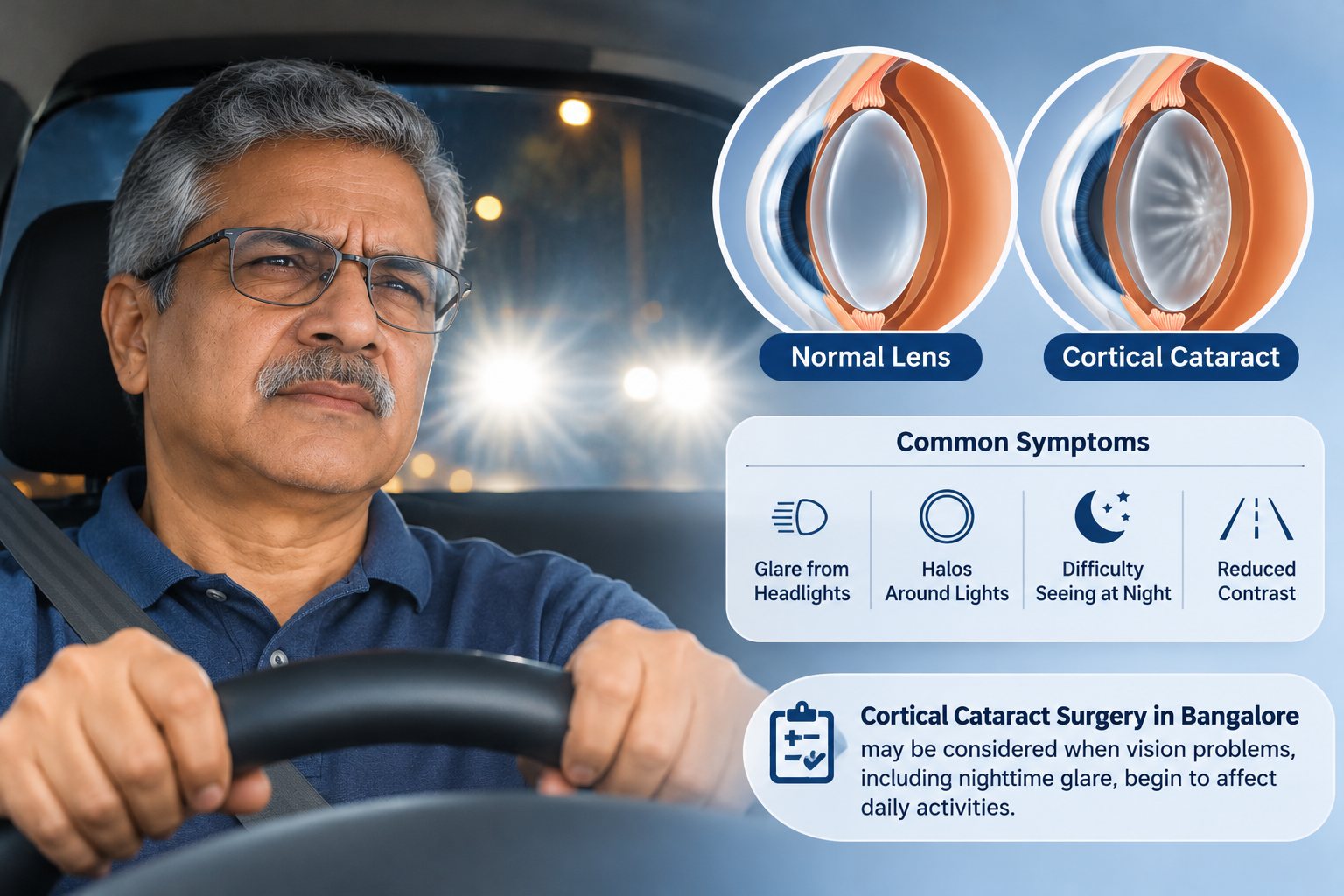
A cortical cataract develops when the outer layer of the eye’s natural lens becomes cloudy, forming wedge-shaped or spoke-like opacities. These cloudy areas scatter incoming light and can cause glare, halos around headlights and reduced contrast, especially during night driving.
People researching Cortical Cataract Symptoms Bangalore may notice that approaching vehicle headlights appear unusually bright even when their daytime vision seems reasonably clear.
At Kiran Eye Hospital, JP Nagar, Bengaluru, Dr. Kiran Kumar K and the ophthalmology team evaluate these symptoms to determine whether cataracts or another eye condition is affecting vision.
Why does a cortical cataract look like spokes on a wheel?
The natural lens contains a central nucleus surrounded by an outer layer called the cortex.
A cortical cataract develops when changes in lens fibres cause portions of this outer region to become cloudy.
These opacities often begin near the edges of the lens and may gradually extend towards its centre.
During an eye examination, they can resemble triangular wedges or the spokes of a wheel.
Initially, the central visual pathway may remain relatively clear.
However, as the cloudy areas expand or interfere with incoming light, visual symptoms can become more noticeable.
The effect depends on the location and extent of the opacities rather than their appearance alone.
Why do vehicle headlights appear unusually bright at night?
Night-driving discomfort is a characteristic concern in patients with cortical cataracts.
In darkness, the pupil naturally enlarges to allow more light into the eye.
As the pupil expands, incoming light may pass through the peripheral cloudy areas of the lens.
Instead of focusing cleanly on the retina, some light scatters inside the eye.
This can produce:
- Glare from approaching headlights.
- Halos or streaks around streetlights.
- Difficulty recognising pedestrians in poorly lit areas.
- Reduced clarity when moving between bright and dark environments.
- Difficulty distinguishing road markings.
- Increased discomfort during rainy nighttime driving.
These symptoms may be particularly troublesome when headlights are directly ahead.
However, glare is not always caused by cataracts. Dry eye disease, refractive errors and other ocular conditions can produce similar complaints.
Can I have a cortical cataract even if my eye-chart vision is normal?
Yes. Some people with early cortical cataracts perform reasonably well during routine visual acuity testing.
An eye chart measures the ability to recognise letters under controlled conditions, but it may not fully reflect difficulties caused by glare or reduced contrast.
Someone may read the chart comfortably during an examination yet struggle to see road markings under bright headlights.
This difference is important because visual function involves more than reading small letters.
An ophthalmologist may consider glare testing or contrast sensitivity assessment when symptoms are greater than standard visual acuity results suggest.
What causes cortical cataracts to develop?
Age-related changes in the natural lens are a common cause.
As lens fibres age, their structure and transparency can change, resulting in areas of clouding.
Other recognised cataract risk factors include diabetes, smoking, previous eye injuries and prolonged ultraviolet exposure.
Certain medications and individual medical conditions may also contribute to cataract development.
Cortical cataracts can affect one eye or both eyes, sometimes progressing at different rates.
The speed of progression varies, so a diagnosis does not automatically mean that surgery is immediately necessary.
How can I tell whether my night-driving problem is caused by a cortical cataract?
Persistent glare, halos or difficulty seeing in low-light conditions should prompt an eye examination.
The ophthalmologist will ask when the symptoms started, whether both eyes are affected and whether changing spectacles improves vision.
A comprehensive assessment may include:
Visual acuity testing: Measures distance and near vision.
Refraction testing: Identifies spectacle prescription changes.
Slit-lamp examination: Allows the ophthalmologist to identify characteristic spoke-like clouding within the lens cortex.
Dilated eye examination: Helps assess the lens and retina.
Glare and contrast sensitivity testing: May be recommended to evaluate difficulties not fully explained by ordinary eye-chart results.
Additional investigations may be necessary when another eye condition is suspected.
Can spectacles or anti-glare glasses improve night vision?
Updated spectacles may help when an uncorrected refractive error contributes to visual difficulties.
Anti-reflective spectacle coatings may reduce reflections from the glasses themselves.
However, they cannot remove cloudiness within the natural lens.
Some patients find it helpful to keep windshields clean, avoid unnecessary nighttime driving and improve lighting for everyday tasks.
These measures may provide temporary assistance but do not reverse the cataract.
No established medication or eye drop can dissolve an age-related cortical cataract.
When symptoms significantly affect daily activities, cataract surgery may be considered.
Will cataract surgery help with nighttime glare?
Cataract surgery removes the cloudy natural lens and replaces it with an artificial intraocular lens.
Many patients experience improvements in visual clarity and glare-related difficulties after surgery.
However, the outcome depends on retinal health, other eye conditions and the selected intraocular lens.
Some intraocular lenses can themselves produce visual effects such as halos, particularly under low-light conditions.
Patients considering Cortical Cataract Surgery in Bangalore should discuss their nighttime driving requirements with the ophthalmologist before selecting a lens.
The surgeon can explain the available options, potential benefits and limitations.
Further information is available on Kiran Eye Hospital’s cataract surgery service page.
When should I seek medical attention for worsening night vision?
Arrange an ophthalmic examination if glare, halos or poor nighttime visibility begin interfering with driving or other activities.
Avoid driving at night if your vision is unreliable.
Seek urgent medical attention for sudden vision loss, severe eye pain, new flashes, numerous floaters or a dark shadow across vision.
These symptoms are not typical of a gradually developing cortical cataract and may indicate another condition requiring prompt evaluation.
Where can I seek cortical cataract evaluation in Bangalore?
Patients seeking an assessment for Cortical Cataract Symptoms Bangalore can visit Kiran Eye Hospital, located at Vishnu Towers, ITI Layout, 1st Phase, JP Nagar, Bengaluru.
Dr. Kiran Kumar K, Medical Director and Chief Surgeon, holds MBBS, MD (AIIMS, New Delhi), DNB, FAICO (Cornea), FAICO (Refractive Surgery) and MNAMS qualifications. His documented expertise includes cataract, corneal and refractive surgery.
A consultation with Dr. Kiran Kumar K or the ophthalmology team can help determine whether cortical lens clouding is responsible for nighttime glare and whether monitoring or surgical treatment is appropriate.
Frequently Asked Questions About Cortical Cataracts
1. Why do cortical cataracts cause more glare during night driving?
During darkness, the pupil becomes larger, allowing light to pass through more peripheral portions of the lens. Spoke-like cortical opacities may scatter this light, creating glare and halos around headlights.
2. Can cortical cataracts affect night vision before daytime vision?
Yes. Some patients notice nighttime glare and reduced contrast before significant daytime visual blurring develops. However, other conditions can produce similar symptoms and should be evaluated.
3. Do all cortical cataracts require immediate surgery?
No. Mild cortical cataracts may be monitored when daily activities are not significantly affected. Surgery is generally considered when visual difficulties interfere with normal activities or when other clinical indications exist.
4. Can anti-glare glasses correct night vision problems caused by cortical cataracts?
Anti-reflective coatings may reduce reflections from spectacle lenses, but they cannot remove light scattering caused by a cloudy natural lens. An ophthalmologist can determine whether cataract treatment is necessary.
5. Will night vision become completely normal after cortical cataract surgery?
Many patients notice improvement in visual clarity and glare after cataract surgery. However, outcomes depend on retinal health, other eye conditions and intraocular lens selection. Completely normal night vision cannot be guaranteed.
Book a Consultation
It’s easy and free!