Can I have LASIK surgery if I recently recovered from an eye infection? Yes, LASIK may be possible after an eye infection has completely resolved, but eligibility depends on the type of infection, corneal healing and overall eye health. LASIK should not be performed while an active infection or significant inflammation is present. Some previous …

Can I have LASIK surgery if I recently recovered from an eye infection?
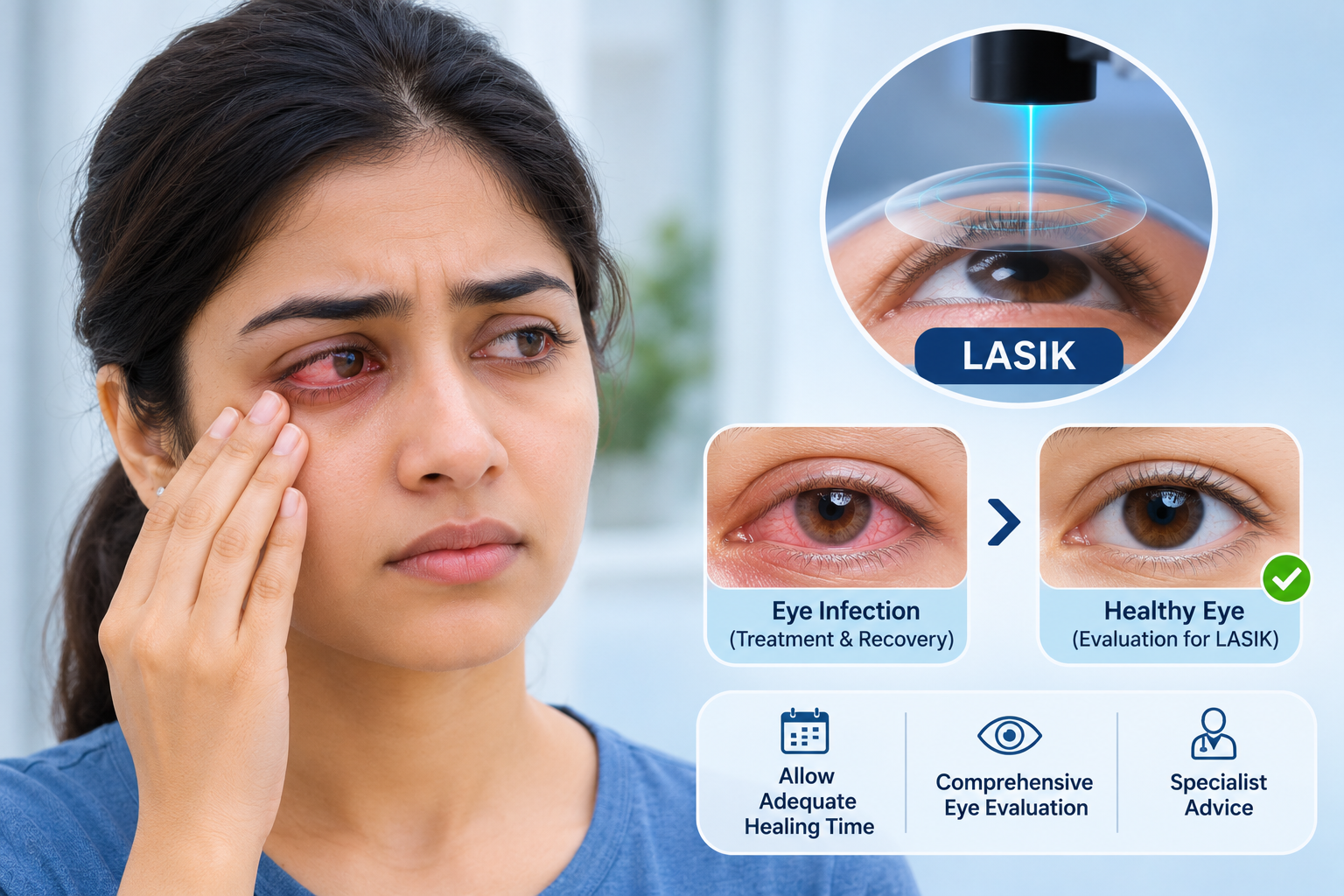
Yes, LASIK may be possible after an eye infection has completely resolved, but eligibility depends on the type of infection, corneal healing and overall eye health. LASIK should not be performed while an active infection or significant inflammation is present. Some previous infections, particularly those affecting the cornea, may make LASIK unsuitable even after symptoms improve.
Patients researching LASIK after eye infection Bangalore should understand that the disappearance of redness or discharge does not necessarily mean the eye is ready for surgery.
At Kiran Eye Hospital, JP Nagar, Bengaluru, Dr. Kiran Kumar K and the ophthalmology team can evaluate corneal health before considering refractive surgery.
Why does a previous eye infection matter before LASIK?
LASIK involves creating a thin corneal flap and reshaping the underlying tissue using a laser.
For appropriate healing, the cornea and surrounding ocular surface should be healthy.
An infection can temporarily damage the corneal surface, disturb the tear film or cause inflammation.
In some cases, infection leaves behind scarring or irregularities that affect how light enters the eye.
Performing LASIK before these changes have stabilised may increase the risk of complications or make surgical planning less reliable.
This is why ophthalmologists assess previous infections rather than relying only on current spectacle power.
Can I undergo LASIK after conjunctivitis or pink eye?
Conjunctivitis is inflammation of the conjunctiva, the thin membrane covering the white part of the eye and inner eyelids.
It may be caused by viruses, bacteria or allergies, although allergic conjunctivitis is not an infection.
Symptoms can include redness, watering, itching, discharge and irritation.
Patients with active infectious conjunctivitis should postpone elective LASIK.
After recovery, the ophthalmologist must confirm that inflammation has resolved and that the cornea and ocular surface are healthy.
Some viral infections can also affect the cornea, so additional assessment may be necessary even after visible redness disappears.
What if my previous infection affected the cornea?
A corneal infection, known as infectious keratitis, requires particular caution.
Keratitis may be associated with bacteria, viruses, fungi or other microorganisms.
Symptoms may include pain, redness, excessive watering, light sensitivity and reduced vision.
Unlike uncomplicated conjunctivitis, keratitis can damage deeper corneal tissue.
After treatment, some patients develop scars, thinning or irregular corneal curvature.
These changes may affect LASIK suitability because the procedure requires adequate corneal thickness and predictable tissue reshaping.
The ophthalmologist must determine whether the cornea has healed sufficiently and whether any remaining abnormalities make surgery inappropriate.
Can I undergo LASIK if I previously had herpes infection in the eye?
A history of herpes simplex keratitis or herpes zoster affecting the eye is an important consideration.
These infections can sometimes recur, and surgical stress or treatment-related factors may increase the risk of reactivation.
Consequently, previous herpetic eye disease is considered a significant precaution when evaluating refractive surgery.
Some patients may be advised against LASIK, particularly when there have been repeated episodes or residual corneal damage.
In carefully selected cases, a specialist may consider additional precautions.
Patients should always disclose previous herpes-related eye infections, even if the last episode occurred several years earlier.
How long should I wait after an eye infection before LASIK?
There is no universal waiting period that applies to every infection.
A mild conjunctival infection that resolves without corneal involvement differs considerably from a severe episode of infectious keratitis.
The surgeon may need to confirm that inflammation has settled, eye medications are no longer required for the acute infection and corneal measurements remain stable.
Some patients require repeat examinations over time.
Others may remain unsuitable for LASIK because of permanent corneal changes.
The decision should therefore be based on clinical recovery rather than a fixed number of days or weeks.
Which eye tests determine whether I am ready for LASIK?
A detailed examination helps determine whether a previous infection has affected the cornea or visual function.
Slit-lamp examination: Checks for residual inflammation, corneal scars and surface abnormalities.
Visual acuity and refraction testing: Measures vision and identifies prescription changes.
Corneal topography: Maps the corneal surface to detect irregular curvature.
Corneal tomography: Evaluates corneal structure and possible abnormalities.
Corneal pachymetry: Measures thickness to help assess whether laser treatment is appropriate.
Tear film assessment: Identifies dryness or ocular surface instability.
Additional investigations may be recommended when the infection history or examination findings require further evaluation.
What happens if an eye infection has left a corneal scar?
Not every corneal scar has the same effect on vision.
A small peripheral scar may have a different impact from a central scar that distorts incoming light.
Significant scarring, thinning or irregular corneal shape can make LASIK unsuitable.
The ophthalmologist may recommend continued monitoring, spectacles, specialised contact lenses or treatment directed at the underlying corneal problem.
PRK or SMILE may be discussed in selected cases, but neither is automatically safe simply because LASIK is unsuitable.
Patients can review the hospital’s LASIK surgery, PRK surgery and SMILE surgery information.
When should I seek medical attention instead of planning LASIK?
Arrange an ophthalmic examination if redness, irritation, fluctuating vision or light sensitivity persists after an infection.
Seek urgent medical attention for increasing eye pain, reduced vision, marked light sensitivity or a white spot on the cornea.
These symptoms may indicate active keratitis or another condition requiring prompt treatment.
Contact lens users with painful red eyes should remove their lenses and seek urgent assessment.
Do not use leftover antibiotic or steroid eye drops without medical advice.
Where can I discuss LASIK eligibility after an eye infection in Bangalore?
Patients considering LASIK after eye infection Bangalore can seek a refractive surgery evaluation at Kiran Eye Hospital, Vishnu Towers, ITI Layout, 1st Phase, JP Nagar, Bengaluru.
Dr. Kiran Kumar K, Medical Director and Chief Surgeon, holds MBBS, MD (AIIMS, New Delhi), DNB, FAICO (Cornea), FAICO (Refractive Surgery) and MNAMS qualifications.
His documented expertise includes corneal conditions, keratoplasty, LASIK, PRK and SMILE surgery.
A consultation with Dr. Kiran Kumar K or the hospital’s ophthalmology team can help determine whether an earlier infection has fully resolved, whether corneal abnormalities remain and which treatment pathway may be appropriate.
Frequently Asked Questions About LASIK After an Eye Infection
1. Can I undergo LASIK after recovering from conjunctivitis?
Possibly. LASIK may be considered once conjunctivitis has fully resolved and the eye examination confirms that no significant inflammation or corneal problems remain.
2. How long should I wait after an eye infection before LASIK?
There is no fixed waiting period for every patient. The timing depends on the type of infection, whether the cornea was affected and whether eye measurements have stabilised.
3. Can a corneal scar from an old infection prevent LASIK?
Yes. Significant corneal scarring, irregular curvature or thinning can make LASIK unsuitable. The ophthalmologist must evaluate corneal structure and visual function before recommending treatment.
4. Is LASIK possible after herpes simplex eye infection?
A history of herpes simplex keratitis requires careful specialist assessment because the infection may reactivate and can leave corneal damage. LASIK may be inappropriate for some patients.
5. Can I choose SMILE or PRK if LASIK is unsuitable after an infection?
Sometimes, but these procedures also require adequate corneal health. Previous infection-related scarring, thinning or inflammation may affect eligibility for any laser refractive surgery.
Book a Consultation
It’s easy and free!