
Why is a retina scan recommended before cataract surgery? An eye doctor may recommend a retina scan before cataract surgery to check whether the retina, particularly the macula responsible for central vision, is healthy. The scan can reveal retinal conditions that may not be obvious during a routine examination and could affect vision after surgery. …

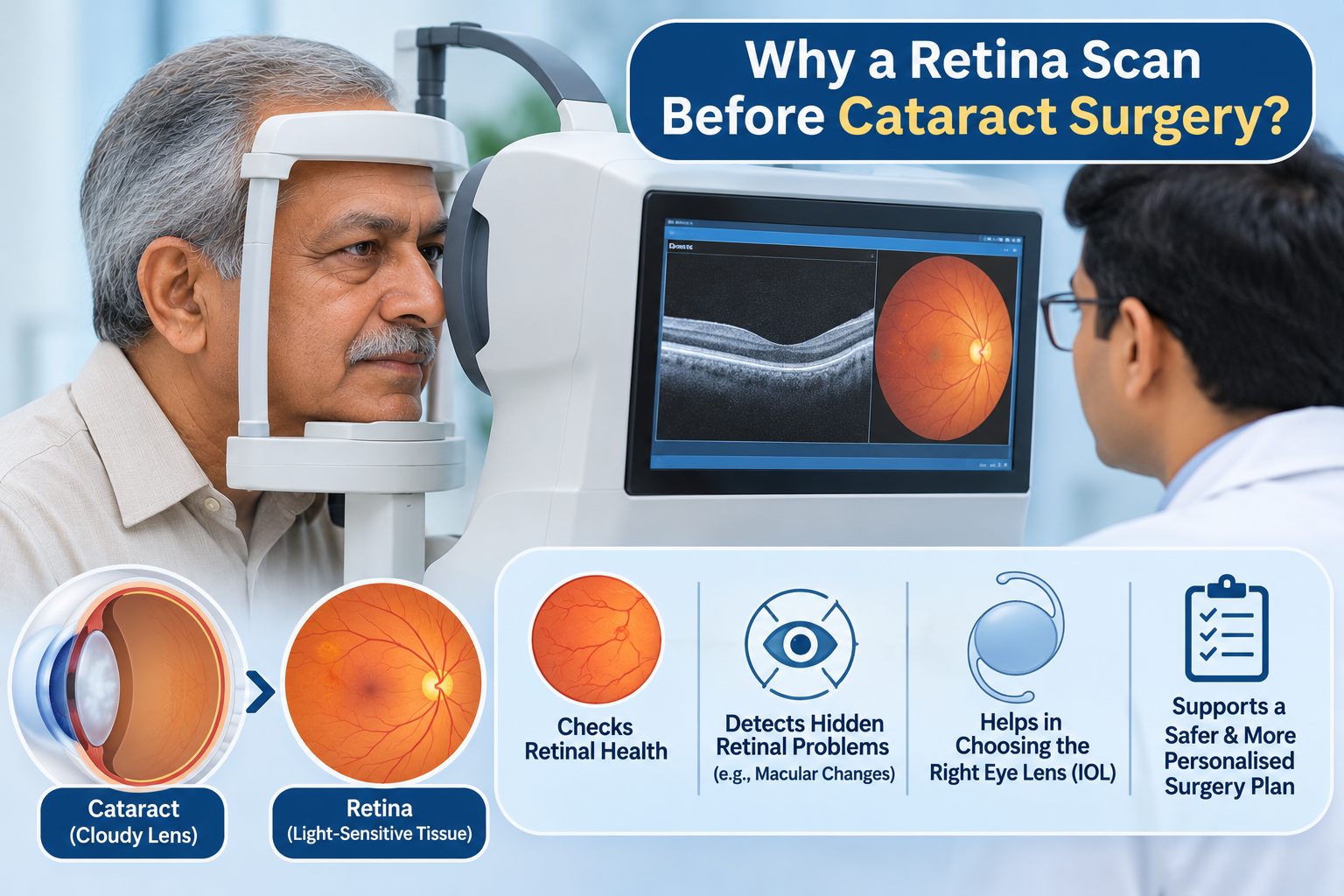
Why is a retina scan recommended before cataract surgery?
An eye doctor may recommend a retina scan before cataract surgery to check whether the retina, particularly the macula responsible for central vision, is healthy. The scan can reveal retinal conditions that may not be obvious during a routine examination and could affect vision after surgery.
Patients searching for Retina Scan Before Cataract Surgery Bangalore sometimes wonder why an additional investigation is needed when the cataract has already been diagnosed.
At Kiran Eye Hospital, JP Nagar, Bengaluru, Dr. Kiran Kumar K and the ophthalmology team assess eye health to support appropriate cataract treatment planning.
Why does the retina matter if the cataract is in the lens?
The natural lens and retina perform different functions.
The lens focuses incoming light, while the retina converts that light into signals transmitted to the brain.
A cataract develops when the lens becomes cloudy, reducing the clarity of light reaching the retina.
During cataract surgery, the cloudy lens is removed and replaced with an artificial intraocular lens.
However, replacing the lens cannot correct an underlying retinal disease.
If the macula or another important retinal structure is damaged, vision may remain limited even after technically successful cataract surgery.
Understanding retinal health beforehand helps the ophthalmologist explain realistic visual expectations.
What is an OCT retina scan, and is it painful?
Optical coherence tomography, commonly called OCT, is a non-invasive imaging test that produces detailed cross-sectional images of retinal tissue.
Patients usually sit in front of a scanning machine and look towards a fixation target while images are captured.
The test generally takes only a few minutes and does not involve injections or surgical incisions.
Pupil-dilating drops may be used depending on the examination requirements.
OCT provides information about retinal thickness, macular structure and abnormalities that may be difficult to identify through ordinary examination alone.
An OCT scan complements a dilated retinal examination rather than replacing it.
Which hidden retinal conditions can a scan detect?
Some retinal disorders cause relatively few noticeable symptoms during their early stages.
A cataract can also make it difficult for patients to recognise whether blurred vision has more than one cause.
A retina scan may identify:
- Age-related macular degeneration: Changes affecting central retinal function.
- Diabetic macular oedema: Fluid accumulation involving the macula.
- Epiretinal membrane: A thin layer of tissue that can distort the retinal surface.
- Macular holes: Openings affecting the central macula.
- Vitreomacular traction: Abnormal pulling on the retinal surface.
OCT may also reveal structural changes associated with previous retinal disease.
Other retinal problems, particularly peripheral retinal tears, require a dilated examination and cannot be excluded by macular OCT alone.
Why might I need a retina scan even if I have no retinal symptoms?
An important reason for preoperative retinal imaging is that some abnormalities remain unnoticed until detailed testing is performed.
For example, a patient may believe all blurred vision is caused by cataracts, while a separate macular condition also contributes.
A doctor may recommend OCT when visual acuity is worse than expected for the observed cataract, when there is a history of retinal disease or when certain intraocular lenses are being considered.
The need for OCT varies.
Not every patient requires the same imaging tests before cataract surgery.
The ophthalmologist selects investigations according to individual findings and risk factors.
Is retinal screening especially important if I have diabetes?
Diabetes can affect the small blood vessels supplying the retina.
Diabetic retinopathy may develop without obvious symptoms, and macular oedema can reduce central vision.
Before cataract surgery, an ophthalmologist may recommend a dilated retinal examination and OCT when appropriate.
If significant retinal disease is detected, additional treatment or monitoring may be necessary.
Depending on the condition, treatment may involve medication injections into the eye, retinal laser treatment or other specialist care.
The ophthalmologist may coordinate retinal management with cataract surgery planning.
Patients with diabetes should also continue appropriate systemic medical care.
Can retinal scan results change my artificial lens selection?
Yes. Retinal findings can influence the choice of intraocular lens, or IOL, implanted during cataract surgery.
Different lenses are designed to address different visual requirements.
Some multifocal and other presbyopia-correcting lenses may be less suitable for patients with significant macular disease because reduced contrast sensitivity or other visual limitations can affect satisfaction.
If retinal abnormalities are identified, the surgeon may recommend a different lens design or discuss additional limitations.
This makes retinal evaluation particularly relevant when patients are considering lenses intended to reduce dependence on spectacles.
The final choice should reflect retinal health, eye measurements and the patient’s everyday visual needs.
What happens if the retina scan shows a problem?
An abnormal retina scan does not automatically mean cataract surgery must be cancelled.
The next step depends on the diagnosis and severity.
Some stable conditions may simply require monitoring and realistic counselling about visual outcomes.
Active macular swelling or another treatable retinal condition may require specialist management before surgery.
In other cases, cataract surgery may proceed with additional precautions or postoperative monitoring.
The doctor should explain how the retinal condition and cataract may each contribute to reduced vision.
Patients can learn more through the hospital’s cataract surgery and retina specialist service pages.
Can a retina scan be performed if my cataract is very dense?
A dense cataract can interfere with the passage of light needed for OCT imaging.
When the retina cannot be adequately visualised, the ophthalmologist may recommend an alternative investigation.
A B-scan ultrasound can help assess certain structures at the back of the eye when the cataract prevents a clear view.
However, B-scan ultrasound does not provide the same detailed macular images as OCT.
The surgeon will explain which investigations are useful and what limitations remain before surgery.
When should I seek urgent medical attention for retinal symptoms?
Arrange an ophthalmic examination if you notice persistent distortion, blurred central vision or unexplained changes in sight.
Seek urgent medical attention for sudden vision loss, new flashes of light, a sudden increase in floaters or a dark curtain across your vision.
These symptoms may indicate retinal conditions requiring prompt evaluation and should not be attributed automatically to cataracts.
Where can I discuss retinal evaluation before cataract surgery in Bangalore?
Patients seeking Retina Scan Before Cataract Surgery Bangalore can consider an ophthalmic evaluation at Kiran Eye Hospital, Vishnu Towers, ITI Layout, 1st Phase, JP Nagar, Bengaluru.
Dr. Kiran Kumar K, Medical Director and Chief Surgeon, holds MBBS, MD (AIIMS, New Delhi), DNB, FAICO (Cornea), FAICO (Refractive Surgery) and MNAMS qualifications. His documented clinical expertise includes cataract, corneal and refractive surgery.
A consultation with Dr. Kiran Kumar K or the ophthalmology team can help determine which retinal investigations are indicated, whether additional specialist care is needed and how examination results may influence cataract surgery planning.
Frequently Asked Questions About Retina Scans Before Cataract Surgery
1. Is a retina scan compulsory for every cataract surgery patient?
No. An OCT retina scan is not universally required for every patient. An ophthalmologist may recommend it when retinal disease is suspected, vision is worse than expected or additional information is needed for surgical planning.
2. Can a retina scan detect problems that an ordinary eye examination misses?
Yes. OCT can reveal structural abnormalities of the macula that may not be obvious during a routine examination. However, it complements rather than replaces a comprehensive dilated retinal examination.
3. Is an OCT scan painful or harmful to the eyes?
OCT is a non-invasive imaging test that uses light to capture retinal images. It does not require an incision or injection and is generally painless.
4. Can cataract surgery proceed if the retina scan is abnormal?
Sometimes. The decision depends on the retinal condition, its severity and whether treatment is needed before surgery. The ophthalmologist may recommend monitoring, retinal treatment or changes to the surgical plan.
5. Will a normal retina scan guarantee clear vision after cataract surgery?
No. A normal scan is reassuring but cannot guarantee a particular outcome. Vision after surgery also depends on the optic nerve, cornea, other eye conditions, surgical healing and intraocular lens selection.
Book a Consultation
It’s easy and free!