Why do I still need spectacles even after successful cataract surgery? Some patients still need glasses after cataract surgery because the artificial lens implanted during the procedure may provide clear focus at only one distance. Remaining astigmatism, small refractive errors and individual healing differences can also affect vision. Importantly, needing spectacles does not automatically mean …

Why do I still need spectacles even after successful cataract surgery?
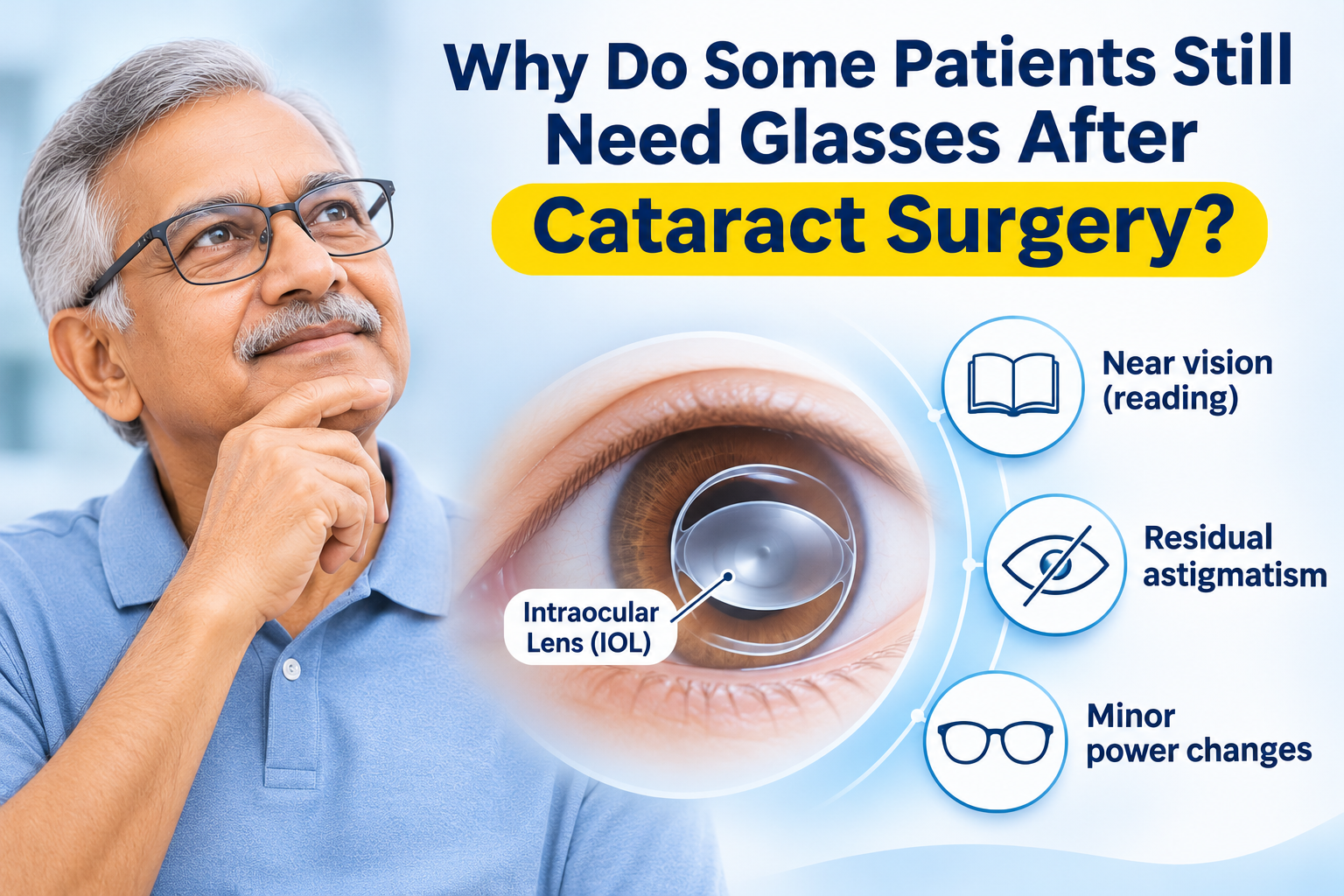
Some patients still need glasses after cataract surgery because the artificial lens implanted during the procedure may provide clear focus at only one distance. Remaining astigmatism, small refractive errors and individual healing differences can also affect vision.
Importantly, needing spectacles does not automatically mean cataract surgery was unsuccessful.
Patients researching Need Glasses After Cataract Surgery Bangalore often expect that removing cataracts will eliminate their spectacle prescription completely.
At Kiran Eye Hospital, JP Nagar, Bengaluru, Dr. Kiran Kumar K and the ophthalmology team help patients understand postoperative vision and appropriate spectacle correction.
Why can I see distant objects clearly but struggle to read?
This is a common experience after cataract surgery.
During the procedure, the cloudy natural lens is replaced with an artificial intraocular lens, or IOL.
A standard monofocal lens is generally selected to provide clear focus at one distance, often distance vision.
Consequently, patients may see road signs or television clearly but struggle to read books, use mobile phones or examine small labels without spectacles.
Unlike the natural lens in younger eyes, a standard monofocal IOL does not change focus for different distances.
Reading glasses help compensate for this limitation.
This is an expected optical outcome rather than necessarily a surgical complication.
Can my spectacle power remain even after the cloudy lens is removed?
Yes. Cataract removal and complete correction of spectacle power are not the same thing.
The surgeon calculates the artificial lens power using detailed eye measurements.
However, the final refractive result may differ slightly from the intended target because of individual anatomical characteristics, measurement limitations and healing.
This is called residual refractive error.
A patient may have a small amount of remaining nearsightedness, farsightedness or astigmatism.
Even a modest prescription can affect demanding activities such as night driving or reading fine print.
An updated spectacle prescription may provide satisfactory correction without requiring another procedure.
Why might I need cylindrical glasses after cataract surgery?
Astigmatism occurs when the eye’s optical surfaces focus light unevenly.
Although cataract surgery replaces the natural lens, pre-existing corneal astigmatism may remain.
Patients may notice blurred outlines, shadowing around letters or difficulty seeing distant objects sharply.
A standard monofocal lens does not specifically correct corneal astigmatism.
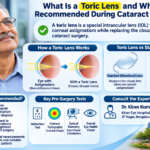
Toric intraocular lenses can reduce suitable amounts of regular corneal astigmatism, but they are not appropriate for every patient.
If residual astigmatism remains after surgery, cylindrical spectacles may improve clarity.
The ophthalmologist evaluates the amount and cause of astigmatism before recommending correction.
Why is my vision still changing during the first few weeks?
Vision does not necessarily stabilise immediately after cataract surgery.
Temporary corneal swelling, inflammation, tear film disturbances and normal postoperative healing may influence visual clarity.
Some patients notice:
- Fluctuating blurred vision.
- Temporary dryness or watering.
- Mild light sensitivity.
- Difficulty focusing on nearby text.
- Different clarity between the two eyes.
These symptoms often improve as healing progresses.
However, worsening vision or increasing discomfort should not be dismissed as normal recovery.
The ophthalmologist assesses whether further treatment or observation is required.
When should I get new glasses after cataract surgery?
Many patients undergo postoperative refraction once their vision has stabilised, often around three to six weeks after uncomplicated surgery.
Some may be ready earlier, while others require more time.
The appropriate timing depends on healing, the surgical technique and individual findings.
Purchasing expensive prescription glasses immediately after surgery may be premature because the required power can change.
Temporary reading glasses may be useful when the ophthalmologist permits them.
If cataract surgery is planned for the second eye, the surgeon may recommend waiting until both eyes have recovered before finalising spectacles.
Why do my eyes feel unbalanced after surgery on only one eye?
When cataract surgery is completed in one eye, its focusing power may differ considerably from that of the unoperated eye.
This difference is called anisometropia.
Patients may experience visual imbalance, altered depth perception, headaches or difficulty adapting to their existing spectacles.
The symptoms depend on the difference between the eyes and the way spectacle lenses affect image size.
Some patients benefit from temporary optical correction while awaiting surgery on the second eye.
Others may require an individualised approach.
Persistent imbalance should be discussed with the ophthalmologist.
Can premium cataract lenses eliminate the need for glasses?
Multifocal, trifocal and extended depth-of-focus lenses are designed to provide a broader range of vision than standard monofocal lenses.
They may reduce spectacle dependence for selected patients.
However, these lenses also have limitations.
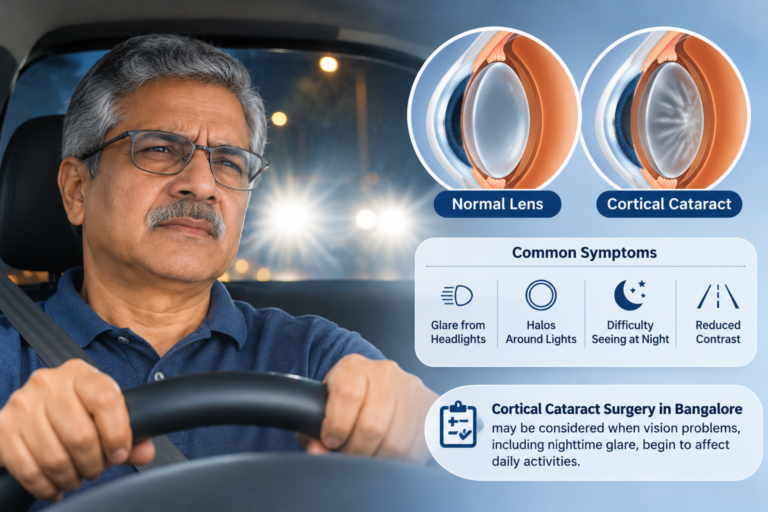
Some patients experience glare, halos or reduced contrast sensitivity, particularly in low-light conditions.
Fine-print reading or other demanding tasks may still require spectacles.
Suitability depends on retinal health, corneal condition, visual requirements and personal preferences.
A premium lens does not guarantee freedom from glasses.
What if glasses do not improve my vision after cataract surgery?
If vision remains blurred despite appropriate spectacles, an additional eye examination is necessary.
Possible causes include persistent corneal swelling, dry eye disease, retinal abnormalities or posterior capsule opacification, which may develop months or years after surgery.
Posterior capsule opacification is sometimes called a secondary cataract, although the original cataract does not return.
The ophthalmologist may recommend refraction, slit-lamp examination, retinal imaging or optical coherence tomography.
Treatment depends on the diagnosis and may include ocular surface therapy, retinal treatment or YAG laser capsulotomy when indicated.
What should I discuss during my cataract surgery consultation?
Patients seeking a Cataract Surgery Consultation Bangalore should discuss their visual priorities before selecting an artificial lens.
Important considerations include whether they regularly read, use computers, drive at night or prefer to minimise spectacle dependence.
The ophthalmologist can explain the expected focal distance, the possibility of residual spectacle power and the limitations of different lens designs.
Patients can learn more from the hospital’s cataract surgery service and intraocular lens guide.
When should I seek medical attention after cataract surgery?
Arrange a follow-up examination if blurred vision persists, spectacles do not improve clarity or your vision changes unexpectedly.
Seek urgent ophthalmic care for severe eye pain, increasing redness, sudden vision loss, new flashes, numerous floaters or a dark shadow across your sight.
These symptoms may indicate complications requiring prompt treatment.
Where can I discuss glasses after cataract surgery in Bangalore?
Patients searching for Need Glasses After Cataract Surgery Bangalore can seek postoperative evaluation at Kiran Eye Hospital, Vishnu Towers, ITI Layout, 1st Phase, JP Nagar, Bengaluru.
Dr. Kiran Kumar K, Medical Director and Chief Surgeon, holds MBBS, MD (AIIMS, New Delhi), DNB, FAICO (Cornea), FAICO (Refractive Surgery) and MNAMS qualifications. His documented expertise includes cataract, corneal and refractive surgery.
An examination with Dr. Kiran Kumar K or the ophthalmology team can help determine whether glasses are needed for reading, distance vision or residual astigmatism, and whether additional investigation is appropriate.
Frequently Asked Questions About Glasses After Cataract Surgery
1. Is it normal to need reading glasses after cataract surgery?
Yes. Patients who receive monofocal lenses set for distance vision commonly need reading glasses for books, mobile phones and other close-up activities.
2. Does needing glasses mean my cataract surgery failed?
No. Cataract surgery removes the cloudy natural lens, but some patients retain a small refractive error or require glasses for specific distances. Spectacle use does not automatically indicate surgical failure.
3. How long should I wait before getting new spectacles after cataract surgery?
Many patients receive a final spectacle prescription around three to six weeks after uncomplicated surgery, although timing varies. Your ophthalmologist should confirm that your vision is sufficiently stable.
4. Can I still need distance glasses after a monofocal lens implant?
Yes. Residual nearsightedness, farsightedness or astigmatism may make distance spectacles helpful, even when the artificial lens was intended to provide clear distance vision.
5. Can multifocal or trifocal lenses completely eliminate spectacles?
These lenses may reduce dependence on glasses, but complete spectacle independence is not guaranteed. Some patients still require spectacles for fine print, particular distances or demanding visual activities.
Book a Consultation
It’s easy and free!