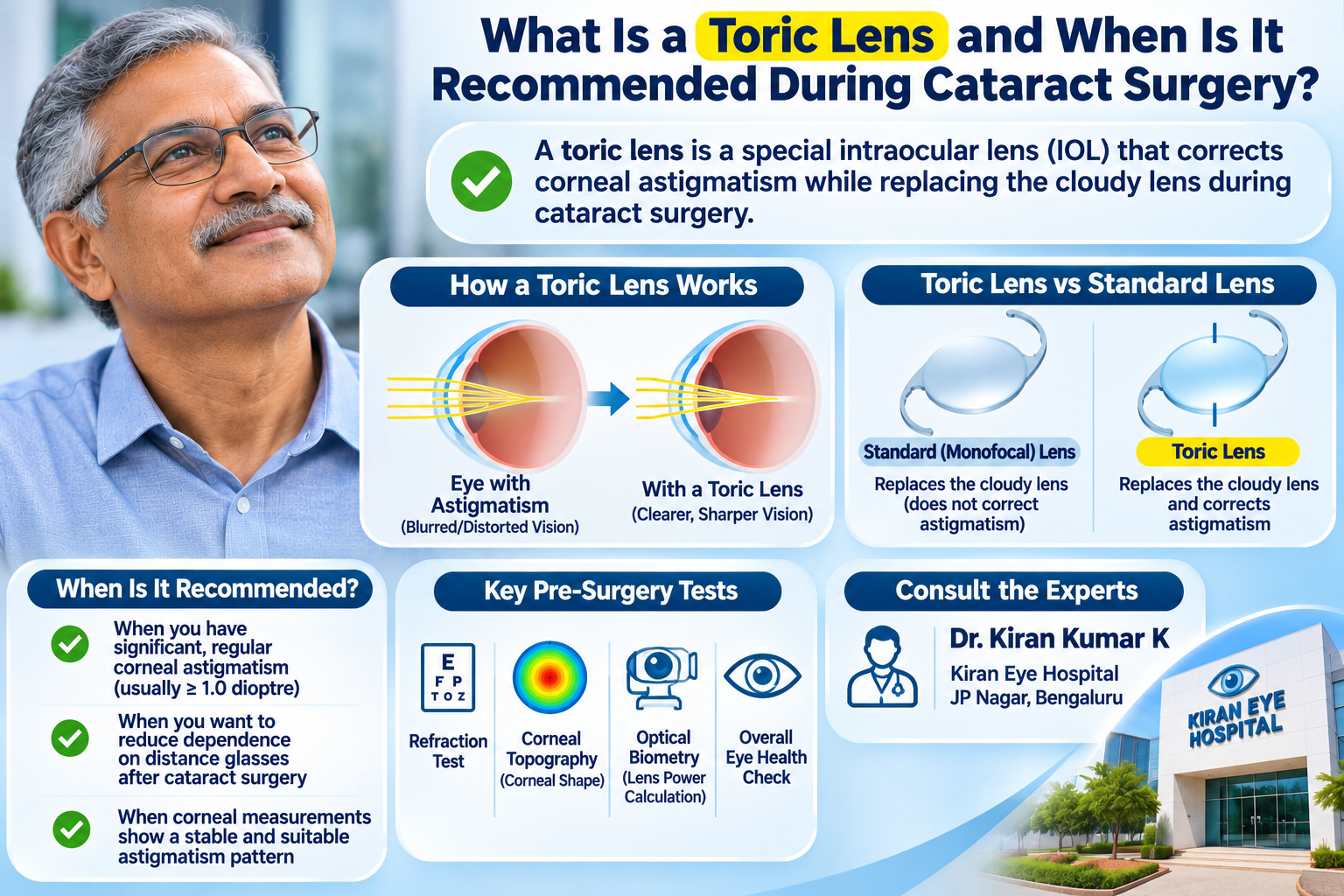
What is a toric lens, and why might I need one during cataract surgery? A toric intraocular lens (IOL) is an artificial lens designed to correct certain amounts of corneal astigmatism while replacing the cloudy natural lens during cataract surgery. It may be recommended when a patient has significant, regular corneal astigmatism and wishes to …

What is a toric lens, and why might I need one during cataract surgery?
A toric intraocular lens (IOL) is an artificial lens designed to correct certain amounts of corneal astigmatism while replacing the cloudy natural lens during cataract surgery. It may be recommended when a patient has significant, regular corneal astigmatism and wishes to reduce dependence on distance spectacles after surgery.
Patients exploring Toric Lens For Cataract Surgery in Bangalore should understand that not everyone with a cataract needs a toric lens.
At Kiran Eye Hospital, JP Nagar, Bengaluru, Dr. Kiran Kumar K and the ophthalmology team evaluate corneal measurements, cataract severity and visual requirements before discussing suitable lens options.
Why does astigmatism matter when I already have a cataract?
A cataract clouds the natural lens, while astigmatism usually results from uneven curvature of the cornea.
A regularly shaped cornea focuses incoming light relatively evenly.
When regular corneal astigmatism is present, the cornea has different curvatures in different directions, causing light to focus unevenly.
Patients may notice blurred or distorted vision at different distances.
Removing the cataract improves the clarity of the optical pathway, but ordinary cataract surgery does not necessarily eliminate pre-existing corneal astigmatism.
A toric lens is designed to address both the cloudy lens and suitable corneal astigmatism during the same operation.
What symptoms suggest that I might benefit from a toric lens?
Astigmatism does not always produce symptoms that are easily distinguishable from cataracts.
Possible complaints include:
- Blurred vision at distance or near.
- Distorted outlines around objects.
- Difficulty reading road signs.
- Eye strain during prolonged visual tasks.
- Difficulty seeing fine details clearly.
- Continued dependence on cylindrical spectacle correction.
However, these symptoms can also occur with dry eye disease, other refractive errors or corneal irregularities.
The decision to recommend a toric IOL depends on measured corneal astigmatism rather than symptoms alone.
How much astigmatism makes a toric lens worth considering?
The amount of corneal astigmatism is measured in dioptres (D).
Current European cataract surgery guidance recommends considering toric IOLs for regular corneal astigmatism of approximately 1.0 D or more.
Evidence of benefit becomes stronger at higher measurements, particularly above 1.5–2.0 D.
However, this is not an automatic requirement or a fixed eligibility threshold for every patient.
The surgeon also evaluates the expected astigmatism after surgery, corneal shape, ocular surface health and the patient’s visual goals.
A patient with a small amount of astigmatism may not receive a meaningful additional benefit from a toric lens.
How is a toric lens different from a standard monofocal lens?
A standard monofocal lens primarily provides a selected focal distance, usually distance vision.
A monofocal toric lens also provides a primary focal distance but includes additional optical correction for regular corneal astigmatism.
This may improve uncorrected distance vision in suitable patients.
However, a standard monofocal toric lens does not automatically provide clear near vision.
Reading glasses may still be needed.
Toric correction is also available in certain multifocal and extended depth-of-focus lens designs, but their suitability requires separate consideration.
Choosing a toric lens and choosing a lens for reading vision are two different decisions.
Why is the exact position of a toric lens important?
Unlike an ordinary monofocal lens, a toric IOL must be positioned along a specific axis to correct astigmatism effectively.
Before surgery, the ophthalmologist calculates the appropriate lens power and intended alignment.
During implantation, the surgeon rotates the lens to the planned position.
If a toric lens rotates significantly after surgery, its astigmatism-correcting effect can decrease.
This may cause residual blurred vision or an unexpected spectacle prescription.
Most implanted lenses remain adequately positioned, but clinically significant rotation sometimes requires further assessment or repositioning.
Accurate planning and postoperative monitoring are therefore important.
Which tests are needed before toric lens implantation?
Toric lens selection involves detailed corneal and eye measurements.
Refraction testing: Identifies spectacle power and cylindrical correction.
Keratometry: Measures corneal curvature and astigmatism.
Corneal topography: Maps the corneal surface to identify regular or irregular astigmatism.
Corneal tomography: Provides additional information about corneal structure and curvature.
Optical biometry: Measures eye dimensions for calculating artificial lens power.
Slit-lamp examination: Evaluates cataract severity and the ocular surface.
Dilated retinal examination: Identifies other conditions that may affect postoperative vision.
The surgeon may also assess dry eye disease because tear film instability can interfere with accurate measurements.
Can patients with irregular astigmatism or keratoconus receive toric lenses?
Not everyone with astigmatism is suitable for a toric IOL.
Toric lenses work most predictably when corneal astigmatism is regular and stable.
Conditions such as keratoconus, corneal scars or previous corneal surgery can make lens power calculations more challenging.
Some carefully selected patients with stable keratoconus may still be considered for toric implantation.
However, others may achieve more predictable results with a different intraocular lens and postoperative spectacle or contact lens correction.
The ophthalmologist should evaluate the cornea individually rather than assuming that all cylindrical spectacle prescriptions can be corrected with a toric lens.
Will I be completely free from glasses after toric cataract surgery?
Not necessarily.
A toric lens may reduce the need for distance spectacles by correcting suitable corneal astigmatism.
However, some patients still require glasses because of residual refractive error, healing differences or other eye conditions.
Those receiving monofocal toric lenses commonly need reading glasses for close activities.
Patients should also understand that cataract surgery has potential risks, including infection, inflammation and retinal complications.
The purpose of lens selection is to improve the likelihood of meeting realistic visual goals, not to guarantee spectacle independence.
What if my vision remains blurry after receiving a toric lens?
Blurred vision during early recovery may be related to normal healing, temporary corneal swelling or dry eyes.
Persistent blur can also result from residual astigmatism, lens misalignment or other eye conditions.
The ophthalmologist may perform refraction, slit-lamp examination and additional measurements to determine the cause.
Management may include spectacles, treatment of ocular surface problems or, in selected cases, lens repositioning.
Additional procedures are recommended only when the expected benefits justify the risks.
When should I seek medical attention?
Arrange an ophthalmic examination if blurred or distorted vision increasingly interferes with reading, driving or other routine activities.
After cataract surgery, seek urgent ophthalmic assessment for sudden vision loss, increasing eye pain, significant redness, new flashes or a dark shadow across your vision.
These symptoms should not be assumed to result from an artificial lens adjustment.
Where can I discuss toric cataract lens options in Bangalore?
Patients considering Toric Lens For Cataract Surgery in Bangalore can seek evaluation at Kiran Eye Hospital, Vishnu Towers, ITI Layout, 1st Phase, JP Nagar, Bengaluru.
Dr. Kiran Kumar K, Medical Director and Chief Surgeon, holds MBBS, MD (AIIMS, New Delhi), DNB, FAICO (Cornea), FAICO (Refractive Surgery) and MNAMS qualifications. His documented expertise includes cataract and corneal surgery.
A consultation with Dr. Kiran Kumar K or the ophthalmology team can help determine whether regular corneal astigmatism is present, whether toric correction may be appropriate and what vision to expect after treatment.
Learn more through the hospital’s cataract surgery service and intraocular lens guide.
Frequently Asked Questions About Toric Lenses
1. Is a toric lens necessary for everyone undergoing cataract surgery?
No. Toric lenses are primarily considered for patients with suitable corneal astigmatism. Patients with little or no astigmatism may not need this additional correction.
2. Can a toric lens correct both cataracts and astigmatism?
Yes. During cataract surgery, the cloudy natural lens is removed and a toric intraocular lens may be implanted to correct appropriate amounts of corneal astigmatism.
3. Will I still need reading glasses after receiving a toric lens?
Possibly. A monofocal toric lens generally provides a selected focal distance and may reduce distance spectacle dependence, but reading glasses are commonly still needed.
4. Can a toric lens move after cataract surgery?
Yes. Toric lenses can occasionally rotate away from their intended axis, reducing astigmatism correction. Significant rotation may require ophthalmic assessment and, in selected cases, repositioning.
5. Can someone with keratoconus receive a toric lens?
Some patients with stable keratoconus and relatively regular astigmatism may be considered for toric lenses. However, significant irregularity or progressive disease can make the outcome less predictable.
Book a Consultation
It’s easy and free!