Why do some patients see glare or halos around lights after LASIK? Glare and halos are recognised visual disturbances that may occur after LASIK surgery. They can develop because the cornea is healing, the tear film is unstable or light is focusing differently after laser reshaping. These effects are often more noticeable at night when …

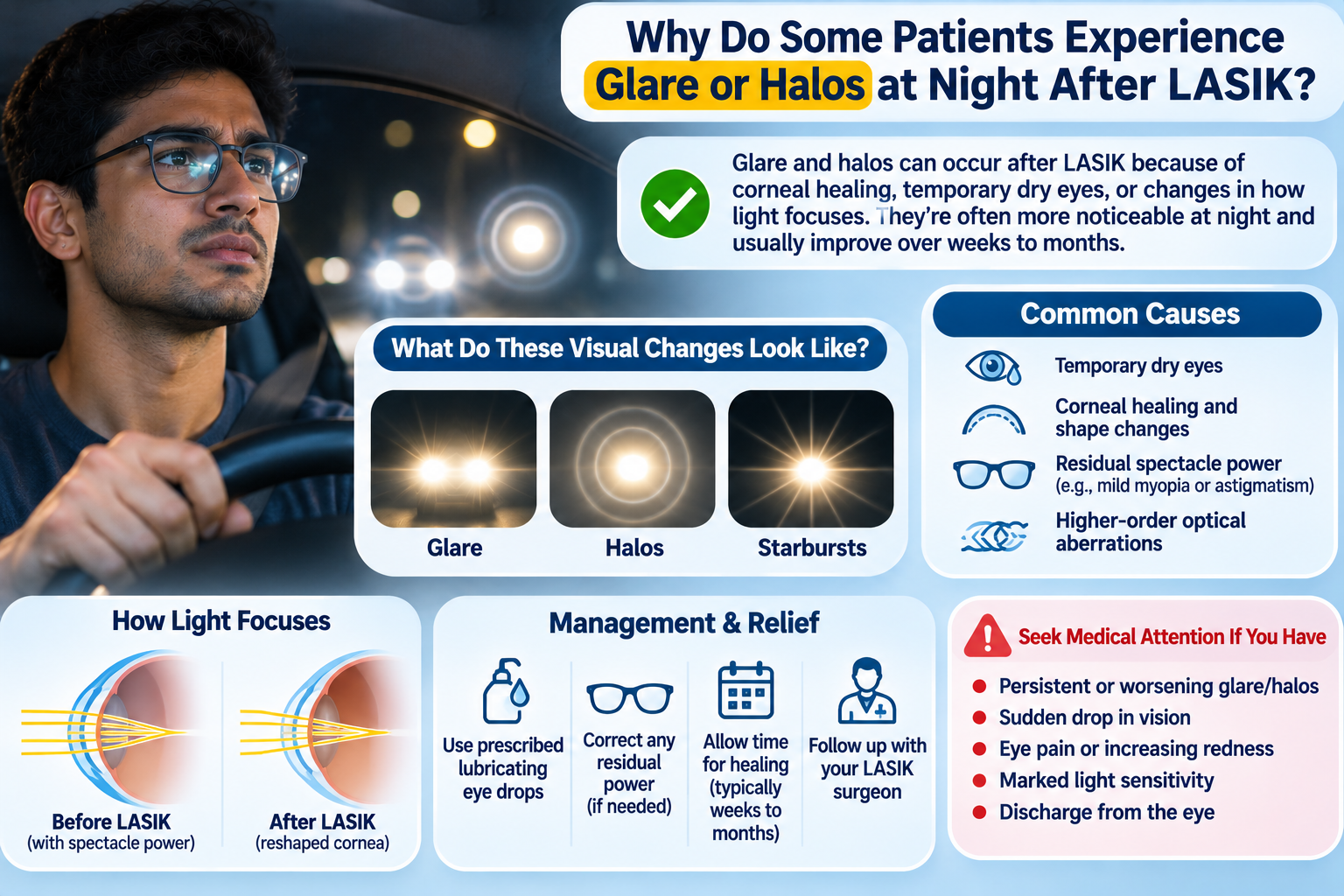
Why do some patients see glare or halos around lights after LASIK?
Glare and halos are recognised visual disturbances that may occur after LASIK surgery. They can develop because the cornea is healing, the tear film is unstable or light is focusing differently after laser reshaping. These effects are often more noticeable at night when the pupils naturally enlarge.
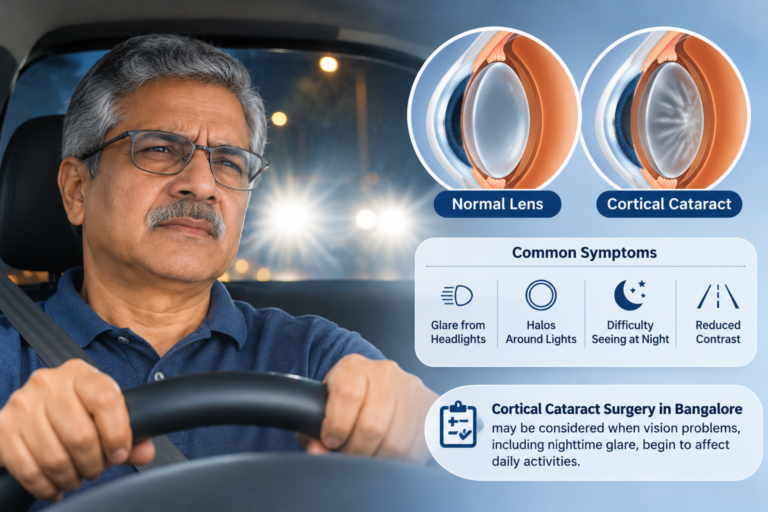
Patients experiencing Halos after LASIK at night may see glowing rings, streaks or star-like patterns around headlights and streetlights.
At Kiran Eye Hospital, JP Nagar, Bengaluru, Dr. Kiran Kumar K and the ophthalmology team assess postoperative visual symptoms and determine whether they are part of recovery or require further investigation.
What is the difference between glare, halos and starbursts?
Although these symptoms are often mentioned together, they describe different visual experiences.
Glare: Bright lights appear unusually intense or uncomfortable, making surrounding objects difficult to see.
Halos: Circular rings or glowing outlines appear around lights, particularly at night.
Starbursts: Light appears to spread outward in multiple rays, resembling a star.
Some patients also notice ghost images or reduced contrast sensitivity.
These disturbances can occur even when ordinary eye-chart vision is good.
For example, a patient may read distant letters clearly during a daytime examination but struggle with approaching vehicle headlights after sunset.
Why are halos more noticeable during night driving?
In dim lighting, the pupils enlarge to allow more light into the eyes.
This can make certain optical imperfections more noticeable.
After LASIK, changes in corneal shape and higher-order optical aberrations may influence how light focuses, particularly in low-light conditions.
Historically, large pupils were considered an important risk factor for postoperative halos. However, more recent research indicates that pupil size alone does not reliably predict these symptoms.
Corneal shape, optical aberrations, tear film quality and individual visual characteristics also matter.
Patients should therefore undergo an appropriate examination rather than assuming that large pupils are the only cause.
Can dry eyes cause glare and halos after LASIK?
Yes. Temporary dry eye symptoms are common after LASIK.
The procedure affects corneal nerves involved in tear production and ocular surface sensitivity.
An unstable tear film can cause incoming light to scatter irregularly, contributing to fluctuating vision and glare.
Patients may notice:
- Burning or gritty sensations.
- Temporary blurred vision.
- Increased discomfort during screen use.
- Watering or irritation.
- Visual clarity that changes after blinking.
Dry eye symptoms may be particularly noticeable during prolonged computer use or in air-conditioned environments.
The ophthalmologist may recommend preservative-free lubricating drops or other appropriate dry eye treatment.
How long do glare and halos usually last after LASIK?
Many patients notice improvement during the first few weeks or months as the cornea heals and vision stabilises.
Glare, halos and other night-vision disturbances are commonly reported during the first one to three months after refractive surgery.
For some patients, visual stabilisation may take approximately three to six months.
However, recovery varies, and a smaller proportion of patients may experience persistent symptoms.
The presence of halos during early recovery does not automatically indicate surgical failure.
Nevertheless, symptoms that remain troublesome, worsen or interfere with daily activities should be evaluated.
Could leftover spectacle power cause halos after LASIK?
Yes. Residual refractive error can contribute to blurred vision, glare or difficulty seeing clearly at night.
Some patients may have a small amount of remaining myopia or astigmatism after surgery.
Others may experience changes in corneal healing that influence their final prescription.
Higher-order aberrations can also affect visual quality even when ordinary spectacle power is minimal.
The ophthalmologist may recommend refraction testing and additional optical measurements to identify the cause.
Not every visual disturbance requires another laser procedure.
Which eye tests help identify the cause of nighttime glare?
A postoperative assessment may include several investigations.
Visual acuity testing: Measures how clearly the patient sees.
Refraction testing: Identifies remaining spectacle power or astigmatism.
Slit-lamp examination: Evaluates corneal healing, flap position and ocular surface health.
Tear film assessment: Checks for dryness or tear film instability.
Corneal topography: Maps corneal curvature and identifies irregularities.
Wavefront aberrometry: May be used to assess higher-order optical aberrations.
Additional tests may be recommended when another eye condition is suspected.
The investigation depends on the patient’s symptoms and the surgeon’s clinical findings.
Can glare and halos after LASIK be treated?
Management depends on the underlying cause.
For dry eye-related disturbances, lubricating drops and other ocular surface treatments may improve comfort and visual stability.
A small residual prescription may sometimes be managed with spectacles, particularly for night driving.
Persistent optical irregularities require more detailed assessment.
In carefully selected patients, an enhancement procedure may be discussed after refractive stability has been established.
However, additional surgery carries risks and does not guarantee that halos or glare will disappear.
Patients should avoid using pupil-constricting medications or other eye drops without an ophthalmologist’s advice.
Is it safe to drive at night if I still see halos?
Night driving requires adequate visual clarity, contrast sensitivity and the ability to recognise hazards under changing lighting conditions.
If headlights produce significant glare or halos, judging road markings and identifying pedestrians may become difficult.
Patients should avoid driving at night when visual disturbances interfere with safe driving.
Even if daytime vision is satisfactory, an ophthalmologist may recommend further evaluation before nighttime driving.
Patients should not rely solely on their spectacle prescription or daytime visual acuity to assess driving readiness.
When should I seek medical attention for postoperative halos?
Mild glare and halos may occur during routine LASIK recovery.
However, arrange an eye examination when symptoms persist, interfere with daily activities or become progressively worse.
Seek urgent ophthalmic care if you experience severe pain, increasing redness, sudden visual deterioration, discharge or marked light sensitivity.
These symptoms may indicate complications requiring prompt assessment.
Do not rub your eyes or independently change prescribed medications.
Where can I discuss persistent halos after LASIK in Bangalore?
Patients searching for a LASIK Surgery Doctor Bangalore can seek postoperative evaluation at Kiran Eye Hospital, Vishnu Towers, ITI Layout, 1st Phase, JP Nagar, Bengaluru.
Dr. Kiran Kumar K, Medical Director and Chief Surgeon, holds MBBS, MD (AIIMS, New Delhi), DNB, FAICO (Cornea), FAICO (Refractive Surgery) and MNAMS qualifications.
His documented expertise includes LASIK, PRK, SMILE and corneal surgery.
A consultation with Dr. Kiran Kumar K or the ophthalmology team can help determine whether Halos after LASIK at night are related to dry eyes, corneal healing, residual refractive error or another optical condition.
Additional information is available on the hospital’s LASIK surgery service page.
Frequently Asked Questions About Glare and Halos After LASIK
1. Are halos around lights normal after LASIK surgery?
Halos can occur during early LASIK recovery as the cornea heals and vision stabilises. Many patients notice improvement over time, but persistent or worsening symptoms should be evaluated by an ophthalmologist.
2. How long do nighttime halos last after LASIK?
Some patients experience improvement within weeks, while others notice symptoms for several months. Visual stabilisation may take three to six months, and a smaller number of patients may have longer-lasting disturbances.
3. Can dry eyes make night vision worse after LASIK?
Yes. An unstable tear film may cause fluctuating vision, glare and halos. Appropriate dry eye treatment may improve symptoms when ocular surface instability is contributing to the problem.
4. Can glasses help reduce glare after LASIK?
Glasses may improve night vision when residual myopia or astigmatism contributes to visual disturbances. However, spectacles may not fully correct halos caused by higher-order optical aberrations or other corneal changes.
5. Should I undergo another LASIK procedure if halos continue?
Not necessarily. The ophthalmologist must first identify the cause and confirm refractive stability. Enhancement surgery may be considered in selected cases, but it does not guarantee that halos or glare will resolve.
Book a Consultation
It’s easy and free!