Can cataract surgery help me see both near and distant objects? Yes. Certain artificial intraocular lenses (IOLs), particularly multifocal and trifocal lenses, are designed to provide vision at more than one distance after cataract surgery. Extended depth-of-focus (EDOF) lenses may also improve the range of clear vision, especially for distance and intermediate tasks. However, no …

Can cataract surgery help me see both near and distant objects?
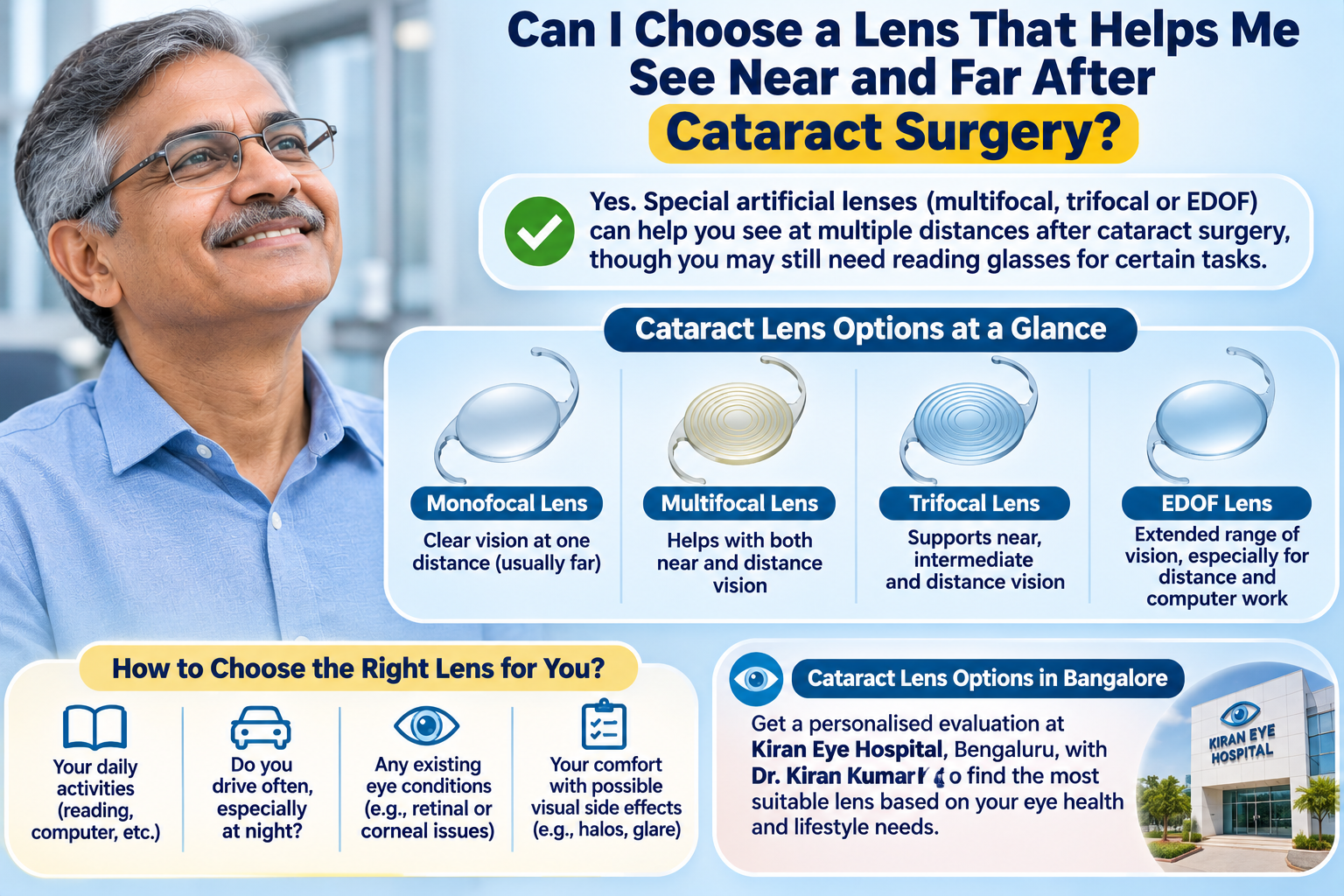
Yes. Certain artificial intraocular lenses (IOLs), particularly multifocal and trifocal lenses, are designed to provide vision at more than one distance after cataract surgery. Extended depth-of-focus (EDOF) lenses may also improve the range of clear vision, especially for distance and intermediate tasks.
However, no lens guarantees complete freedom from spectacles.
Patients considering a lens for near and distance vision after cataract surgery should understand that the right choice depends on their eye health, daily activities and visual expectations.
At Kiran Eye Hospital, JP Nagar, Bengaluru, Dr. Kiran Kumar K and the ophthalmology team assess individual requirements before discussing suitable lens options.
Why might I still need reading glasses after cataract surgery?
The natural lens helps the eye focus on objects at different distances.
With age, this focusing ability gradually decreases, causing presbyopia, or difficulty seeing nearby objects clearly.
Cataract surgery removes the cloudy natural lens and replaces it with an artificial one.
A standard monofocal lens provides a primary focal distance, commonly selected for clear distance vision.
Consequently, someone with a monofocal lens set for distance may still require reading glasses for mobile phones, books or close work.
Other lens designs aim to reduce this dependence by providing a broader range of focus.
What is the difference between monofocal, multifocal and trifocal lenses?
These lenses differ in how they focus incoming light.
Monofocal lenses: Provide a principal focal distance, usually near or far. Patients commonly choose distance correction and use reading glasses when needed.
Multifocal lenses: Distribute light across more than one focal point to support vision at different distances.
Trifocal lenses: Are a type of multifocal lens designed to support near, intermediate and distance vision.
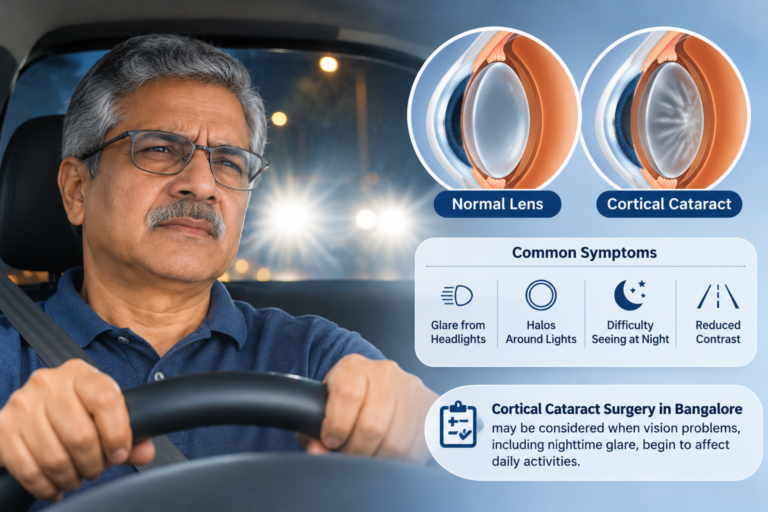
Although multifocal and trifocal lenses may reduce dependence on spectacles, they can produce halos, glare or reduced contrast sensitivity in some patients.
The most suitable option depends on the patient’s individual visual needs and tolerance for optical side effects.
Can an EDOF lens help me use computers and see distant objects?
Extended depth-of-focus lenses are designed to provide an extended range of vision rather than several distinct focal points.
They may be particularly relevant for people who frequently use computers, view dashboards or perform tasks at arm’s length.
Many EDOF designs support good distance and intermediate vision.
However, patients may still need reading glasses for fine print or prolonged close work.
Some EDOF lenses may produce fewer unwanted visual disturbances than certain multifocal lenses, although results vary by design.
Patients should discuss whether their main priority is reading small text, working on a laptop or seeing distant objects clearly.
How do I choose a lens based on my daily routine?
Instead of beginning with a lens brand, consider the activities that matter most.
A person who frequently reads books may place greater importance on near vision.
Someone working on a desktop computer may prioritise intermediate vision.
A patient who drives regularly at night may be particularly concerned about glare, halos and contrast sensitivity.
Useful questions include:
- Do I spend several hours reading or using my phone?
- Is computer work more important than fine-print reading?
- How often do I drive after dark?
- Would I accept occasional reading glasses?
- Am I comfortable with possible halos around lights?
Discussing these priorities can help the ophthalmologist explain the trade-offs between lens designs.
Can I choose a multifocal lens if I have astigmatism?
Astigmatism occurs when the eye’s optical surfaces have an uneven curvature, resulting in blurred or distorted vision.
A toric intraocular lens is designed to correct suitable amounts of regular corneal astigmatism.
Toric correction can be incorporated into selected monofocal, multifocal or EDOF lens designs.
However, not everyone with astigmatism is suitable for every toric lens.
The surgeon must assess corneal curvature, the amount of astigmatism and the overall condition of the eye.
Accurate measurements and appropriate lens positioning are important for achieving the intended correction.
What eye tests are needed before selecting a cataract lens?
Choosing an artificial lens requires careful preoperative assessment.
Common investigations include:
Visual acuity and refraction testing: Evaluate current vision and spectacle requirements.
Optical biometry: Measures eye dimensions to calculate the appropriate IOL power.
Corneal topography or keratometry: Assess corneal curvature and astigmatism.
Slit-lamp examination: Evaluates cataract severity and the front structures of the eye.
Dilated retinal examination: Checks for retinal conditions that may affect visual outcomes.
Macular OCT: May be recommended to identify retinal abnormalities, particularly when a presbyopia-correcting lens is being considered.
The ophthalmologist may also examine the tear film and ocular surface before finalising measurements.
Are multifocal lenses suitable for every cataract patient?
No. Certain eye conditions may reduce the suitability of multifocal or other presbyopia-correcting lenses.
These include significant macular disease, certain corneal irregularities, advanced glaucoma-related visual changes and poorly controlled dry eye disease.
Such conditions can affect visual quality or make lens outcomes less predictable.
Patients with these findings may benefit more from monofocal or other carefully selected lenses.
The decision should be based on medical suitability rather than assuming that a more expensive lens will always produce better vision.
Can I avoid spectacles completely after cataract surgery?
Some patients using presbyopia-correcting lenses become less dependent on spectacles for everyday activities.
However, reading small print, working in low light or performing highly detailed tasks may still require glasses.
Residual spectacle power, astigmatism and individual healing can also influence the outcome.
Patients considering Cataract Lens Options in Bangalore should understand that no artificial lens can perfectly reproduce the natural focusing ability of a young, healthy eye.
Realistic expectations are an important part of selecting an IOL.
What happens if I am unhappy with my vision after surgery?
The ophthalmologist first determines whether the concern is caused by normal healing, residual refractive error, dry eyes, retinal disease or the optical characteristics of the implanted lens.
Management may include updated spectacles, ocular surface treatment or additional investigations.
In selected situations, further treatment may be considered, but additional procedures carry risks.
Patients should not assume that temporary postoperative blur means the selected lens has failed.
Follow-up examinations help identify the cause and determine the appropriate management.
When should I seek medical attention?
Arrange an eye examination if cataracts increasingly interfere with reading, driving, recognising faces or other daily activities.
After surgery, seek urgent ophthalmic assessment for severe pain, worsening redness, sudden reduction in vision, new flashes or a dark shadow across your sight.
These symptoms should not be attributed simply to adjustment to a new lens.
Where can I discuss cataract lens options in Bangalore?
Patients exploring a lens for near and distance vision after cataract surgery can seek evaluation at Kiran Eye Hospital, Vishnu Towers, ITI Layout, 1st Phase, JP Nagar, Bengaluru.
Dr. Kiran Kumar K, Medical Director and Chief Surgeon, holds MBBS, MD (AIIMS, New Delhi), DNB, FAICO (Cornea), FAICO (Refractive Surgery) and MNAMS qualifications. His documented expertise includes cataract and corneal surgery.
A consultation with Dr. Kiran Kumar K or the ophthalmology team can help patients compare lens designs, understand possible visual side effects and identify an option appropriate for their examination findings.
More information is available through the hospital’s cataract surgery service and guide to intraocular lens options.
Frequently Asked Questions About Cataract Lens Options
1. Can a single cataract lens provide both near and distance vision?
Yes. Multifocal and trifocal intraocular lenses are designed to support vision at multiple distances. However, results vary, and some patients may still require spectacles for particular activities.
2. Which cataract lens is better for computer users?
An EDOF lens may be considered for patients who prioritise distance and intermediate vision, including computer work. However, individual eye health and reading requirements influence lens selection.
3. Do multifocal lenses cause halos while driving at night?
Some patients experience halos, glare or other visual disturbances with multifocal lenses, particularly in low-light conditions. The likelihood and severity vary between lens designs and individuals.
4. Can I receive a premium cataract lens if I have retinal problems?
Not always. Certain retinal conditions can reduce visual quality and make multifocal or other presbyopia-correcting lenses less suitable. An ophthalmologist should assess retinal health before recommending a lens.
5. Will I need reading glasses after choosing a trifocal lens?
Possibly. Trifocal lenses may reduce spectacle dependence for near, intermediate and distance tasks, but they do not guarantee complete independence from reading glasses.
Book a Consultation
It’s easy and free!