Can I undergo cataract surgery if I already have keratoconus? Yes. Patients with keratoconus can undergo cataract surgery when clinically appropriate. However, the procedure requires additional planning because keratoconus changes the shape of the cornea, making artificial lens power calculations less predictable. Surgery removes the cloudy natural lens but does not correct the underlying corneal …

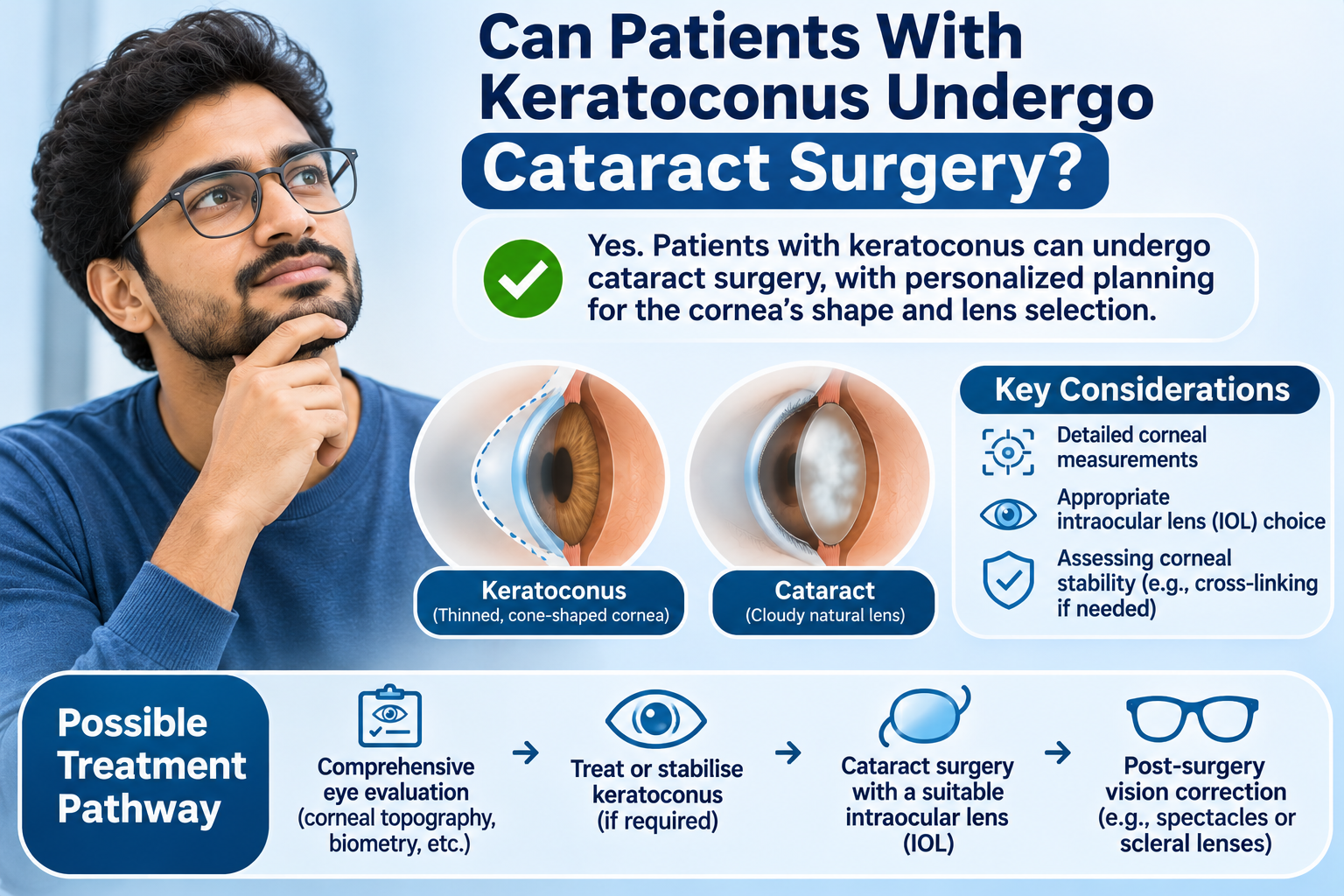
Can I undergo cataract surgery if I already have keratoconus?
Yes. Patients with keratoconus can undergo cataract surgery when clinically appropriate. However, the procedure requires additional planning because keratoconus changes the shape of the cornea, making artificial lens power calculations less predictable. Surgery removes the cloudy natural lens but does not correct the underlying corneal condition.
Patients researching Cataract Surgery with Keratoconus Bangalore should understand that the main challenge is not simply removing the cataract, but determining which lens and visual correction strategy will work best afterwards.
At Kiran Eye Hospital, JP Nagar, Bengaluru, Dr. Kiran Kumar K and the ophthalmology team evaluate cataracts alongside existing corneal conditions.
Why does keratoconus make cataract surgery planning different?
Keratoconus causes progressive thinning and outward bulging of the cornea, creating an irregular shape.
This irregularity can produce distorted vision, ghost images, glare and astigmatism.
A cataract develops separately, when the natural lens inside the eye becomes cloudy.
When both conditions are present, vision may be affected by two different optical problems.
Removing the cataract improves light transmission, but the irregular corneal surface can continue producing distorted images.
The ophthalmologist must therefore determine how much of the patient’s reduced vision comes from the cataract and how much comes from keratoconus.
How do I know whether my blurred vision is from keratoconus or cataracts?
Patients with longstanding keratoconus may already experience blurred vision despite wearing spectacles.
When cataracts develop, they may notice additional changes such as increased haze, stronger glare or reduced visibility in dim lighting.
Some symptoms overlap, making it difficult to distinguish the conditions without examination.
Possible changes include:
- Increasingly cloudy or blurred vision.
- Ghost images or distorted outlines.
- Greater sensitivity to headlights.
- Difficulty reading despite updated spectacles.
- Reduced contrast and visual clarity.
A significant change in established vision should prompt an eye examination rather than an assumption that keratoconus has progressed.
Which tests are needed before cataract surgery with keratoconus?
Accurate preoperative measurements are particularly important.
Visual acuity and refraction testing: Determine current vision and whether changing spectacle power contributes to symptoms.
Corneal topography: Maps corneal curvature and identifies irregular astigmatism.
Corneal tomography: Evaluates the front and back corneal surfaces, thickness and keratoconus characteristics.
Optical biometry: Measures eye dimensions used to calculate intraocular lens power.
Slit-lamp examination: Assesses cataract severity and corneal clarity.
Retinal examination or OCT: May be recommended to identify additional causes of visual impairment.
Patients wearing rigid gas-permeable or scleral contact lenses may need to stop wearing them for an individually determined period before measurements.
Repeated measurements can help establish whether the cornea is sufficiently stable.
Why is choosing an artificial lens more difficult with keratoconus?
Cataract surgery replaces the cloudy natural lens with an artificial intraocular lens, or IOL.
The appropriate IOL power is calculated using measurements of the eye, including corneal curvature.
Because keratoconus produces irregular curvature, conventional calculations may be less accurate.
This can increase the possibility of a residual spectacle prescription or an unexpected refractive result after surgery.
Specialised calculation methods, including keratoconus-adjusted formulas, may improve planning.
However, even advanced measurements cannot guarantee complete accuracy.
Patients should discuss the possibility of needing glasses or contact lenses after the operation.
Can I receive a toric lens if I have keratoconus?
Toric intraocular lenses are designed to correct certain types of astigmatism.
They may be considered in carefully selected patients with mild or moderate, stable keratoconus and sufficiently regular astigmatism.
However, they are not suitable for every keratoconic eye.
Severe corneal irregularity can make the correction less predictable.
For patients who depend on scleral or rigid contact lenses, the future contact lens prescription should also be considered.
A monofocal intraocular lens may be preferable in some cases, particularly when keratoconus is advanced.
The surgeon should explain the benefits, limitations and alternatives before lens selection.
Should keratoconus be treated before cataract surgery?
Sometimes. The treatment sequence depends on whether keratoconus is stable or progressing.
If corneal changes are continuing, corneal cross-linking may be considered to strengthen the cornea and slow progression.
In selected cases, the ophthalmologist may recommend stabilising the cornea before final cataract measurements.
Patients with severe scarring or advanced disease may require additional corneal treatment.
However, not everyone with keratoconus needs cross-linking or corneal surgery before cataract removal.
The appropriate pathway depends on age, progression, corneal condition and how significantly the cataract affects vision.
Will I still need scleral lenses after cataract surgery?
Possibly.
Cataract surgery can remove lens clouding, but it does not eliminate the irregular astigmatism caused by keratoconus.
Some patients continue using rigid gas-permeable or scleral lenses to obtain their best corrected vision.
Others may manage with spectacles, depending on corneal shape and the results of surgery.
Contact lens prescriptions may need to be reassessed after the eye has healed.
Patients should not expect cataract surgery to provide permanent independence from all vision-correction devices.
When should I seek medical attention?
Arrange an ophthalmic examination if your vision becomes increasingly cloudy, glare worsens or your existing contact lenses no longer provide satisfactory clarity.
Seek urgent eye care for sudden visual deterioration, significant pain, pronounced redness or a sudden cloudy appearance of the cornea.
In patients with keratoconus, sudden corneal clouding can occasionally indicate acute corneal hydrops, which requires prompt assessment.
Do not delay evaluation by assuming every visual change is caused by cataracts.
Where can I discuss cataract surgery with keratoconus in Bangalore?
Patients exploring Cataract Surgery with Keratoconus Bangalore can seek an assessment at Kiran Eye Hospital, Vishnu Towers, ITI Layout, 1st Phase, JP Nagar, Bengaluru.
Dr. Kiran Kumar K, Medical Director and Chief Surgeon, holds MBBS, MD (AIIMS, New Delhi), DNB, FAICO (Cornea), FAICO (Refractive Surgery) and MNAMS qualifications.
His documented clinical expertise includes cataract surgery, corneal conditions and keratoconus management.
An examination with Dr. Kiran Kumar K or the ophthalmology team can help determine whether the cornea is stable, which artificial lens options may be appropriate and what vision correction may still be required afterwards.
Patients can also read about the hospital’s cataract surgery and keratoconus treatment services.
Frequently Asked Questions About Cataract Surgery With Keratoconus
1. Is cataract surgery safe for patients with keratoconus?
Cataract surgery may be appropriate for patients with keratoconus, but additional examinations and surgical planning are required. The risks and likely outcomes depend on corneal stability, disease severity and other eye conditions.
2. Will cataract surgery cure keratoconus?
No. Cataract surgery removes the cloudy natural lens but does not correct the thinning or irregular shape of the cornea caused by keratoconus.
3. Can patients with keratoconus receive toric intraocular lenses?
Some patients with mild, stable keratoconus and relatively regular astigmatism may be suitable for toric lenses. However, significant corneal irregularity can make these lenses less predictable.
4. Do I need corneal cross-linking before cataract surgery?
Not necessarily. Cross-linking may be considered when keratoconus is progressing and corneal stabilisation is needed. The treatment sequence depends on individual examination findings.
5. Will I still need glasses or scleral lenses after cataract surgery?
Possibly. Irregular astigmatism from keratoconus may remain after cataract removal. Some patients continue to require spectacles, rigid gas-permeable lenses or scleral lenses for clearer vision
Book a Consultation
It’s easy and free!