Can LASIK correct both plus and minus spectacle power? Yes. LASIK can correct selected cases of both farsightedness (hyperopia or plus power) and nearsightedness (myopia or minus power). The procedure uses a laser to reshape the cornea, helping light focus more accurately on the retina. However, the treatment pattern differs between the two conditions, and …

Can LASIK correct both plus and minus spectacle power?
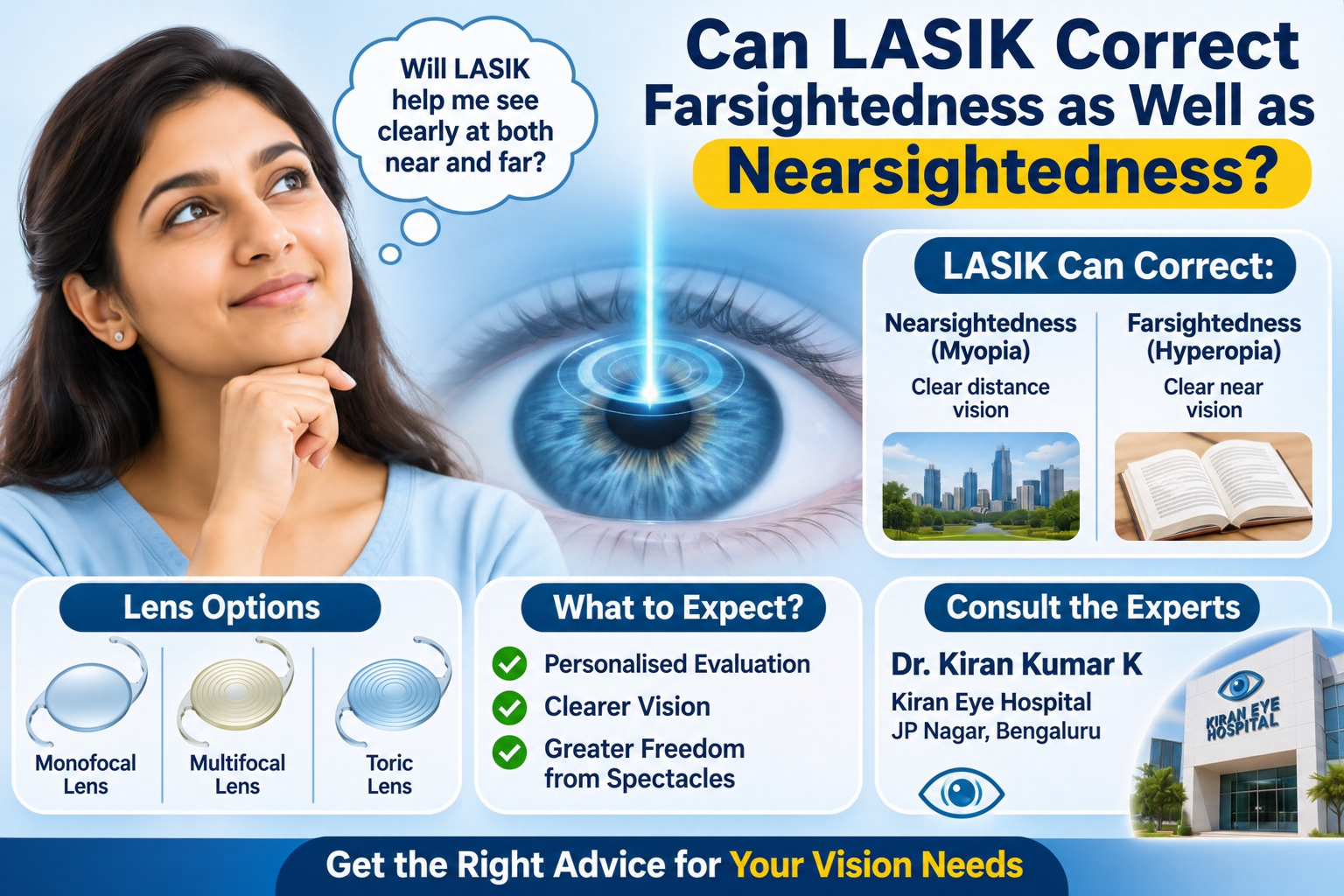
Yes. LASIK can correct selected cases of both farsightedness (hyperopia or plus power) and nearsightedness (myopia or minus power). The procedure uses a laser to reshape the cornea, helping light focus more accurately on the retina.
However, the treatment pattern differs between the two conditions, and not every prescription is suitable.
Patients exploring LASIK for farsightedness Bangalore should also understand that farsightedness is different from age-related difficulty with reading.
At Kiran Eye Hospital, JP Nagar, Bengaluru, Dr. Kiran Kumar K and the ophthalmology team evaluate refractive errors before recommending laser vision correction.
What is the difference between farsightedness and nearsightedness?
Both conditions occur when light does not focus correctly on the retina.
Nearsightedness (myopia) usually causes distant objects to appear blurred while nearby objects remain relatively clear. Light focuses in front of the retina.
Farsightedness (hyperopia) occurs when the eye has insufficient focusing power relative to its length, causing light to focus behind the retina when accommodation is relaxed.
Younger people with hyperopia may compensate by using their natural focusing muscles. As a result, they may experience eye strain before noticing significant blurred vision.
The two conditions require different corneal reshaping patterns during LASIK.
How does LASIK correct farsightedness and nearsightedness differently?
LASIK changes the cornea’s curvature using an excimer laser.
For nearsightedness, the laser generally flattens the central cornea to reduce excessive focusing power.
For farsightedness, the laser removes tissue in a more peripheral pattern to increase the curvature of the central cornea.
Both approaches aim to bring incoming light into better focus on the retina.
The surgeon first creates a thin corneal flap, performs the planned laser reshaping and repositions the flap.
Treatment parameters depend on spectacle power, corneal measurements and the laser system.
What symptoms suggest that I may have farsightedness?
Hyperopia can affect people differently depending on age and prescription.
Common complaints include:
- Blurred vision while reading or using a mobile phone.
- Eye strain after prolonged close work.
- Headaches associated with near-vision tasks.
- Difficulty switching focus between near and distant objects.
- Blurred distance vision when hyperopia is more significant.
Some patients experience symptoms despite having apparently good distance vision.
These complaints may also occur with dry eye disease, binocular vision problems or presbyopia.
A comprehensive eye examination is necessary to identify the cause.
Is farsightedness the same as needing reading glasses after 40?
No. This distinction is especially important.
Hyperopia is a refractive error related to the focusing characteristics of the eye.
Presbyopia develops with age as the natural lens gradually loses its ability to change focus for nearby objects.
Both may cause reading difficulties, but their treatment approaches differ.
Standard LASIK can correct appropriate amounts of hyperopia, but it does not restore the natural lens’s lost accommodation.
Therefore, someone undergoing hyperopic LASIK may still require reading glasses as presbyopia develops or progresses.
Patients should discuss their age, reading requirements and long-term expectations before surgery.
Can LASIK treat high plus power?
LASIK may correct selected mild or moderate hyperopic prescriptions.
However, higher plus powers can be more challenging to treat predictably.
The likelihood of residual spectacle power or refractive regression may increase with the amount of hyperopia being corrected.
Suitability also depends on corneal thickness, curvature, eye health and the approved treatment range of the equipment.
A patient with a high prescription may need to consider other options.
There is no single safe prescription limit that applies to every eye or laser platform.
What tests are needed before LASIK for farsightedness?
Patients exploring LASIK Surgery in Bannerghatta Road or nearby South Bengaluru should seek a comprehensive refractive surgery assessment before deciding on treatment.
Important investigations include:
Refraction testing: Measures plus or minus spectacle power.
Cycloplegic refraction: May help identify hidden hyperopia by temporarily relaxing the eye’s focusing mechanism.
Corneal topography: Maps corneal shape and curvature.
Corneal tomography: Evaluates corneal structure and screens for abnormalities.
Pachymetry: Measures corneal thickness.
Tear film assessment: Identifies significant dryness.
Slit-lamp and retinal examinations: Assess overall eye health.
These findings help determine whether LASIK is suitable and whether additional treatment considerations apply.
Can someone have farsightedness in one eye and nearsightedness in the other?
Yes. Some patients have different refractive errors in each eye.
One eye may have hyperopia while the other has myopia, a situation known as antimetropia.
LASIK may be considered for both eyes if each independently meets eligibility requirements.
However, correcting both eyes requires careful planning because patients may have adapted to their existing visual balance.
The ophthalmologist should evaluate binocular vision, prescription stability and realistic postoperative expectations before recommending treatment.
Will my farsightedness return after LASIK?
Refractive regression can occur after LASIK.
Some patients may experience a gradual return of a portion of their previous prescription, particularly after hyperopic correction.
Age-related changes in the natural lens can also affect vision over time.
This does not necessarily mean the original procedure was unsuccessful.
Regular eye examinations help distinguish corneal changes, residual refractive error and presbyopia.
Additional surgery is not automatically appropriate for every patient with changing vision.
What if I am not suitable for hyperopic LASIK?
When LASIK is unsuitable, the ophthalmologist may recommend spectacles, contact lenses or another procedure depending on the diagnosis.
PRK may be considered for selected refractive errors, although it also requires adequate corneal health.
Lens-based procedures may be discussed for certain patients, especially when age-related lens changes are present.
Not every alternative is appropriate for every prescription.
Patients can review the hospital’s LASIK surgery and PRK surgery services for further information.
When should I seek medical attention?
Arrange an eye examination if you experience persistent blurred vision, frequent spectacle changes, headaches during reading or increasing difficulty with near tasks.
Seek urgent medical attention if blurred vision develops suddenly or is associated with severe eye pain, flashes, new floaters or sudden loss of sight.
These symptoms should not be assumed to result from ordinary farsightedness or nearsightedness.
Where can I consult an eye specialist for LASIK in Bangalore?
Patients researching LASIK for farsightedness Bangalore can seek evaluation at Kiran Eye Hospital, Vishnu Towers, ITI Layout, 1st Phase, JP Nagar, Bengaluru.
Dr. Kiran Kumar K, Medical Director and Chief Surgeon, holds MBBS, MD (AIIMS, New Delhi), DNB, FAICO (Cornea), FAICO (Refractive Surgery) and MNAMS qualifications.
His documented expertise includes LASIK, PRK, SMILE and corneal surgery.
A consultation with Dr. Kiran Kumar K or the ophthalmology team can help determine whether hyperopia, myopia or presbyopia explains the patient’s symptoms and which vision correction approach may be appropriate.
Frequently Asked Questions About LASIK for Farsightedness and Nearsightedness
1. Can LASIK correct plus power in the eyes?
Yes. LASIK can correct selected hyperopic or plus-power prescriptions by reshaping the cornea. Suitability depends on the amount of hyperopia, corneal measurements and overall eye health.
2. Is LASIK for farsightedness different from LASIK for nearsightedness?
Yes. LASIK generally flattens the central cornea for myopia and increases its central curvature for hyperopia. Both procedures aim to improve how light focuses on the retina.
3. Can LASIK correct both distance and reading vision permanently?
Standard LASIK can correct suitable refractive errors, but it does not prevent age-related presbyopia. Some patients may still require reading glasses as they grow older.
4. Is LASIK suitable for people with high farsighted spectacle power?
Not everyone with high hyperopia is suitable for LASIK. Treatment predictability and eligibility depend on prescription strength, corneal shape, thickness and other examination findings.
5. Can farsightedness return after LASIK surgery?
Yes. Some patients experience refractive regression or age-related vision changes after LASIK. An ophthalmologist can determine the cause and discuss appropriate treatment options.
Book a Consultation
It’s easy and free!