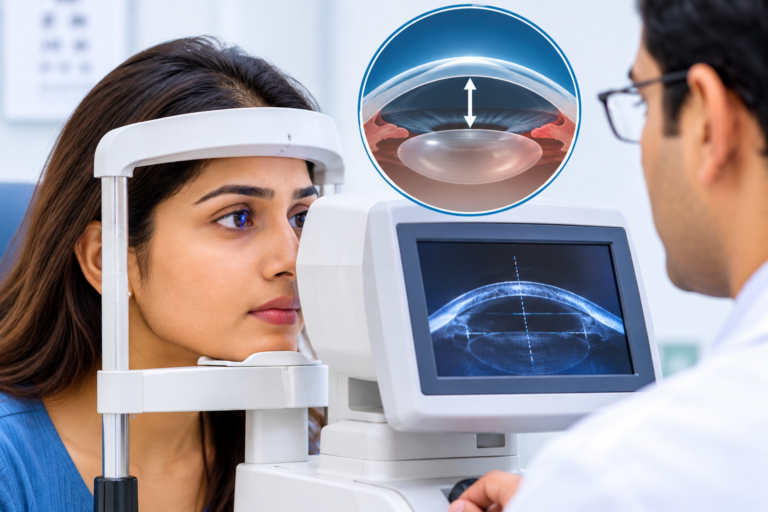
Do you feel that your glasses become less effective just a few months after getting a new prescription? Frequent changes in spectacle power may sometimes indicate more than an ordinary refractive error. In people with keratoconus, the cornea gradually becomes thinner and changes shape, affecting how light enters the eye. This can lead to changing …


Do you feel that your glasses become less effective just a few months after getting a new prescription? Frequent changes in spectacle power may sometimes indicate more than an ordinary refractive error. In people with keratoconus, the cornea gradually becomes thinner and changes shape, affecting how light enters the eye. This can lead to changing spectacle power keratoconus, irregular astigmatism and distorted vision. Understanding why these changes happen and monitoring corneal health can help identify disease progression and determine whether additional treatment is necessary.
Why Does My Glasses Power Keep Increasing With Keratoconus?
Keratoconus is an eye condition in which the cornea, the transparent front surface of the eye, becomes progressively thinner and bulges outward into an irregular cone-like shape.
A healthy cornea has a relatively smooth curvature that helps focus light onto the retina. When its shape becomes irregular, light does not focus evenly, resulting in blurred or distorted vision.
As keratoconus develops, patients may experience:
- Increasing nearsightedness (myopia).
- Changes in cylindrical spectacle power.
- Increasing or irregular astigmatism.
- Difficulty achieving clear vision with regular glasses.
- Frequent changes in spectacle prescriptions.
This explains why simply updating glasses may not always provide consistent visual clarity.
How Does Keratoconus Affect Spectacle Prescription?
The changing shape of the cornea is the main reason spectacle prescriptions may become unstable in keratoconus.
In the early stages, the corneal changes may be relatively mild. Spectacles can often correct the resulting refractive error.
As the condition progresses, the cornea may develop greater curvature differences across its surface. This produces irregular astigmatism, which standard cylindrical spectacle lenses may not fully correct.
Patients may notice:
Increasing cylindrical power: Changes in corneal curvature can alter the amount and direction of astigmatism.
Frequent prescription changes: A spectacle prescription that worked previously may no longer provide the same clarity.
Ghost images: Some patients notice shadow-like images around letters or objects.
Difficulty with night vision: Light sources may appear distorted, with increased glare or halos.
Importantly, a changing prescription alone does not confirm keratoconus progression. Corneal imaging and clinical examination are needed to establish whether structural changes are occurring.
What Are the Warning Signs That Keratoconus May Be Progressing?
Patients should pay attention to changes in vision rather than relying only on their latest spectacle prescription.
Common warning signs include:
- Repeated changes in glasses power over a relatively short period.
- Increasing blurred vision despite wearing updated spectacles.
- Difficulty reading small text clearly.
- Distorted or wavy appearance of straight lines.
- Increased sensitivity to bright lights.
- Difficulty driving at night.
- Different levels of clarity between the two eyes.
Keratoconus often affects both eyes, but the rate and severity of progression may differ.
If these symptoms develop, an ophthalmologist may recommend a detailed corneal assessment.
Which Tests Can Identify Changes in Keratoconus?
A routine eyesight test measures how clearly you can see with different spectacle powers. However, it cannot fully evaluate the structural changes occurring in the cornea.
Several investigations may be recommended.
1. Corneal Topography
Corneal topography creates a map of the corneal surface and measures its curvature.
It helps identify irregular steepening and patterns associated with keratoconus.
2. Corneal Tomography
Corneal tomography provides information about both the front and back surfaces of the cornea, along with thickness distribution.
Comparing scans taken at different visits helps the ophthalmologist assess possible structural progression.
3. Pachymetry
Pachymetry measures corneal thickness.
Since keratoconus involves progressive corneal thinning, this measurement provides useful information when interpreted alongside other clinical findings.
4. Refraction Testing
Refraction testing measures the patient’s current spectacle power, including spherical and cylindrical correction.
Comparing previous and current prescriptions can help identify changes in refractive error.
5. Slit-Lamp Examination
A slit-lamp examination allows the ophthalmologist to examine the cornea for thinning, scarring and other changes associated with keratoconus.
Together, these tests help determine whether the condition is stable or progressing.
Can New Glasses Stop Keratoconus From Progressing?
No. Updated spectacles can correct refractive errors and improve vision, but they do not strengthen the cornea or stop the underlying structural changes.
Depending on the stage of keratoconus, treatment options may include:
Spectacles: Suitable for some patients with early-stage keratoconus when the refractive error can be adequately corrected.
Specialised contact lenses: Rigid gas-permeable, hybrid or scleral lenses may help improve visual clarity when irregular astigmatism makes spectacles less effective.
Corneal Cross-Linking (CXL): This procedure uses riboflavin eye drops and ultraviolet-A light to strengthen corneal tissue. It is generally considered when progression has been established and the patient is clinically suitable.
Intracorneal Ring Segments (Intacs): These implants may be considered in selected patients to modify corneal shape and improve certain visual irregularities. They do not independently stop disease progression.
Corneal Transplantation: In advanced cases involving significant scarring or severe visual impairment, corneal transplantation may be considered.
The appropriate treatment depends on corneal thickness, disease severity, visual requirements and other examination findings.
When Should You Consult an Eye Specialist for Changing Spectacle Power?
Do not repeatedly replace your glasses without investigating the reason for frequent prescription changes.
Arrange an ophthalmic examination if:
- Your spectacle power changes repeatedly.
- Your vision remains blurred despite updated glasses.
- You notice increasing astigmatism.
- You experience distorted vision or difficulty with night driving.
- Your contact lenses no longer fit comfortably.
Seek urgent medical attention if you experience sudden significant blurring, eye pain, redness or a rapid reduction in vision. These symptoms may indicate acute corneal hydrops or another eye condition requiring prompt evaluation.
Avoid rubbing your eyes, particularly if you have allergies or persistent itching. Discuss appropriate treatment for eye allergies with your ophthalmologist.
Where Can You Get Keratoconus Evaluation in JP Nagar, Bangalore?
Patients experiencing frequent spectacle prescription changes can undergo a detailed corneal examination at Kiran Eye Hospital, JP Nagar, Bangalore.
Dr. Kiran Kumar K, Medical Director and Chief Surgeon at Kiran Eye Hospital, holds MBBS, MD (AIIMS, New Delhi), DNB, FAICO (Cornea), FAICO (Refractive Surgery) and MNAMS qualifications.
His professional profile lists expertise in keratoconus management, including topography-guided treatments, specialised contact lens fitting and Intacs procedures.
Patients experiencing changing spectacle power keratoconus can discuss their previous prescriptions, visual difficulties and corneal examination findings with the ophthalmologist.
For more information, visit the hospital’s Keratoconus Treatment service page or Dr. Kiran Kumar’s profile.
Frequently Asked Questions
1. Why does my cylindrical power keep increasing with keratoconus?
Keratoconus changes the curvature of the cornea, resulting in irregular astigmatism. As the corneal shape changes, the cylindrical component of the spectacle prescription may also change.
2. Can keratoconus progress even if my vision seems stable?
Yes. Some structural changes may occur before noticeable visual deterioration. Corneal topography and tomography help identify changes that a routine eyesight test may not detect.
3. How often should I check my spectacle power if I have keratoconus?
Follow the examination schedule recommended by your ophthalmologist. The frequency depends on age, disease severity, previous scan results and suspected progression. Younger patients or those with documented progression may require closer monitoring.
4. Does corneal cross-linking reduce spectacle power?
Corneal cross-linking is primarily intended to strengthen the cornea and slow or halt progression. It is not primarily a procedure for reducing spectacle power. Some patients may still require glasses or specialised contact lenses afterwards.
5. Can I wear contact lenses if my spectacle power keeps changing?
Yes, many patients with keratoconus can use specially fitted contact lenses. The type of lens depends on corneal shape, disease severity and individual comfort. Regular follow-up is important to assess lens fit and corneal health.
Book a Consultation
It’s easy and free!