
If you are considering ICL surgery, you may be surprised when your eye doctor recommends several measurements beyond checking your glasses prescription. One important assessment is the anterior chamber depth (ACD) measurement. The anterior chamber depth test for ICL helps determine whether there is sufficient space inside the front part of your eye for the …

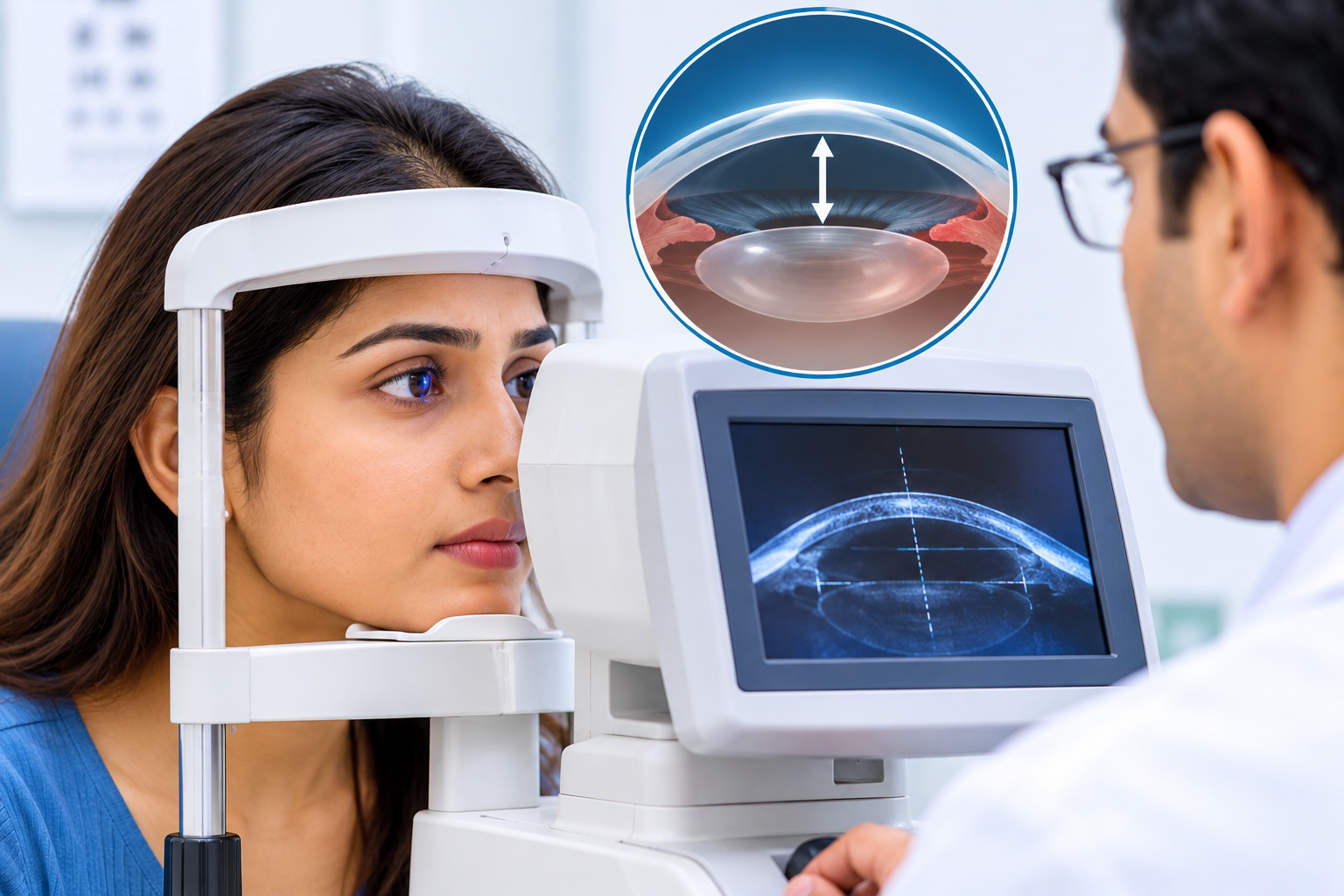
If you are considering ICL surgery, you may be surprised when your eye doctor recommends several measurements beyond checking your glasses prescription. One important assessment is the anterior chamber depth (ACD) measurement. The anterior chamber depth test for ICL helps determine whether there is sufficient space inside the front part of your eye for the implantable lens. It is an important part of surgical suitability assessment because the position of the implanted lens and the surrounding eye structures must be carefully evaluated before surgery.
What Is Anterior Chamber Depth in the Eye?
The anterior chamber is the fluid-filled space between the cornea and the natural lens of the eye. It contains a clear fluid called aqueous humour, which helps maintain eye pressure and provides nutrients to certain eye structures.
Anterior chamber depth refers to the distance between the back surface of the cornea (corneal endothelium) and the front surface of the natural crystalline lens.
This measurement helps the ophthalmologist understand the internal dimensions of the eye.
In ICL surgery, a specially designed lens is placed behind the iris and in front of the natural lens. Therefore, the available space in this region is an important consideration when planning the procedure.
Why Is an Anterior Chamber Depth Test for ICL Important?
The anterior chamber depth test for ICL is performed to assess whether the eye has suitable internal dimensions for lens implantation.
The measurement is important for several reasons:
- Checking available space: The doctor evaluates whether the anterior segment has sufficient depth for the proposed lens.
- Reducing the risk of complications: An inadequately shallow chamber may increase the risk of problems involving the iris, eye pressure and surrounding structures.
- Supporting lens selection: Eye measurements contribute to decisions about the appropriate ICL dimensions and positioning.
- Assessing surgical suitability: ACD is considered alongside other measurements to determine whether ICL is an appropriate option.
The required measurement depends on the specific lens model and its manufacturer’s instructions. There is no single number that should be used independently to decide every patient’s eligibility.
How Is Anterior Chamber Depth Measured Before ICL Surgery?
Patients often wonder whether this examination involves touching the eye or using an injection.
Most modern anterior chamber measurements are performed using non-contact imaging equipment. The examination is generally quick and does not require a surgical procedure.
Common methods include:
1. Optical Biometry
Optical biometry uses light-based technology to measure different dimensions of the eye. Depending on the instrument, it can provide information about anterior chamber depth, eye length and other measurements needed for surgical planning.
2. Anterior Segment OCT
Anterior Segment Optical Coherence Tomography (AS-OCT) uses light waves to create detailed cross-sectional images of the front structures of the eye.
It helps the ophthalmologist assess the cornea, iris, anterior chamber and natural lens position.
3. Scheimpflug Imaging
Scheimpflug imaging, available through devices such as Pentacam, captures detailed images of the anterior segment.
It can help assess anterior chamber depth, corneal shape and other measurements relevant to refractive surgery planning.
The doctor selects the appropriate examination depending on the patient’s eye condition and the information needed.
What Is the Normal Anterior Chamber Depth Required for ICL Surgery?
This is one of the most common questions patients ask when they receive their eye examination report.
The required anterior chamber depth depends on the type of phakic intraocular lens being considered and the measurement method.
For certain posterior chamber ICL models, a commonly referenced minimum is approximately 2.8–3.0 mm when measured from the corneal endothelium to the natural lens. However, the applicable manufacturer’s instructions and the surgeon’s assessment must determine the actual eligibility criteria.
It is also important to understand that different instruments may measure the depth from different reference surfaces.
For example, a measurement taken from the front surface of the cornea is not identical to a measurement taken from the corneal endothelium. Corneal thickness may need to be accounted for when interpreting the result.
Therefore, patients should not compare their measurements with someone else’s report or assume that one number guarantees eligibility.
What Other Eye Tests Are Required Before ICL Surgery?
Anterior chamber depth is only one part of the preoperative evaluation. A complete eye examination helps the surgeon understand whether the procedure is appropriate.
Other important assessments may include:
Corneal Endothelial Cell Count: This test evaluates the cells on the inner surface of the cornea. These cells help maintain corneal clarity and are important when assessing the suitability and long-term safety of ICL implantation.
Anterior Chamber Angle Examination: Gonioscopy or appropriate imaging helps evaluate the drainage angle of the eye. A narrow angle may affect surgical suitability.
White-to-White Measurement: This measures the horizontal visible diameter of the cornea and contributes to lens sizing calculations.
Corneal Topography: This examines the shape and curvature of the cornea and helps identify abnormalities.
Intraocular Pressure Test: This checks the pressure inside the eye and helps identify conditions such as elevated eye pressure or glaucoma.
Retinal Examination: A dilated retinal examination may be recommended, particularly for patients with high myopia, to identify retinal changes that need attention.
These assessments provide a more complete picture than a glasses prescription alone.
Can You Have ICL Surgery If Your Anterior Chamber Is Shallow?
Not every patient with a high spectacle power is automatically suitable for ICL surgery.
If the anterior chamber is shallower than the required range for a particular lens, the surgeon may advise against that procedure because the available space and positioning of the implant need to be considered carefully.
Depending on the patient’s overall eye health, alternatives may include:
- Spectacles or contact lenses.
- Laser vision correction, if corneal thickness, shape and other factors permit.
- Other suitable vision correction options after a detailed ophthalmic assessment.
A shallow measurement does not automatically mean that every form of vision correction is unsuitable. The decision depends on the complete examination.
Does Anterior Chamber Depth Change Over Time?
Anterior chamber depth is not necessarily constant throughout life.
Changes in the natural lens, particularly with age-related lens thickening, can influence the available space in the anterior segment.
This is one reason why accurate measurements and appropriate follow-up are important when considering an intraocular lens procedure.
Patients should share their previous eye surgery records, examination reports and relevant medical history with their ophthalmologist before undergoing ICL evaluation.
Where Can You Get an ICL Suitability Evaluation in JP Nagar?
Patients considering implantable lens surgery should undergo a detailed eye examination before making a decision.
At Kiran Eye Hospital, JP Nagar, Bangalore, patients can consult the ophthalmology team regarding refractive surgery evaluation, including ICL/IPCL procedures.
Dr. Kiran Kumar K, Medical Director and Chief Surgeon, holds MBBS, MD (AIIMS, New Delhi), DNB, FAICO (Cornea), FAICO (Refractive Surgery) and MNAMS qualifications. His listed areas of expertise include corneal care and refractive surgery.
Patients can discuss their prescription, corneal measurements and anterior chamber depth findings to understand whether ICL surgery may be suitable for their eyes.
For further information, visit the hospital’s ICL/IPCL Surgery service page and Dr. Kiran Kumar’s profile.
Frequently Asked Questions
1. Is the anterior chamber depth test painful?
No. Measurements using optical biometry, AS-OCT and Scheimpflug imaging are generally non-contact examinations. They do not involve an incision or injection.
2. How long does an anterior chamber depth test take?
The actual measurement is generally quick. The complete preoperative examination may take longer because the ophthalmologist needs to evaluate several aspects of eye health and vision.
3. Does a high spectacle power mean I am suitable for ICL surgery?
No. Spectacle power is only one factor. The surgeon also considers anterior chamber depth, corneal endothelial cell count, eye pressure, chamber angle, lens sizing and overall eye health.
4. Can anterior chamber depth be measured without touching the eye?
Yes. Several commonly used instruments measure anterior chamber depth using optical technology without directly touching the eye.
5. Is anterior chamber depth the only test needed before ICL surgery?
No. It is one of several important assessments. A complete evaluation may include corneal topography, endothelial cell count, angle examination, refraction, eye pressure measurement and retinal examination.
Book a Consultation
It’s easy and free!