Can LASIK correct high minus power and cylindrical power together? Yes. LASIK can correct selected patients who have both nearsightedness (myopia) and astigmatism. However, a high spectacle prescription requires careful assessment because correcting larger refractive errors may involve removing more corneal tissue. Patients exploring LASIK for high myopia and astigmatism should understand that eligibility depends …


Can LASIK correct high minus power and cylindrical power together?
Yes. LASIK can correct selected patients who have both nearsightedness (myopia) and astigmatism. However, a high spectacle prescription requires careful assessment because correcting larger refractive errors may involve removing more corneal tissue.
Patients exploring LASIK for high myopia and astigmatism should understand that eligibility depends on corneal thickness, corneal shape, prescription stability and overall eye health—not spectacle power alone.
At Kiran Eye Hospital, JP Nagar, Bengaluru, Dr. Kiran Kumar K and the ophthalmology team assess these factors before recommending refractive surgery.
Why do I have both high minus power and cylindrical power?
Myopia usually occurs when the eye is longer than normal or has excessive focusing power, causing distant objects to appear blurred.
Astigmatism develops when the cornea or natural lens has different curvatures in different directions, producing uneven focusing.
A person may therefore have both conditions simultaneously.
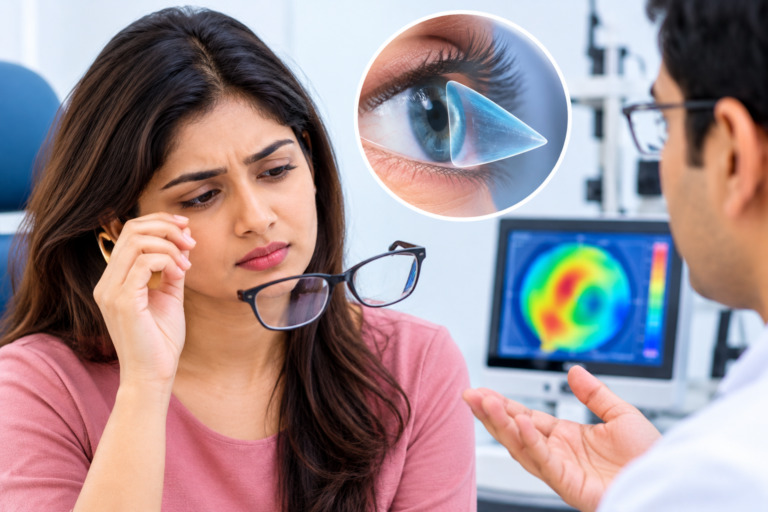
For example, a spectacle prescription can contain a spherical component for myopia and a cylindrical component for astigmatism.
Together, these can cause:
- Blurred vision while looking at distant objects.
- Distorted edges around letters and road signs.
- Difficulty recognising objects without spectacles.
- Ghosting or shadowing around text.
- Eye strain during prolonged visual activities.
The severity of these symptoms depends on the prescription and other eye conditions.
Does a higher spectacle prescription make LASIK less suitable?
A higher prescription does not automatically rule out LASIK.
However, the amount of laser correction required generally increases as spectacle power rises.
The surgeon must ensure that enough healthy corneal tissue remains after treatment.
Correcting high myopia along with significant astigmatism can place greater demands on corneal thickness and shape.
Extremely high refractive errors may also have less predictable outcomes.
There is no single safe spectacle-power limit for every patient because eligibility varies with the individual eye and approved laser treatment range.
Why is corneal thickness important when correcting high power?
LASIK reshapes the cornea using an excimer laser.
A thin flap is created, and the laser removes a calculated amount of tissue beneath it.
Higher corrections generally require greater tissue removal.
The surgeon must assess whether the remaining cornea will retain adequate structural strength.
If insufficient tissue remains, the risk of postoperative corneal instability or ectasia may increase.
Simply having a naturally thick cornea does not guarantee LASIK suitability.
Corneal shape, tissue distribution and other risk factors must also be evaluated.
Can high myopia increase the risk of retinal problems?
Yes. High myopia is often associated with an elongated eyeball.
This can increase the risk of certain retinal conditions, including retinal tears, retinal detachment and myopic retinal degeneration.
LASIK corrects how light focuses, but it does not shorten the eyeball or eliminate the underlying retinal risks associated with high myopia.
This distinction is important for patients who believe that removing their spectacle power also removes every consequence of nearsightedness.
A dilated retinal examination may be recommended before surgery.
Any significant retinal findings may require additional assessment or treatment.
Which tests determine whether I qualify for LASIK?
Patients considering LASIK for High Spectacle Prescription Bangalore should undergo a comprehensive refractive surgery evaluation.
Important investigations include:
Refraction testing: Measures spherical and cylindrical spectacle power and confirms prescription stability.
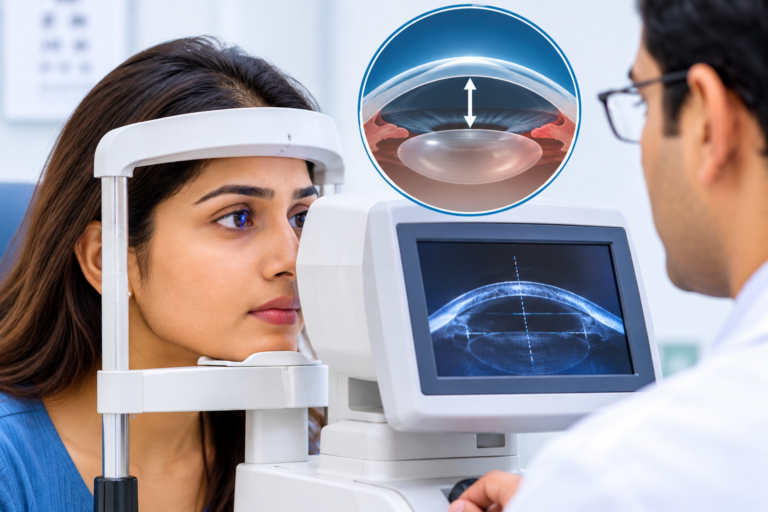
Corneal topography: Maps the corneal surface and identifies irregular curvature.
Corneal tomography: Assesses corneal shape, thickness distribution and abnormalities associated with ectasia risk.
Pachymetry: Measures corneal thickness.
Tear film assessment: Identifies significant dry eye disease.
Slit-lamp examination: Evaluates the cornea, lens and ocular surface.
Dilated retinal examination: Checks for retinal changes associated with high myopia.
The ophthalmologist may also review previous spectacle prescriptions to determine whether the power has remained stable.
Can LASIK correct high astigmatism completely?
LASIK can correct suitable amounts of regular astigmatism alongside myopia.
However, the degree of correction depends on the approved treatment range and individual corneal measurements.
Some patients may retain a small amount of cylindrical power after surgery.
Higher astigmatism can also require particularly careful laser treatment planning.
If the cornea has significant irregularity, such as keratoconus, ordinary LASIK may be unsuitable.
Patients should understand that reducing spectacle dependence is a possible goal, but complete correction cannot be guaranteed.
Is SMILE or PRK better when my spectacle power is high?
Different laser procedures have different advantages and limitations.
SMILE may be considered for selected patients with myopia and astigmatism, depending on the available technology and approved correction range.
PRK reshapes the corneal surface without creating a LASIK flap, but it still removes corneal tissue.
Neither procedure is automatically safer simply because the prescription is high.
The ophthalmologist must evaluate the cornea, total correction required and expected remaining tissue.
A procedure suitable for one patient may be inappropriate for another with a similar spectacle prescription.
What if my cornea is unsuitable for laser surgery?
An implantable collamer lens (ICL) may be considered for selected patients with moderate or high myopia.
Unlike LASIK, ICL surgery places an artificial lens inside the eye without removing corneal tissue for refractive correction.
Toric ICL designs may also correct suitable astigmatism.
However, ICL is an intraocular operation and carries risks, including raised eye pressure, inflammation, cataract formation and other complications.
Patients need separate tests to assess internal eye dimensions and lens suitability.
Spectacles or contact lenses remain appropriate alternatives when surgery presents unnecessary risks.
Learn more through the hospital’s LASIK surgery, SMILE surgery and ICL/IPCL services.
Will my high spectacle power return after LASIK?
Some patients experience residual refractive error or regression after surgery.
Higher initial prescriptions may be associated with a greater possibility of needing additional optical correction.
Long-term changes can also occur independently of the original treatment.
A patient may still need spectacles for particular activities, and enhancement surgery is not always appropriate.
Regular eye examinations remain important, particularly for patients with high myopia and associated retinal risks.
When should I seek medical attention?
Arrange an eye examination if your spectacle power changes frequently, vision becomes increasingly distorted or updated glasses no longer provide satisfactory clarity.
Seek urgent ophthalmic care for sudden flashes, numerous new floaters, a dark curtain across vision or sudden loss of sight.
These symptoms may indicate a retinal problem and should not be attributed to ordinary myopia or astigmatism.
Where can I discuss LASIK for high spectacle power in Bangalore?
Patients researching LASIK for high myopia and astigmatism can seek an eligibility assessment at Kiran Eye Hospital, Vishnu Towers, ITI Layout, 1st Phase, JP Nagar, Bengaluru.
Dr. Kiran Kumar K, Medical Director and Chief Surgeon, holds MBBS, MD (AIIMS, New Delhi), DNB, FAICO (Cornea), FAICO (Refractive Surgery) and MNAMS qualifications. His documented expertise includes LASIK, PRK, SMILE and corneal surgery.
An examination with Dr. Kiran Kumar K or the ophthalmology team can help determine whether laser correction is appropriate or whether another vision correction method may be preferable.
Frequently Asked Questions About LASIK for High Myopia and Astigmatism
1. Can LASIK correct both high myopia and astigmatism in one procedure?
Yes. LASIK may correct suitable amounts of myopia and regular astigmatism together. Eligibility depends on corneal measurements, total refractive correction and overall eye health.
2. Is there a maximum minus power that LASIK can correct?
There is no single maximum prescription suitable for every patient. The approved laser treatment range, corneal thickness, corneal shape and expected remaining tissue determine eligibility.
3. Can I undergo LASIK if I have high cylindrical power?
Possibly. LASIK can correct selected cases of regular astigmatism, but significant irregularity or excessive correction requirements may make the procedure unsuitable.
4. Is ICL a better option than LASIK for high spectacle power?
ICL may be considered when high myopia or corneal limitations make LASIK less suitable. However, ICL has its own eligibility requirements and surgical risks, so the choice requires individual assessment.
5. Does LASIK remove the retinal risks associated with high myopia?
No. LASIK changes the cornea’s focusing power but does not reverse the elongated shape of a highly myopic eye. Regular retinal assessment may still be important.
Book a Consultation
It’s easy and free!