Why is it becoming difficult to see nearby objects after turning 40? Difficulty focusing on nearby objects after 40 is commonly caused by presbyopia, a natural age-related change in the eye's focusing ability. As the eye's internal lens becomes less flexible, reading small print, viewing a mobile phone and performing close-up tasks can become increasingly …

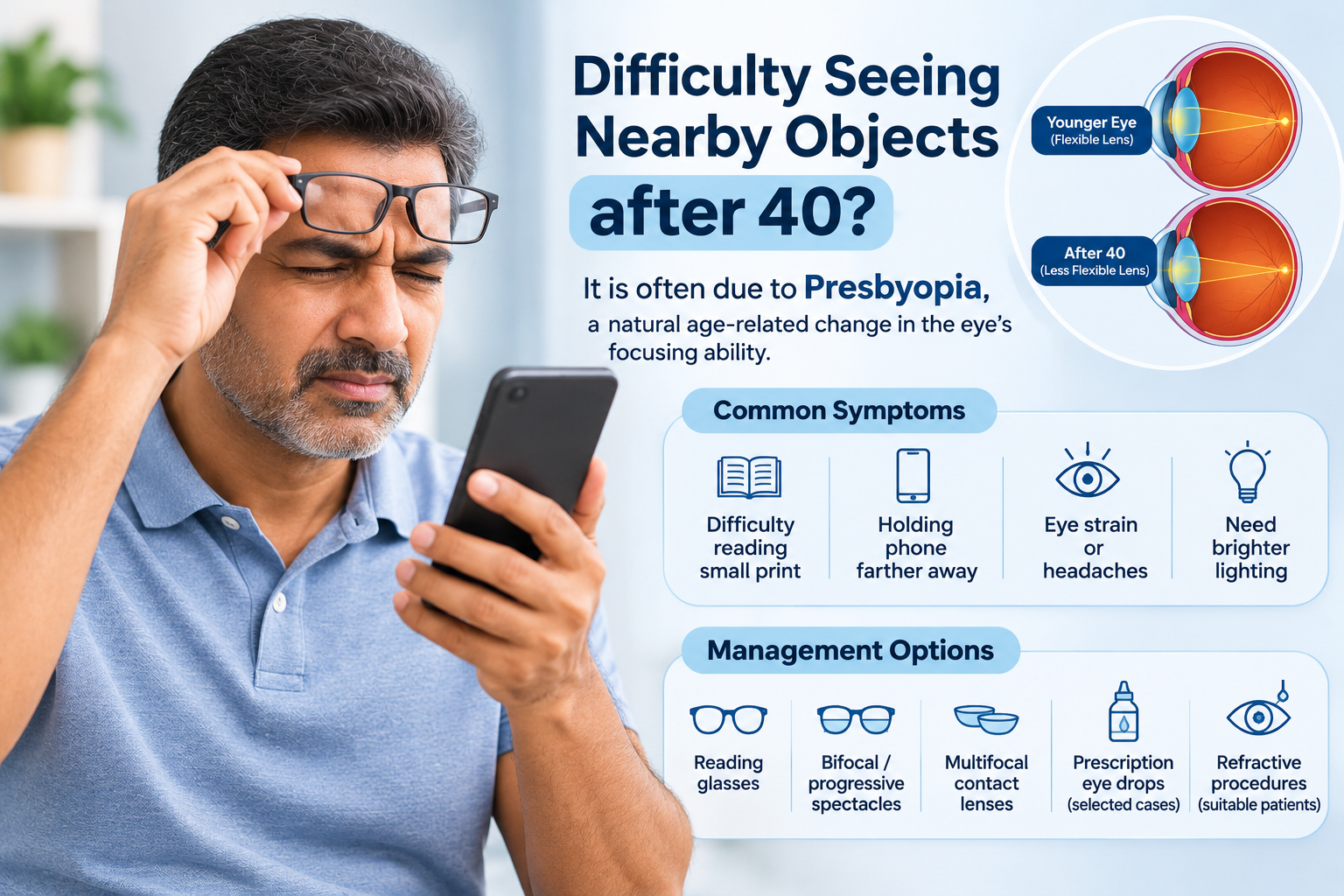
Why is it becoming difficult to see nearby objects after turning 40?
Difficulty focusing on nearby objects after 40 is commonly caused by presbyopia, a natural age-related change in the eye’s focusing ability. As the eye’s internal lens becomes less flexible, reading small print, viewing a mobile phone and performing close-up tasks can become increasingly difficult.
People experiencing difficulty seeing nearby objects after 40 may notice that they need to hold reading materials farther away or increase the lighting around them.
At Kiran Eye Hospital, JP Nagar, Bengaluru, Dr. Kiran Kumar K and the ophthalmology team can evaluate near vision changes and identify appropriate correction options.
Why can I see distant objects clearly but struggle to read my phone?
Many adults notice that distant road signs remain clear while messages on their phone appear blurry.
This happens because the eye must adjust its focusing power when shifting attention from distant objects to nearby ones.
In younger individuals, the natural crystalline lens changes shape relatively easily to focus on close objects.
As people age, the lens gradually loses flexibility. This reduces the eye’s ability to focus at shorter distances.
The condition is called presbyopia and commonly becomes noticeable during the early to mid-forties.
Presbyopia is not the same as cataracts or permanent damage to the eye. However, an examination is necessary to confirm the cause of new visual symptoms.
What are the early warning signs of presbyopia?
Presbyopia usually develops gradually rather than appearing suddenly.
Common symptoms include:
- Difficulty reading small letters on mobile phones.
- Holding books or newspapers farther away.
- Eye strain after reading or computer work.
- Headaches during prolonged close-up activities.
- Difficulty threading a needle or examining small objects.
- Needing brighter lighting to read comfortably.
- Blurred vision when switching between near and distant objects.
These symptoms may become particularly noticeable during evening reading or in dimly lit rooms.
Although they are common with presbyopia, similar symptoms can occur with other refractive or ocular conditions.
Why does reading become more difficult in dim lighting?
Many patients first notice near vision problems while reading restaurant menus, medicine labels or messages in poorly lit environments.
Reduced illumination makes small details harder to distinguish and can make existing focusing difficulties more noticeable.
People with developing presbyopia may compensate by increasing brightness or moving text farther away.
Better lighting can improve reading comfort, but it does not restore the natural lens’s flexibility.
If reading remains difficult despite adequate lighting, a near vision examination is advisable.
Can excessive mobile phone use cause blurry near vision after 40?
Prolonged digital screen use can contribute to eye strain, dryness and fluctuating vision.
During concentrated screen activities, people tend to blink less frequently, which can affect tear film stability.
Symptoms may include tired eyes, burning, temporary blurring and difficulty maintaining focus.
However, mobile phone use does not directly cause presbyopia. Age-related lens changes are responsible for the underlying reduction in near focusing ability.
Adults may experience presbyopia and digital eye strain together.
Taking regular breaks, blinking consciously, adjusting screen distance and improving lighting may reduce discomfort, although these measures do not reverse presbyopia.
Could my near vision problems be caused by something other than ageing?
Yes. Not every near vision complaint after 40 is caused by presbyopia.
Other possible causes include:
Hyperopia: Long-sightedness may make close-up work difficult, particularly when the eye’s focusing ability decreases.
Dry eye disease: Tear film instability can cause fluctuating or intermittent blurred vision.
Cataracts: Clouding of the natural lens can affect vision and may produce glare or reduced contrast.
Diabetes-related changes: Fluctuating blood glucose can temporarily affect focusing and visual clarity.
Uncorrected astigmatism: Irregular focusing may affect clarity at different distances.
An eye examination helps distinguish these conditions from uncomplicated presbyopia.
Which eye tests identify the cause of blurred near vision?
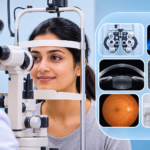
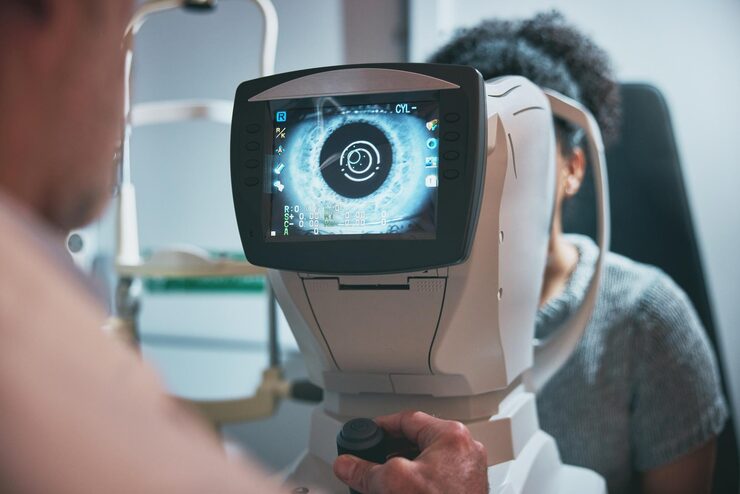
An ophthalmologist may recommend a comprehensive examination that includes:
Near visual acuity testing: Measures how clearly the patient reads at a standard near distance.
Distance vision and refraction testing: Determines whether myopia, hyperopia or astigmatism is also present.
Near addition assessment: Identifies the additional focusing power needed for comfortable close work.
Slit-lamp examination: Evaluates the cornea, natural lens and other structures.
Eye pressure measurement: Helps assess glaucoma-related concerns.
Dilated eye examination: May be recommended to assess the retina and other internal eye structures.
Additional investigations depend on the patient’s symptoms, medical history and examination findings.
What treatment options can improve near vision after 40?
Treatment depends on the diagnosis, existing spectacle prescription and daily visual requirements.
Reading glasses: Often the simplest option for people who primarily struggle with close-up tasks.
Bifocal or progressive spectacles: May help patients requiring correction for both near and distance vision.
Multifocal contact lenses: Can provide an alternative for selected patients who prefer not to wear spectacles.
Prescription eye drops: Certain approved medications can temporarily improve near vision in selected adults, but availability, suitability and side effects require medical assessment.
Refractive procedures: Selected patients may be evaluated for monovision or blended-vision laser techniques.
Patients interested in refractive correction can learn about LASIK surgery at Kiran Eye Hospital.
Surgical treatment is not necessary for everyone, and no procedure guarantees complete freedom from reading glasses.
When should I seek medical attention for near vision changes?
Arrange an eye examination if difficulty reading persists, interferes with work or requires frequent changes in spectacles.
Seek urgent medical attention if blurred vision appears suddenly or is accompanied by severe eye pain, flashes, new floaters, a dark shadow across vision or sudden vision loss.
These symptoms are not typical of uncomplicated presbyopia and may indicate an urgent eye condition.
Where can I get an eye examination for near vision problems in JP Nagar?
Patients experiencing difficulty seeing nearby objects after 40 can seek an eye assessment at Kiran Eye Hospital, Vishnu Towers, ITI Layout, 1st Phase, JP Nagar, Bengaluru.
Dr. Kiran Kumar K, Medical Director and Chief Surgeon, holds MBBS, MD (AIIMS, New Delhi), DNB, FAICO (Cornea), FAICO (Refractive Surgery) and MNAMS qualifications. His professional profile includes corneal and refractive surgery expertise.
A consultation with Dr. Kiran Kumar K or the ophthalmology team can help establish whether near vision difficulties are caused by presbyopia or another eye condition and identify suitable management options.
Frequently Asked Questions About Near Vision Problems After 40
1. Is it normal to need reading glasses after the age of 40?
Yes. Many adults develop presbyopia during their forties and require additional focusing power for close-up activities. An eye examination can determine the appropriate correction.
2. Can presbyopia be reversed naturally through eye exercises?
There is no established evidence that eye exercises reverse the age-related loss of lens flexibility responsible for presbyopia. Appropriate spectacles, contact lenses or selected medical treatments can help manage symptoms.
3. Why do I need to hold my phone farther away to read clearly?
Holding the phone farther away reduces the focusing demand on the eyes. This is a common compensation used by people developing presbyopia.
4. Will wearing reading glasses make my eyes weaker?
No. Reading glasses do not weaken the eyes or accelerate presbyopia. They compensate for reduced near focusing ability and can improve visual comfort.
5. Can I have presbyopia even if I have never worn spectacles?
Yes. Presbyopia affects the natural lens’s focusing ability and can develop in people who previously had excellent distance and near vision. An eye examination can confirm the diagnosis.
Book a Consultation
It’s easy and free!