What is a nuclear cataract, and why does it affect eyesight? A nuclear cataract develops when the central part, or nucleus, of the eye's natural lens gradually becomes harder, denser and cloudy. These changes interfere with how light focuses on the retina, causing blurred distance vision, frequent spectacle prescription changes and difficulty seeing clearly at …

What is a nuclear cataract, and why does it affect eyesight?
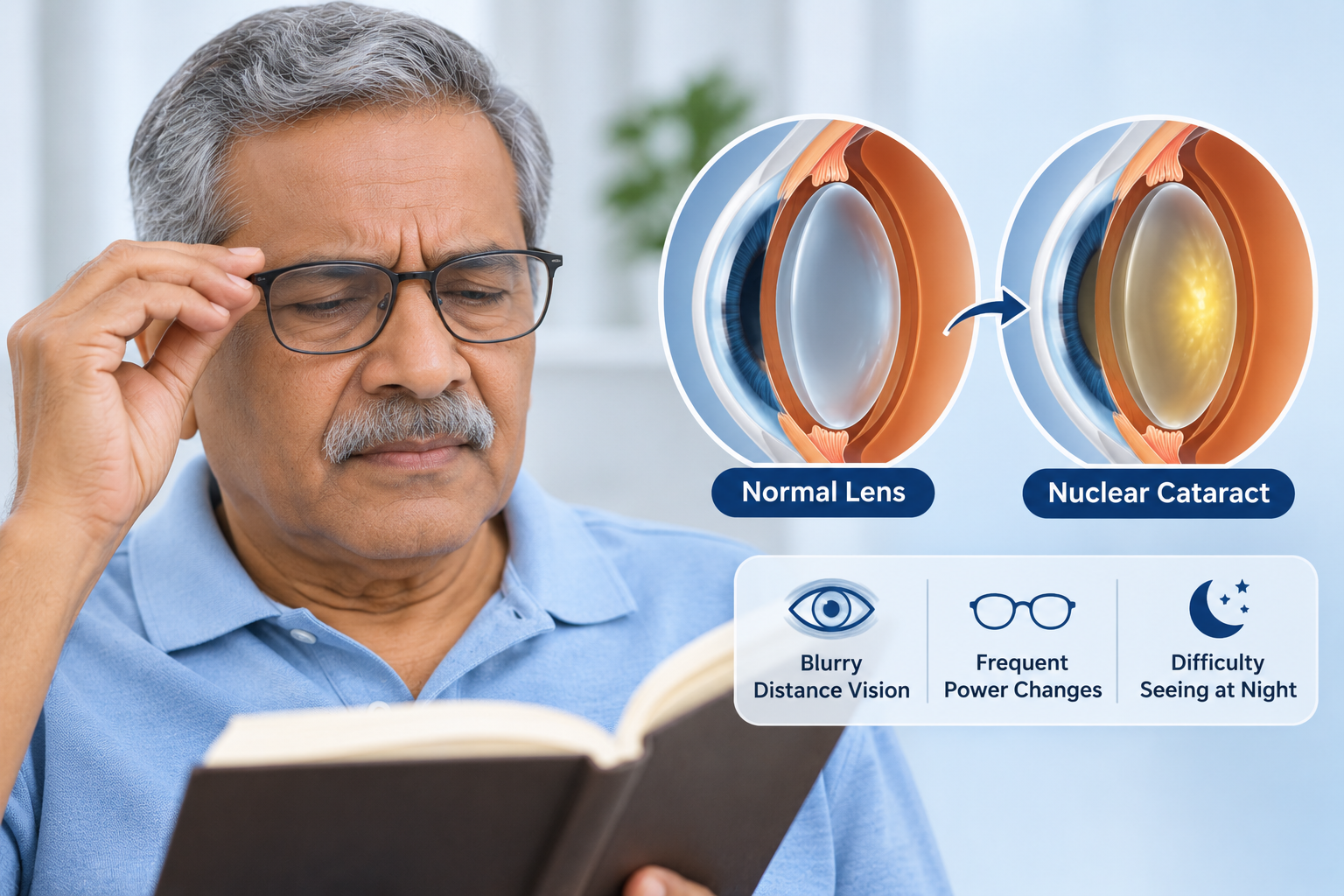
A nuclear cataract develops when the central part, or nucleus, of the eye’s natural lens gradually becomes harder, denser and cloudy. These changes interfere with how light focuses on the retina, causing blurred distance vision, frequent spectacle prescription changes and difficulty seeing clearly at night.
Patients exploring Nuclear Cataract Surgery Bangalore may be surprised to learn that this cataract can sometimes temporarily improve their ability to read without glasses.
At Kiran Eye Hospital, JP Nagar, Bengaluru, Dr. Kiran Kumar K and the ophthalmology team evaluate these changes to determine whether monitoring or treatment is appropriate.
Why does the centre of the eye lens become cloudy?
The natural lens is normally transparent and helps focus light onto the retina.
With ageing, proteins within the lens undergo structural changes. The central lens gradually becomes denser, harder and less transparent.
This process is called nuclear sclerosis. When these changes cause significant clouding and affect vision, the condition is commonly described as a nuclear sclerotic cataract.
Ageing is the main contributing factor. Other recognised cataract risk factors include smoking, diabetes, prolonged ultraviolet exposure, previous eye injuries and family history.
Nuclear cataracts usually develop gradually and may affect both eyes at different rates.
Why am I suddenly able to read without my reading glasses?
Some people notice an unexpected improvement in near vision during the early stages of nuclear cataract development.
This phenomenon is called second sight.
As the central lens becomes denser, its refractive properties can change, causing a shift towards myopia, or nearsightedness.
Someone who previously needed reading glasses may temporarily find it easier to read small print without them.
However, this improvement does not mean that the eyes are becoming healthier.
As the cataract progresses, the lens becomes increasingly cloudy, and both near and distance vision may deteriorate.
An unexpected change in reading-glass requirements should therefore be discussed with an ophthalmologist.
Why is my distance vision becoming blurry despite changing spectacles?
A nuclear cataract can gradually change the focusing power of the natural lens.
Patients may notice that distant road signs, television subtitles or objects across a room become difficult to see.
An updated spectacle prescription may initially improve clarity.
However, further changes can occur as the lens continues to harden.
Common symptoms include:
- Increasing difficulty seeing distant objects.
- Frequent changes in spectacle power.
- Blurred vision despite updated glasses.
- Reduced clarity while driving at night.
- Difficulty distinguishing objects in low-contrast settings.
- Glare around vehicle headlights.
Not every change in spectacle power is caused by cataracts. A comprehensive eye examination is needed to identify the underlying reason.
Can nuclear cataracts affect night driving before daytime vision?
Yes. Some patients experience difficulty driving at night even when daytime vision remains reasonably comfortable.
Reduced contrast sensitivity and light scattering within the ageing lens can make objects less distinct in low-light conditions.
Headlights from approaching vehicles may also produce uncomfortable glare.
Patients may find it difficult to judge road markings, identify pedestrians or recognise objects against dark backgrounds.
These difficulties can affect driving confidence and safety.
If night driving becomes unreliable, avoid driving until an ophthalmologist evaluates your vision.
How is a nuclear cataract diagnosed?
An ophthalmologist evaluates the symptoms, spectacle history and overall eye health.
Common investigations include:
Visual acuity testing: Measures how clearly you see at distance and near.
Refraction testing: Identifies changes in spectacle power, including a possible myopic shift.
Slit-lamp examination: Allows direct assessment of the central lens for hardening, yellowing and cloudiness.
Dilated eye examination: Helps evaluate the lens and detect retinal abnormalities.
Eye pressure measurement: May be performed as part of a comprehensive assessment.
Additional tests, such as retinal optical coherence tomography, may be recommended when another condition is suspected.
The ophthalmologist considers both cataract appearance and its effect on everyday vision.
Can a nuclear cataract be treated with glasses or eye drops?
In the early stages, updated spectacles may improve vision.
Appropriate lighting, anti-glare measures and regular monitoring may also help patients manage their symptoms.
However, glasses cannot remove cloudiness from the natural lens.
Currently, no established eye drop can reverse an age-related nuclear cataract.
When the cataract significantly affects daily activities, surgery may be recommended.
The decision depends on functional difficulties, examination findings and individual visual requirements rather than age alone.
What happens during nuclear cataract surgery?
Cataract surgery involves removing the cloudy natural lens and replacing it with a transparent artificial intraocular lens.
The commonly used phacoemulsification technique employs ultrasound energy to break up and remove lens material.
The surgeon then implants a selected artificial lens to help focus light.
The artificial lens type is chosen after assessing eye measurements, lifestyle requirements and expectations.
Patients should understand that surgery involves potential risks, including inflammation, infection, retinal complications and postoperative visual disturbances.
The extent of visual improvement depends on retinal health and other existing eye conditions.
More information is available on the hospital’s cataract surgery service page.
When should I seek medical attention for changing vision?
Arrange an ophthalmic examination if your spectacle prescription changes frequently, distance vision becomes progressively blurred or night driving becomes difficult.
Seek urgent medical attention if you experience sudden vision loss, severe eye pain, new flashes, numerous floaters or a dark shadow across vision.
These symptoms are not typical of a slowly progressing nuclear cataract and may indicate another condition requiring prompt treatment.
Where can I discuss nuclear cataract treatment in Bangalore?
Patients considering Nuclear Cataract Surgery Bangalore can seek an ophthalmic evaluation at Kiran Eye Hospital, located at Vishnu Towers, ITI Layout, 1st Phase, JP Nagar, Bengaluru.
Dr. Kiran Kumar K, Medical Director and Chief Surgeon, holds MBBS, MD (AIIMS, New Delhi), DNB, FAICO (Cornea), FAICO (Refractive Surgery) and MNAMS qualifications. His clinical expertise includes cataract, corneal and refractive surgery.
A consultation with Dr. Kiran Kumar K or the hospital’s ophthalmology team can help determine whether nuclear cataract changes are responsible for fluctuating spectacle power and whether continued monitoring or surgical treatment is appropriate.
Frequently Asked Questions About Nuclear Cataracts
1. Is a nuclear cataract the same as a nuclear sclerotic cataract?
Yes. Nuclear sclerotic cataract describes clouding associated with hardening of the central lens. Nuclear sclerosis refers to the hardening process, which may develop before a visually significant cataract forms.
2. Why does my spectacle power keep increasing with a nuclear cataract?
Changes in the density and refractive properties of the central lens can cause a shift towards myopia. This may lead to frequent spectacle prescription changes as the cataract develops.
3. Can a nuclear cataract temporarily improve reading vision?
Yes. Some patients experience a temporary improvement in unaided near vision, known as second sight. However, this does not indicate recovery, and vision may worsen as the cataract progresses.
4. How quickly does a nuclear cataract progress?
Nuclear cataracts usually develop gradually over several years, although progression varies between individuals. Regular eye examinations help monitor changes and guide treatment decisions.
5. Do all nuclear cataracts require immediate surgery?
No. Mild nuclear cataracts may initially be managed with updated spectacles and monitoring. Surgery is generally considered when the cataract significantly interferes with vision or daily activities, or when other clinical indications exist.
Book a Consultation
It’s easy and free!