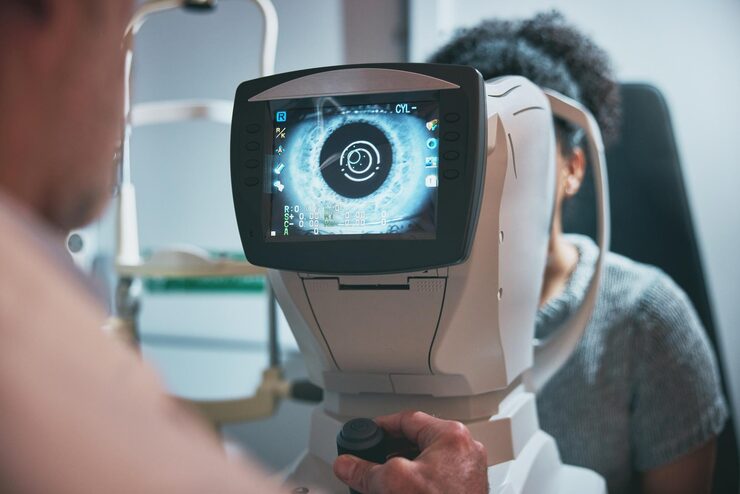
ICL for patients not suitable for LASIK is an important option to understand when laser vision correction is not appropriate because of thin corneas, high spectacle power or certain corneal conditions. Being unsuitable for LASIK does not automatically mean that you cannot consider other vision correction procedures. Implantable Collamer Lens (ICL) surgery works differently from …

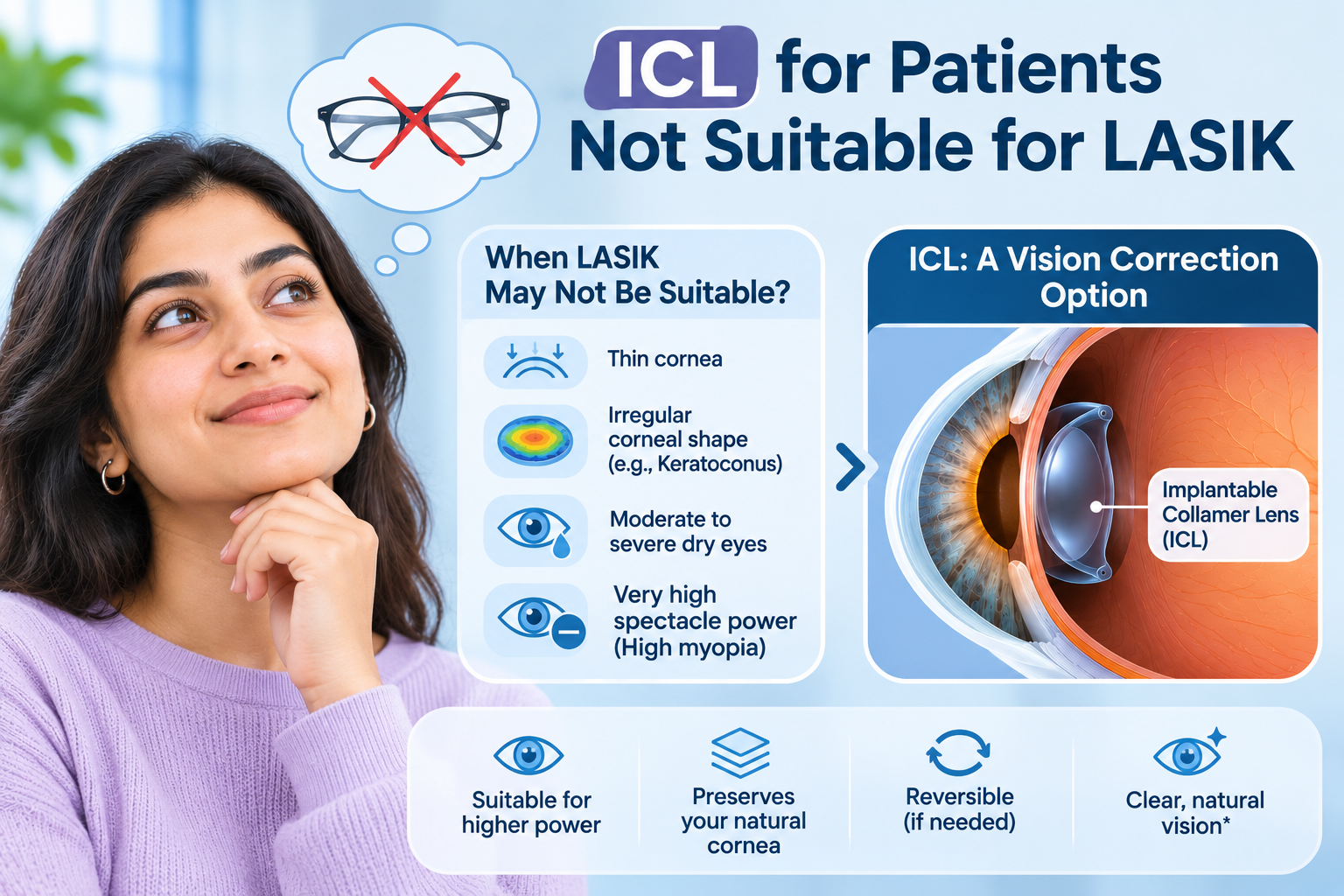
ICL for patients not suitable for LASIK is an important option to understand when laser vision correction is not appropriate because of thin corneas, high spectacle power or certain corneal conditions. Being unsuitable for LASIK does not automatically mean that you cannot consider other vision correction procedures. Implantable Collamer Lens (ICL) surgery works differently from LASIK because it involves placing a specialised lens inside the eye without reshaping the cornea to correct the refractive error. For patients exploring vision correction options near Bannerghatta Road, understanding the differences between these procedures can help them prepare for an informed ophthalmology consultation.
Why Are Some Patients Not Suitable for LASIK Surgery?
LASIK corrects refractive errors by reshaping the cornea using a laser. Although it is suitable for many people, certain eye conditions may make the procedure unsuitable or increase its risks.
Common reasons include:
- Thin cornea: Removing additional corneal tissue may compromise corneal strength in patients with insufficient thickness.
- High myopia: Very high spectacle power may require more tissue removal than the cornea can safely accommodate.
- Keratoconus: This condition causes progressive thinning and irregular bulging of the cornea.
- Irregular corneal shape: Abnormal corneal measurements may affect the safety of laser-based correction.
- Severe dry eye: Existing ocular surface problems may worsen after certain laser procedures.
- Unstable spectacle power: Changing refractive error can affect the predictability of surgical correction.
A detailed examination is necessary because not every patient with one of these conditions is automatically unsuitable for all forms of laser vision correction.
What Is ICL Surgery and How Does It Work?
ICL stands for Implantable Collamer Lens. It is a specialised artificial lens designed to correct refractive errors such as myopia and certain types of astigmatism.
Unlike LASIK, which reshapes the cornea, ICL surgery involves placing a customised lens inside the eye, behind the iris and in front of the natural crystalline lens.
The natural lens remains in place, allowing the eye to retain its natural focusing function.
The procedure generally involves:
- Applying appropriate anaesthesia to keep the eye comfortable.
- Making a small incision in the cornea.
- Inserting the folded ICL through the incision.
- Positioning the lens behind the iris.
- Checking the lens position and eye pressure after implantation.
ICL is an intraocular procedure, so it requires careful assessment and postoperative monitoring.
Why Is ICL Considered for Patients With Thin Corneas?
One of the common concerns among people researching LASIK is being told that their corneas are too thin for the procedure.
LASIK removes a calculated amount of corneal tissue to change the way light focuses on the retina. When corneal thickness is insufficient, removing additional tissue may increase the risk of biomechanical instability and corneal ectasia.
ICL works differently. It corrects the refractive error by adding a lens inside the eye rather than removing corneal tissue to reshape it.
For this reason, an ophthalmologist may consider ICL for selected patients with thin corneas.
However, thin corneas do not automatically make someone suitable for ICL. Corneal health, anterior chamber depth, endothelial cell count and other eye measurements must also be evaluated.
Can ICL Surgery Help Patients With High Myopia?
High myopia means having a significant degree of short-sightedness, making distant objects appear blurred.
Patients with high myopia may depend on thick prescription glasses or contact lenses for everyday activities. Some may also be unsuitable for corneal laser procedures because the required tissue removal could exceed safe limits.
ICL may be considered because the implanted lens can correct moderate to high degrees of myopia within the approved range of the particular lens.
However, people with high myopia should also undergo a detailed retinal examination. High myopia can be associated with retinal complications, including retinal tears and retinal detachment.
ICL corrects the refractive error but does not eliminate the underlying retinal risks associated with high myopia.
What Is the Difference Between ICL and LASIK Surgery?
Both procedures aim to reduce dependence on glasses or contact lenses, but they work differently.
Feature | LASIK | ICL |
Procedure | Reshapes the cornea | Implants a lens inside the eye |
Corneal tissue | Tissue is removed | No corneal tissue is removed for refractive correction |
Thin cornea | May be unsuitable | May be considered after evaluation |
High myopia | Limited by safe corneal correction | May correct higher prescriptions within lens indications |
Natural lens | Remains unchanged | Remains unchanged |
Surgical approach | Corneal laser procedure | Intraocular lens implantation |
Future intervention | Corneal reshaping is permanent | Implanted lens may be removed or exchanged if medically indicated |
Neither procedure is suitable for everyone. The choice depends on refractive error, corneal measurements, eye anatomy and overall ocular health.
What Tests Are Required Before ICL Surgery?
Before recommending ICL, the ophthalmologist needs to confirm that the eye has sufficient space and healthy structures to accommodate the implanted lens.
The evaluation may include:
- Refraction test: Measures the spectacle power and determines the degree of myopia or astigmatism.
- Corneal topography and tomography: Examines corneal shape, curvature and structural characteristics.
- Anterior chamber depth measurement: Determines whether sufficient space is available for the implanted lens.
- Endothelial cell count: Evaluates the cells lining the inner surface of the cornea.
- Intraocular pressure measurement: Helps identify elevated eye pressure or glaucoma-related concerns.
- Retinal examination: Assesses the retina, particularly in patients with high myopia.
The results help the ophthalmologist determine whether ICL is appropriate or whether another treatment or continued use of glasses or contact lenses is more suitable.
Are There Any Risks Associated With ICL Surgery?
ICL is an established refractive procedure, but it is still surgery inside the eye and has potential complications.
Possible risks include:
- Increased intraocular pressure.
- Cataract formation.
- Glare and halos, particularly in low-light conditions.
- Inflammation or infection.
- Changes in corneal endothelial cell count.
- Incorrect lens sizing or positioning.
- Retinal complications, particularly in people with high myopia.
Some complications may require additional medication or surgical intervention. Regular postoperative examinations are important to monitor eye pressure, lens position and corneal health.
Where Can I Explore ICL Surgery Near Bannerghatta Road?
People living around Bannerghatta Road, Arekere, Hulimavu, JP Nagar and nearby parts of South Bangalore may be researching alternatives to LASIK because of high spectacle power or corneal measurements.
Kiran Eye Hospital is located at Ground Floor, Vishnu Towers, 20, ITI Layout, 1st Phase, JP Nagar, Bengaluru, Karnataka 560078. Patients travelling from Bannerghatta Road can contact the hospital to enquire about consultation and ICL evaluation. The hospital’s listed location is JP Nagar.
Dr. Kiran Kumar K, Medical Director and Chief Surgeon at Kiran Eye Hospital, holds MBBS, MD (AIIMS, New Delhi), DNB, FAICO (Cornea), FAICO (Refractive Surgery) and MNAMS qualifications. His professional profile lists experience in refractive procedures, including LASIK, PRK and SMILE, along with specialised corneal care.
Patients considering ICL for patients not suitable for LASIK can discuss their corneal health, refractive power, treatment options and surgical suitability during an individual ophthalmology consultation.
The appropriate procedure should be selected only after reviewing the patient’s complete eye examination and medical history.
Frequently Asked Questions
1. Is ICL better than LASIK for thin corneas?
ICL may be considered for patients with thin corneas because it corrects vision without removing corneal tissue. However, suitability depends on other eye measurements and overall eye health.
2. Can I undergo ICL surgery if I have high spectacle power?
Some patients with moderate to high myopia may be suitable for ICL. The correct lens power and eligibility must be established through a detailed examination.
3. Is ICL surgery permanent?
The implanted lens is designed to remain inside the eye, but it can be removed or exchanged if medically necessary. Removal is another surgical procedure and does not guarantee that the eye will return to its original refractive state.
4. Does ICL surgery involve removing the natural eye lens?
No. In standard phakic ICL surgery, the natural crystalline lens is retained and the implant is placed in front of it, behind the iris.
5. Can everyone who is unsuitable for LASIK undergo ICL?
No. Patients with certain conditions, such as insufficient anterior chamber depth, low corneal endothelial cell count, glaucoma or cataracts, may also be unsuitable for ICL. Individual assessment is essential.
Book a Consultation
It’s easy and free!