Do you find yourself turning on extra lights, moving closer to a window or increasing your phone’s brightness to read comfortably? This may happen when cataracts begin to affect your vision. Difficulty reading due to cataract is a common concern because the natural lens of the eye gradually becomes cloudy, reducing the amount and quality …

Do you find yourself turning on extra lights, moving closer to a window or increasing your phone’s brightness to read comfortably? This may happen when cataracts begin to affect your vision. Difficulty reading due to cataract is a common concern because the natural lens of the eye gradually becomes cloudy, reducing the amount and quality of light reaching the retina. As a result, printed letters may appear less clear, especially in dimly lit environments.
Needing more light does not always mean you have cataracts. However, if reading has become increasingly difficult or your vision seems different from before, an eye examination can help identify the cause and determine whether treatment is needed.
Why do cataracts make reading difficult?
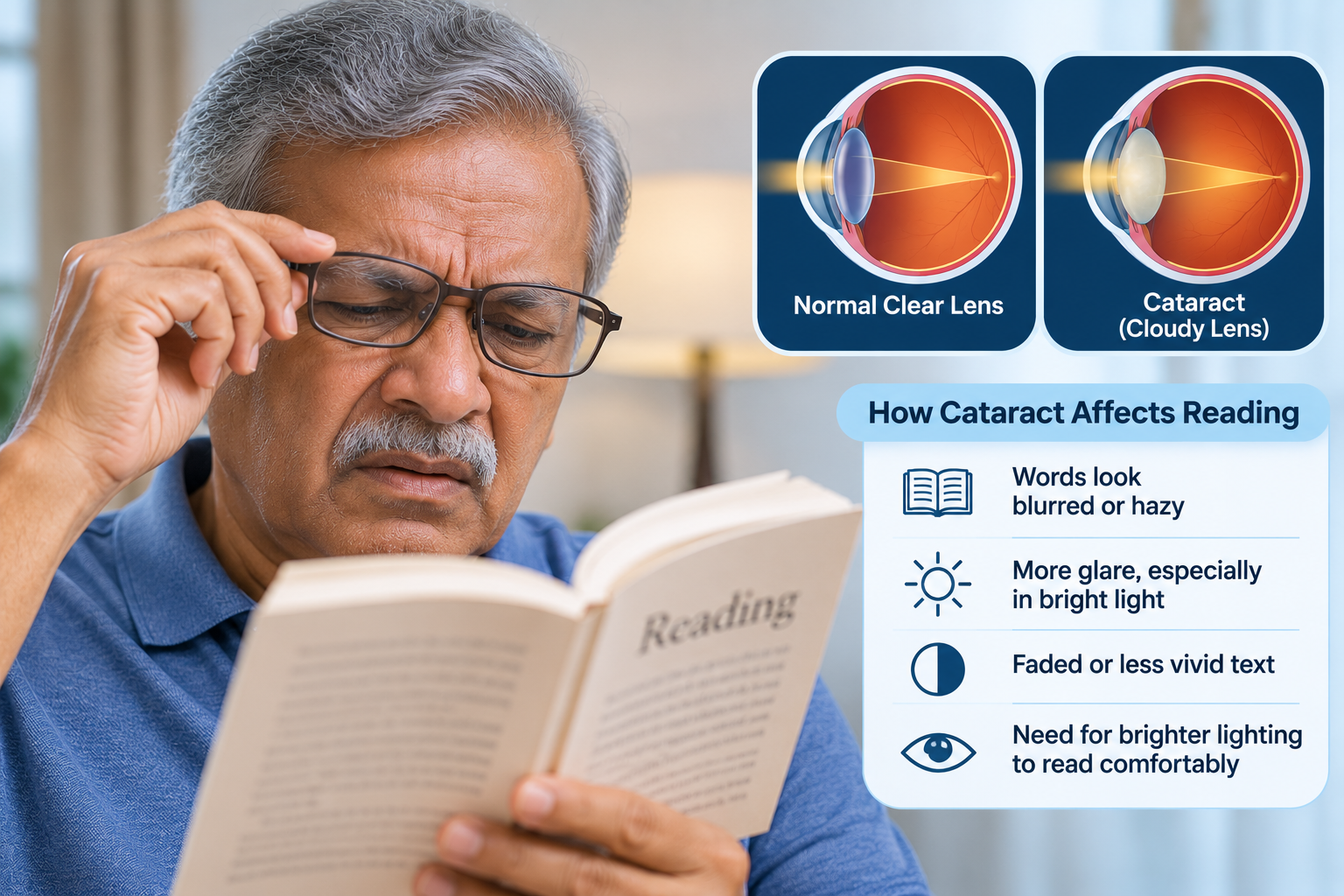
A cataract develops when proteins in the natural lens of the eye begin to break down and form cloudy areas. A healthy lens focuses light onto the retina, allowing you to see objects clearly. When the lens becomes cloudy, light may scatter instead of passing through evenly.
This can make reading more difficult, particularly when the lighting is poor. You may notice that:
-
Printed letters appear faded or less sharp.
-
You need a brighter lamp to read books or newspapers.
-
Small text on mobile phones becomes difficult to see.
-
You prefer reading near a window during daylight.
-
You experience difficulty reading even with your usual glasses.
As cataracts progress, these changes may become more noticeable. The amount of light required for comfortable reading can increase because the cloudy lens reduces image clarity and contrast.
Why do I need brighter light to read than before?
There are several reasons why cataracts can affect your ability to read in normal lighting conditions.
Reduced light transmission: The cloudy lens allows less useful light to reach the retina. This can make reading in a normally lit room feel uncomfortable.
Light scattering: Instead of focusing light properly, the cloudy lens scatters it. This reduces the clarity of letters and makes fine details harder to distinguish.
Reduced contrast sensitivity: Cataracts can make it difficult to distinguish objects or letters from their background. For example, black text on a white page may appear less distinct.
Changes in the type of cataract: Different cataracts affect vision in different ways. A nuclear cataract may cause gradual changes in distance vision and colour perception, while a posterior subcapsular cataract can affect reading and vision in bright light more noticeably.
These changes may develop gradually, so some people adjust their reading habits without immediately realising that their vision has changed.
What other cataract symptoms can affect reading?
Needing more light is only one possible symptom. Cataracts can also cause other visual changes that interfere with everyday activities.
Common symptoms include:
-
Blurred or cloudy vision.
-
Difficulty reading small print.
-
Increased sensitivity to bright lights and glare.
-
Halos around lights, particularly at night.
-
Colours appearing faded or yellowish.
-
Frequent changes in spectacle prescription.
-
Difficulty recognising faces or seeing fine details.
-
Poor vision while driving at night.
Not everyone experiences all these symptoms. Their severity may also depend on the type, location and progression of the cataract.
If reading difficulties occur alongside sudden vision loss, severe eye pain, redness or flashes of light, seek prompt medical attention. These symptoms should not automatically be attributed to cataracts.
Can difficulty reading be caused by something other than cataracts?
Yes. Several eye conditions can make reading difficult, particularly in older adults.
Age-related presbyopia: Presbyopia is a natural age-related change in the eye’s ability to focus on nearby objects. People may need reading glasses or a different prescription to read comfortably.
Dry eye disease: Reduced tear film stability can cause fluctuating or blurred vision. Reading for long periods may also become uncomfortable.
Refractive errors: Changes in spectacle power, including long-sightedness and astigmatism, can affect near vision.
Age-related macular degeneration: This condition affects the central part of the retina and may cause difficulty recognising faces, reading fine print or seeing straight lines clearly.
Diabetic eye disease: Diabetes can affect the retina and other structures of the eye, potentially causing changes in vision.
Since these conditions may have overlapping symptoms, an eye examination is important before deciding on treatment.
How does an eye doctor identify cataracts?
An ophthalmologist will assess your vision and examine the structures of your eyes to determine whether cataracts are responsible for your reading difficulties.
The evaluation may include:
Visual acuity test: This checks how clearly you can see letters and numbers at different distances.
Refraction test: The doctor checks whether an updated spectacle prescription can improve your vision.
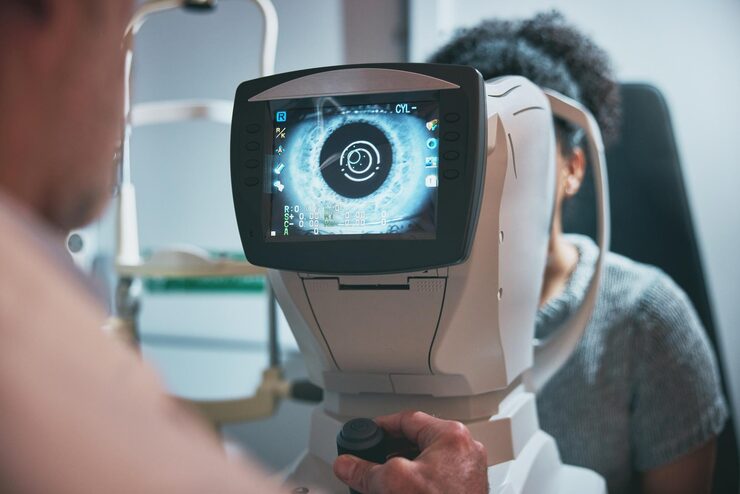
Slit-lamp examination: A specialised microscope helps the ophthalmologist examine the cornea, iris and natural lens to identify cataract changes.
Dilated retinal examination: Eye drops are used to widen the pupils so the doctor can examine the retina and optic nerve. This helps identify other conditions that may affect vision.
Additional tests when required: If cataract surgery is being considered, measurements such as optical biometry may be performed to calculate the appropriate intraocular lens power. A retinal scan or other investigations may be recommended depending on the patient’s eye condition.
The tests recommended will depend on your symptoms, medical history and examination findings.
Does every cataract require surgery to improve reading?
No. Cataracts do not always require immediate surgery. In the early stages, an ophthalmologist may recommend monitoring the condition and making practical adjustments.
These may include:
-
Using a brighter reading lamp with comfortable, evenly distributed lighting.
-
Increasing the font size on mobile phones and digital devices.
-
Using an updated spectacle prescription if appropriate.
-
Avoiding glare from direct or poorly positioned light sources.
-
Attending regular eye examinations to monitor changes.
However, these measures do not remove the cataract. If the cloudy lens continues to affect daily activities, the doctor may discuss cataract surgery.
When should I consider cataract surgery?
Cataract surgery may be considered when vision changes begin to interfere with everyday activities such as reading, working, recognising faces, watching television or driving.
During cataract surgery, the cloudy natural lens is removed and replaced with an artificial intraocular lens (IOL). The type of lens is selected based on factors such as eye measurements, existing eye conditions, visual requirements and the patient’s preferences.
The choice of lens should be discussed with the ophthalmologist. Different IOL options may offer different ranges of vision, and some patients may still need spectacles after surgery.
Patients looking for cataract treatment in Bangalore should choose an eye care centre where the ophthalmologist can assess the cataract, check overall eye health and explain suitable treatment options.
You can learn more about the procedure on the Cataract Treatment service page at Kiran Eye Hospital.
When should I consult an eye specialist?
Arrange an eye examination if you regularly need more light to read, notice increasing difficulty with small print or find that your usual spectacles are no longer helping.
You should seek an earlier assessment if you experience:
-
Rapid or sudden changes in vision.
-
New distortion or missing areas in your central vision.
-
New flashes or a sudden increase in floaters.
-
Eye pain or significant redness.
-
Sudden loss of vision in one or both eyes.
These symptoms may indicate conditions other than cataracts and should not be ignored.
Early evaluation helps identify the reason for your reading difficulties and allows the ophthalmologist to recommend appropriate care.
Frequently Asked Questions
1. Is needing more light to read an early sign of cataracts?
It can be. Cataracts may reduce light transmission and contrast sensitivity, making reading difficult in dim lighting. However, other conditions, including presbyopia and dry eye, can cause similar problems.
2. Can cataracts make reading difficult even with glasses?
Yes. Glasses can correct refractive errors, but they cannot remove cloudiness in the natural lens. If cataracts are affecting vision, changing spectacles may not fully improve reading clarity.
3. Does using brighter light slow down cataract progression?
No. Brighter lighting may make reading more comfortable, but it does not prevent or reverse cataract development.
4. Can cataracts affect only one eye?
Yes. Cataracts can develop in one eye or both eyes. They may also progress at different rates, so vision can be noticeably different between the two eyes.
5. How do I know whether I need cataract surgery?
The decision depends on how much the cataract affects your daily activities, your eye examination findings and your overall visual needs. An ophthalmologist can explain whether monitoring or surgery is appropriate.
Book a Consultation
It’s easy and free!