
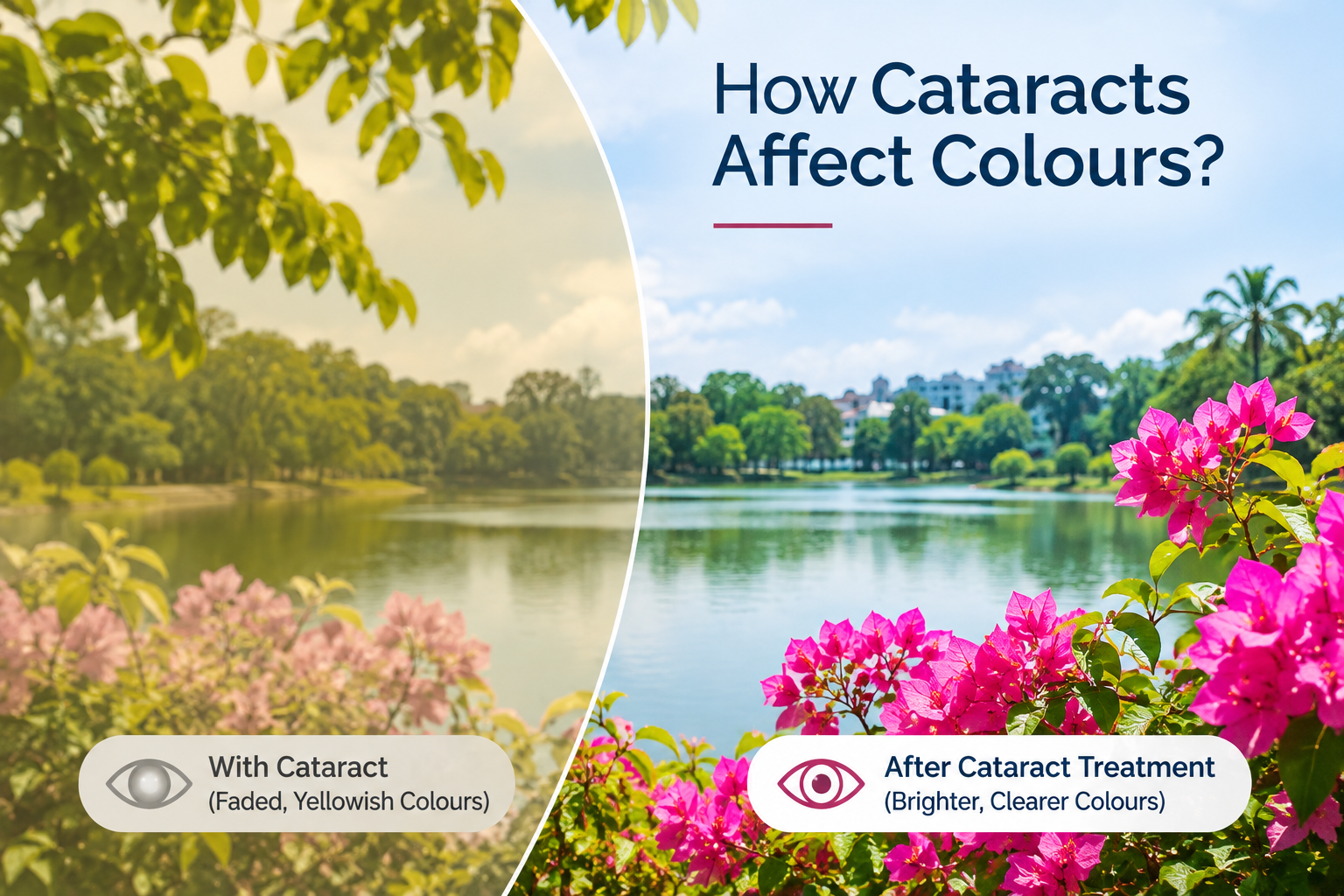
Why do colours appear faded or yellow when cataracts develop? Cataracts cause the eye's natural lens to become cloudy and sometimes yellowish or brownish. These changes reduce the amount and quality of light reaching the retina, making colours appear dull, faded, yellow-tinted or less vibrant. People experiencing faded colours due to cataract may notice that …

Why do colours appear faded or yellow when cataracts develop?
Cataracts cause the eye’s natural lens to become cloudy and sometimes yellowish or brownish. These changes reduce the amount and quality of light reaching the retina, making colours appear dull, faded, yellow-tinted or less vibrant.
People experiencing faded colours due to cataract may notice that white clothes look cream-coloured, blue objects appear less bright, or familiar surroundings seem unusually dull.
At Kiran Eye Hospital, JP Nagar, Bengaluru, Dr. Kiran Kumar K and the ophthalmology team evaluate these visual changes to determine whether cataracts or another eye condition may be responsible.
Why do white objects sometimes appear yellow with cataracts?
The natural lens normally allows light to pass through to the retina, where it is converted into visual signals.
As certain cataracts develop, particularly nuclear cataracts, the lens may gradually become yellow or brown.
This discolouration absorbs more short-wavelength light, especially blue light, changing how the brain perceives colours.
For example:
- White walls may appear cream or slightly yellow.
- Blue clothing may look less vibrant.
- Bright colours may appear muted.
- Similar shades may become difficult to distinguish.
- Images may seem less vivid than before.
These changes often develop gradually, making them difficult to recognise immediately.
Can cataracts affect colour vision even when I can still read clearly?
Yes. Cataracts can affect colour perception and contrast sensitivity before a person notices substantial difficulty reading an eye chart.
Some patients continue performing everyday activities but notice that photographs, flowers or clothing colours appear different.
Others experience reduced contrast, making it harder to distinguish objects from backgrounds of similar shades.
Colour changes may become more noticeable in dim lighting.
However, reduced colour perception is not exclusive to cataracts. Retinal disorders, optic nerve conditions and certain medications can also affect colour vision.
An ophthalmic examination helps identify the cause.
Why does one eye sometimes see colours differently from the other?
Cataracts do not always develop or progress equally in both eyes.
If one natural lens is more yellowed or cloudy, that eye may perceive colours differently.
A person might notice the difference while covering one eye and then the other.
For instance, a white surface may look brighter through one eye and slightly yellow through the other.
This difference can be an important reason to arrange an eye examination.
However, colour differences between the eyes can also indicate retinal or optic nerve problems, especially when the change is sudden.
Patients should avoid assuming that every difference is caused by cataracts.
Does difficulty identifying colours mean my cataract is getting worse?
Not necessarily, but noticeable changes may indicate that the cataract is affecting visual quality.
Other symptoms can include:
- Blurred or hazy vision.
- Increased sensitivity to bright lights.
- Glare from vehicle headlights.
- Difficulty seeing in low-light conditions.
- Reduced contrast sensitivity.
- Frequent changes in spectacle prescription.
The impact varies according to cataract type, severity and other eye conditions.
Gradual changes should be discussed during an ophthalmic examination.
Sudden or rapidly worsening colour vision requires prompt evaluation because cataracts usually progress gradually.
What tests can identify cataract-related colour vision problems?
The ophthalmologist begins by discussing when the changes started and whether one or both eyes are affected.
A comprehensive examination may include:
Visual acuity testing: Measures how clearly objects and letters can be seen.
Slit-lamp examination: Allows direct evaluation of cloudiness and discolouration in the natural lens.
Refraction testing: Determines whether changing spectacle power contributes to reduced visual clarity.
Dilated retinal examination: Evaluates the retina and helps identify other potential causes of colour changes.
Colour vision or contrast sensitivity testing: May be recommended when symptoms require further investigation.
Additional tests, such as optical coherence tomography (OCT), may be necessary if a retinal condition is suspected.
Can glasses or eye drops restore colours affected by cataracts?
Glasses may improve vision when refractive errors contribute to blurred sight, but they cannot remove cloudiness from the natural lens.
Brighter lighting and appropriate visual aids may temporarily improve everyday comfort.
However, no routinely prescribed eye drop has been established to reverse an age-related cataract.
When colour distortion or reduced vision significantly affects daily activities, cataract surgery may be considered.
The decision depends on examination findings, functional difficulties and individual visual needs.
Will colours become brighter after cataract surgery?
Cataract surgery removes the cloudy natural lens and replaces it with a clear artificial intraocular lens.
Many patients notice that colours appear brighter or less yellow after surgery because more light can reach the retina.
Some people become particularly aware of this difference after their first eye has been operated on while the other still has a cataract.
However, the extent of improvement depends on retinal health, optic nerve function, the selected intraocular lens and other individual factors.
Surgery does not guarantee normal colour perception in every patient.
For additional treatment information, patients can read about cataract surgery at Kiran Eye Hospital.
When should I seek medical attention for changes in colour vision?
Arrange an eye examination if colours gradually appear duller, yellowish or different between your eyes.
Seek urgent medical attention if colour perception changes suddenly, particularly with vision loss, eye pain, flashing lights, a dark shadow across vision or other neurological symptoms.
Sudden visual changes should not be attributed to ordinary cataract development without examination.
Early assessment helps identify conditions that may require prompt treatment.
Where can patients near Jayanagar seek cataract evaluation?
Patients searching for a Cataract Surgery Doctor in Jayanagar can consider an ophthalmic evaluation at Kiran Eye Hospital, located in nearby JP Nagar, Bengaluru.
Dr. Kiran Kumar K, Medical Director and Chief Surgeon, holds MBBS, MD (AIIMS, New Delhi), DNB, FAICO (Cornea), FAICO (Refractive Surgery) and MNAMS qualifications. His clinical expertise includes cataract and corneal surgery.
A consultation with Dr. Kiran Kumar K or the ophthalmology team can help patients understand whether faded colours due to cataract are affecting their vision and whether monitoring or treatment is appropriate.
Frequently Asked Questions About Cataracts and Colour Vision
1. Why do white objects look yellow when I have cataracts?
Certain cataracts cause yellowing or browning of the natural lens. This alters the light reaching the retina, making white objects appear cream-coloured or yellowish.
2. Can cataracts make blue and purple colours difficult to distinguish?
Yes. Yellowing of the natural lens can reduce the transmission of shorter-wavelength light, particularly blue light. Some patients may find blue and purple shades less vibrant or harder to distinguish.
3. Can cataracts affect colour vision in only one eye?
Yes. Cataracts may develop at different rates in each eye, causing differences in colour brightness or clarity. An examination is important to exclude other eye conditions.
4. Will cataract surgery restore normal colour vision?
Many patients notice brighter colours after cataract surgery. However, improvement depends on retinal health, optic nerve function and other eye conditions. Normal colour perception cannot be guaranteed.
5. Are faded colours always a sign of cataracts?
No. Retinal conditions, optic nerve disorders and other eye diseases can also affect colour vision. An ophthalmologist can identify the likely cause through appropriate examinations.
Book a Consultation
It’s easy and free!