Does SMILE eye surgery require an incision or stitches? Yes, SMILE eye surgery involves a small incision in the cornea, but stitches are not usually required. The procedure uses a femtosecond laser to create a thin piece of tissue inside the cornea, which the surgeon removes through a small opening, generally around 2–4 millimetres. Unlike …

Does SMILE eye surgery require an incision or stitches?
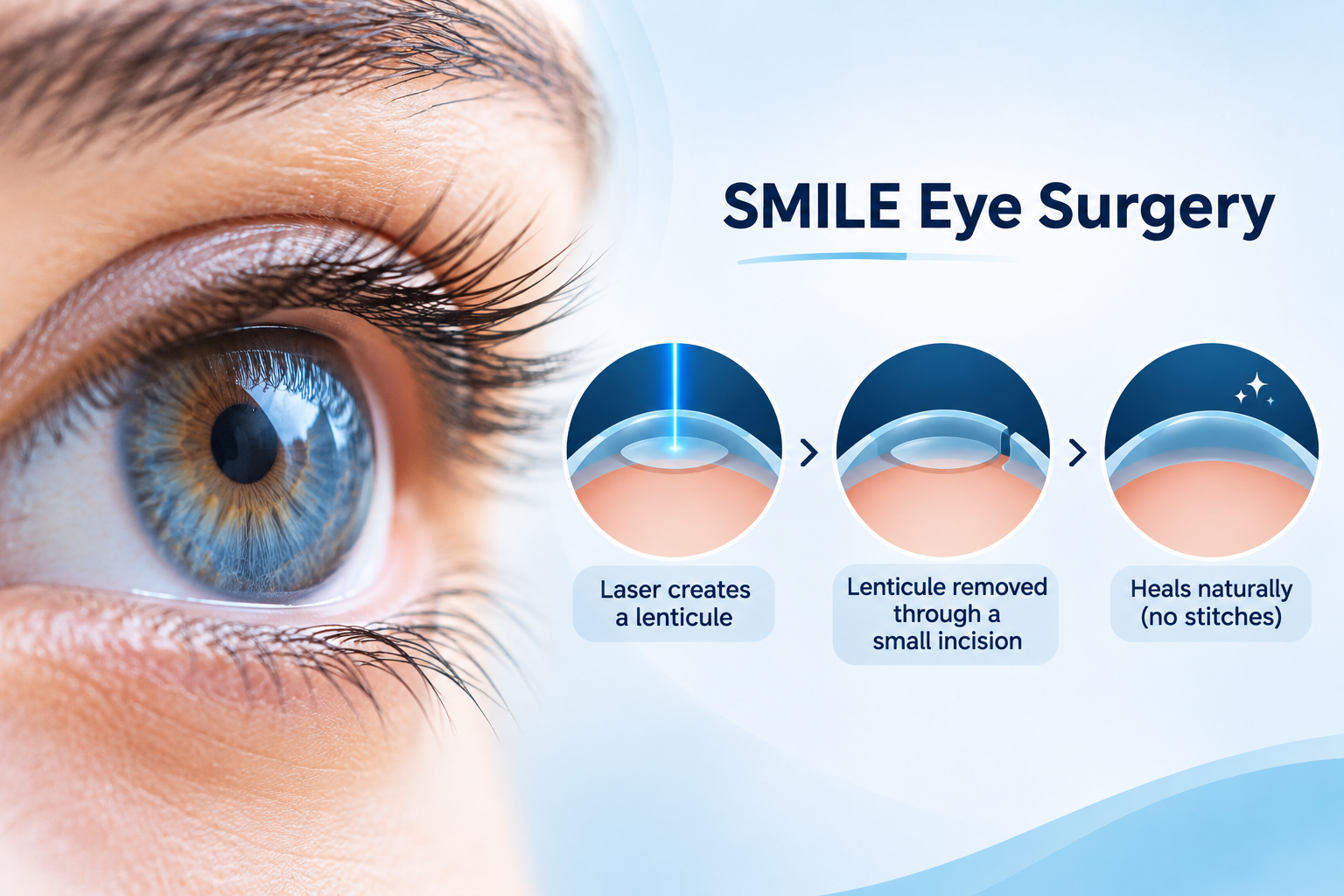
Yes, SMILE eye surgery involves a small incision in the cornea, but stitches are not usually required. The procedure uses a femtosecond laser to create a thin piece of tissue inside the cornea, which the surgeon removes through a small opening, generally around 2–4 millimetres.
Unlike LASIK, SMILE does not involve creating a large corneal flap.
Patients exploring the SMILE eye surgery procedure in Bangalore may feel concerned about cuts, needles or stitches. Understanding how the incision works can help them discuss the procedure with their ophthalmologist.
At Kiran Eye Hospital, JP Nagar, Dr. Kiran Kumar K provides evaluation for SMILE and other refractive procedures.
Where exactly is the cut made during SMILE surgery?
The incision is made in the cornea, the transparent front surface of the eye.
It does not involve cutting the retina, removing the natural lens or opening the entire eyeball.
The laser creates a small, disc-shaped layer of corneal tissue called a lenticule.
A small opening allows the surgeon to separate and remove this lenticule.
Removing the tissue changes the cornea’s shape so that light can focus more accurately on the retina.
The opening is much smaller than the flap created during conventional LASIK.
However, SMILE is still a surgical procedure involving corneal tissue and requires careful planning.
Why does SMILE surgery not usually need stitches?
The corneal incision created during SMILE is small and generally closes naturally as the tissue heals.
Because a large flap is not created, routine suturing is unnecessary in uncomplicated procedures.
The corneal surface gradually heals over the small opening.
The surgeon will examine the eye after the procedure and provide instructions to protect the healing cornea.
Although stitches are not normally used, this does not mean that the surgery has no risks or that healing is identical for every patient.
Additional treatment may occasionally be required if complications develop.
Will I feel the surgeon making the incision?
Before SMILE surgery begins, anaesthetic eye drops are used to numb the surface of the eye.
An eyelid holder helps prevent blinking during treatment.
A contact interface stabilises the eye while the laser creates the lenticule and incision.
Patients may notice pressure, changes in brightness or temporary blurring of vision.
Sharp pain is not expected during an uncomplicated procedure, but some patients may experience pressure or discomfort.
After the laser treatment, the surgeon carefully removes the lenticule through the small incision.
If you experience significant discomfort, tell the surgical team immediately.
How is SMILE different from LASIK if both use a laser?
Both procedures reshape the cornea to correct selected refractive errors, but they use different surgical approaches.
LASIK generally involves creating and lifting a corneal flap before laser reshaping of the underlying tissue.
SMILE creates an internal lenticule and removes it through a smaller opening without creating a flap.
This difference may be relevant for patients concerned about flap-related complications.
However, the smaller incision does not automatically make SMILE the better choice for everyone.
The decision depends on spectacle power, corneal thickness, corneal shape, dry eye findings and other clinical considerations.
What eye problems can SMILE surgery correct?
SMILE is primarily used to treat selected cases of myopia and astigmatism.
Myopia occurs when light focuses in front of the retina, causing distant objects to appear blurred.
Astigmatism occurs when the eye’s optical surfaces have an irregular curvature, producing distorted or blurred vision.
Common concerns include difficulty reading distant signs, recognising objects far away or seeing clearly without spectacles.
These symptoms may also have causes unrelated to refractive error.
Therefore, an eye examination is necessary before deciding whether laser surgery is appropriate.
Which tests are needed before a small-incision eye procedure?
Before recommending surgery, the ophthalmologist evaluates whether the cornea can safely undergo the planned correction.
Common investigations include:
- Refraction testing: Measures spectacle power and checks prescription stability.
- Corneal topography: Maps the corneal surface and identifies irregular curvature.
- Corneal tomography: Examines corneal shape and structure.
- Pachymetry: Measures corneal thickness.
- Tear film assessment: Identifies dry eye concerns.
- Slit-lamp and retinal examinations: Check overall eye health.
Patients with unstable prescriptions, certain corneal abnormalities or other contraindications may be advised against SMILE.
How does the eye heal after SMILE surgery without stitches?
The small incision begins healing naturally after surgery.
During the early postoperative period, patients may experience watering, irritation, light sensitivity or fluctuating vision.
Prescribed eye drops help support recovery and manage inflammation or infection risk.
Patients should avoid rubbing their eyes and follow instructions about washing, swimming, cosmetics and physical activities.
Vision may improve during the first few days, but stabilisation can take longer.
Follow-up appointments allow the ophthalmologist to assess corneal healing and visual recovery.
Patients should not assume that the absence of stitches means they can immediately resume every activity.
Can the small incision become infected or reopen?
Infection after SMILE is uncommon, but it remains a possible complication.
Inflammation, debris within the treated corneal area and other healing problems can also occur.
Avoiding eye rubbing, maintaining hand hygiene and using prescribed medications correctly are important postoperative precautions.
The small incision normally heals without stitches, but it should still be protected during the recovery period.
Seek urgent ophthalmic assessment if you develop increasing pain, worsening redness, discharge, sudden visual deterioration or marked light sensitivity after surgery.
Do not wait for a routine follow-up appointment when these symptoms occur.
Where can I discuss SMILE eye surgery in Bangalore?
Patients researching SMILE Eye Surgery in Bangalore can seek refractive surgery assessment at Kiran Eye Hospital, located in JP Nagar, Bengaluru.
Dr. Kiran Kumar K, Medical Director and Chief Surgeon, holds MBBS, MD (AIIMS, New Delhi), DNB, FAICO (Cornea), FAICO (Refractive Surgery) and MNAMS qualifications.
His professional profile identifies SMILE, LASIK, PRK and corneal surgery among his areas of expertise.
During a consultation, Dr. Kiran Kumar K or the hospital’s ophthalmology team can explain the SMILE eye surgery procedure in Bangalore, how the small incision is created, why stitches are generally unnecessary and whether the procedure is suitable for an individual patient.
Patients can also review the hospital’s SMILE surgery, LASIK surgery and PRK surgery service information.
Frequently Asked Questions About SMILE Surgery Cuts and Stitches
1. Does SMILE surgery involve cutting the eyeball?
SMILE involves a small incision in the transparent cornea, not a large opening into the eyeball. The surgeon removes a thin layer of corneal tissue through this opening to correct selected refractive errors.
2. How big is the incision in SMILE eye surgery?
The corneal incision is generally around 2–4 millimetres, although the exact size depends on the surgical technique and equipment used.
3. Are stitches required after SMILE surgery?
Stitches are not usually required. The small corneal incision generally closes naturally during healing. The ophthalmologist monitors recovery through postoperative examinations.
4. Can I blink during SMILE eye surgery?
An eyelid holder helps keep the eye open during the procedure. The surgical team also uses equipment to stabilise the eye during laser treatment. Patients should follow the surgeon’s instructions.
5. Can the eye become infected even if SMILE does not require stitches?
Yes. Although infection is uncommon, it remains a possible complication. Increasing pain, redness, discharge or worsening vision after surgery requires urgent ophthalmic evaluation.
Book a Consultation
It’s easy and free!