Is SMILE surgery suitable if I work on a computer for 8–10 hours daily? Yes. SMILE (Small Incision Lenticule Extraction) surgery may be suitable for people who work long hours on computers, including IT professionals, designers, accountants and office employees. However, suitability depends on spectacle power, corneal thickness, tear film health and other clinical findings—not …

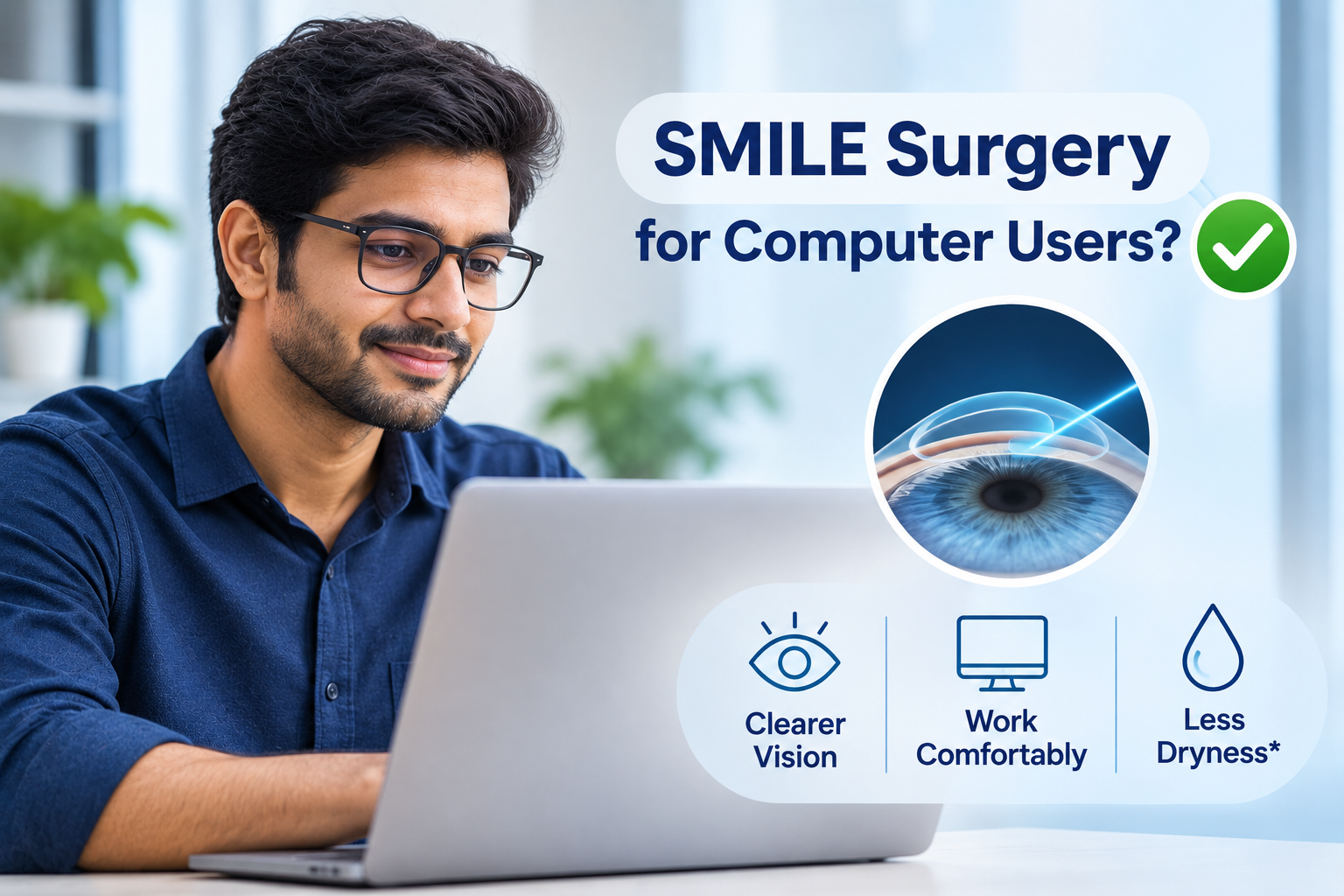
Is SMILE surgery suitable if I work on a computer for 8–10 hours daily?
Yes. SMILE (Small Incision Lenticule Extraction) surgery may be suitable for people who work long hours on computers, including IT professionals, designers, accountants and office employees. However, suitability depends on spectacle power, corneal thickness, tear film health and other clinical findings—not simply the number of hours spent using digital screens.
For patients considering SMILE surgery for computer users, an important concern is whether prolonged screen use could affect postoperative comfort or recovery. At Kiran Eye Hospital, JP Nagar, Bengaluru, Dr. Kiran Kumar K and the ophthalmology team provide refractive surgery assessments to evaluate individual suitability.
Why do my eyes become dry or blurry after working on a laptop?
Long hours of computer work can contribute to digital eye strain, also called computer vision syndrome.
During concentrated screen use, people tend to blink less frequently. Reduced blinking can affect the tear film that keeps the corneal surface moist.
Common symptoms include:
- Burning or dryness after prolonged screen use.
- Fluctuating or temporarily blurred vision.
- Eye fatigue during coding, reading or designing.
- Headaches after extended computer work.
- Watering or a gritty sensation.
- Difficulty maintaining comfortable focus.
These symptoms may also be influenced by air conditioning, poor lighting, uncorrected spectacle power or existing dry eye disease.
Digital screens do not usually cause permanent structural eye damage, but prolonged viewing can produce significant discomfort.
Can existing dry eyes make SMILE surgery unsuitable?
Pre-existing dry eye disease is an important factor during refractive surgery evaluation.
SMILE uses a femtosecond laser to create a small lenticule within the cornea, which is removed through a small incision.
The procedure can temporarily affect corneal nerve function and tear film stability.
Some studies suggest that SMILE may cause fewer early postoperative dry eye symptoms than LASIK in selected patients, but dryness can still occur.
For patients exploring SMILE surgery for IT professionals, the ophthalmologist should assess whether existing dryness needs treatment before surgery.
Significant or poorly controlled dry eye disease may require postponing refractive surgery.
Will SMILE surgery reduce computer-related eye strain?
SMILE is intended to correct selected refractive errors, primarily myopia and astigmatism.
Correcting an underlying spectacle prescription may reduce blur associated with that refractive error.
However, SMILE does not directly treat digital eye strain caused by reduced blinking, prolonged near work or environmental dryness.
Patients may continue experiencing tired eyes or dryness even after satisfactory refractive correction.
Similarly, age-related focusing problems such as presbyopia may still require appropriate visual correction.
Understanding these limitations helps patients establish realistic expectations before surgery.
Which eye tests are important for people who use computers extensively?
Before recommending SMILE, an ophthalmologist performs a comprehensive eye examination.
Important tests may include:
Refraction testing: Measures spectacle power and checks prescription stability.
Corneal topography and tomography: Evaluate corneal shape and identify structural irregularities.
Corneal pachymetry: Measures corneal thickness to assess suitability for laser treatment.
Tear film assessment: Examines tear stability and possible dry eye disease.
Slit-lamp examination: Evaluates the cornea, eyelids and ocular surface.
Overall eye health examination: Identifies other conditions that may influence treatment or recovery.
Patients should mention computer-related discomfort, contact lens intolerance and previous dry eye treatment during consultation.
These details help the surgeon assess the risks and possible benefits of surgery.
How soon can I return to computer work after SMILE surgery?
Some patients can resume limited screen activities within the first few days after SMILE surgery, depending on visual recovery and their surgeon’s instructions.
However, returning immediately to eight or ten hours of continuous computer work may be uncomfortable.
Temporary dryness, watering, light sensitivity and fluctuating vision can affect screen tolerance.
Patients whose jobs require detailed visual tasks, including coding, graphic design or financial analysis, may benefit from arranging a few days of flexibility.
The appropriate return-to-work date should be determined during postoperative follow-up.
Patients can review the hospital’s SMILE surgery service for general information about the procedure and recovery.
How can I protect my eyes during long screen sessions after surgery?
Patients returning to computer work should follow their surgeon’s postoperative instructions.
Helpful measures may include:
- Taking frequent visual breaks using the 20-20-20 rule.
- Blinking consciously during concentrated work.
- Using prescribed lubricating eye drops as directed.
- Positioning the monitor slightly below eye level.
- Adjusting brightness and contrast to reduce glare.
- Avoiding direct air conditioning airflow towards the face.
- Avoiding rubbing the eyes.
- Attending scheduled postoperative appointments.
The 20-20-20 rule involves looking approximately 20 feet away for 20 seconds after every 20 minutes of screen use.
These habits may improve comfort but do not replace postoperative medical care.
What if SMILE surgery is not suitable for my eyes?
Not every person with myopia or astigmatism is eligible for SMILE.
Patients with unsuitable corneal measurements, significant dry eye disease, unstable prescriptions or certain corneal disorders may require alternative management.
Depending on examination findings, the ophthalmologist may recommend spectacles, contact lenses or another refractive procedure.
Patients can also explore the hospital’s LASIK surgery and PRK surgery information.
Each treatment has different eligibility criteria, limitations and potential complications.
When should I seek medical attention for screen-related eye symptoms?
Arrange an ophthalmic examination if blurred vision, persistent dryness, recurrent headaches or eye discomfort interferes with daily computer work.
Following SMILE surgery, increasing redness, worsening vision, significant pain or persistent light sensitivity should be reported promptly.
Seek urgent medical attention for sudden vision loss, severe eye pain or rapidly worsening postoperative symptoms.
These findings should not be dismissed as ordinary digital eye strain.
Where can computer professionals in JP Nagar discuss SMILE surgery?
Patients searching for SMILE surgery for computer users can seek a refractive surgery evaluation at Kiran Eye Hospital, located at Vishnu Towers, ITI Layout, 1st Phase, JP Nagar, Bengaluru.
Dr. Kiran Kumar K, Medical Director and Chief Surgeon, holds MBBS, MD (AIIMS, New Delhi), DNB, FAICO (Cornea), FAICO (Refractive Surgery) and MNAMS qualifications. His published clinical expertise includes SMILE, LASIK and PRK procedures.
A consultation with Dr. Kiran Kumar K or the hospital’s ophthalmology team can help determine whether laser correction is appropriate for an individual’s eye health and work-related visual requirements.
Frequently Asked Questions About SMILE Surgery for Computer Users
1. Can I undergo SMILE surgery if I work on a laptop for 10 hours daily?
Yes, prolonged computer use does not automatically make someone unsuitable for SMILE. However, corneal health, prescription stability and existing dry eye symptoms must be assessed before surgery.
2. Can I use my laptop the day after SMILE surgery?
Some patients may tolerate limited screen use early in recovery, but others experience dryness or blurred vision. Follow your surgeon’s instructions and avoid prolonged screen sessions until you are comfortable and medically cleared.
3. Will SMILE surgery permanently prevent computer-related dry eyes?
No. SMILE corrects selected refractive errors but does not prevent dry eye symptoms associated with prolonged screen use. Blinking habits, tear film health and environmental factors remain important.
4. Is SMILE better than LASIK for people working in IT?
Not necessarily. SMILE may offer certain advantages for selected patients, including potentially less early postoperative dry eye, but neither procedure is universally preferable. The choice depends on individual eye measurements and clinical suitability.
5. Do I need computer glasses after SMILE surgery?
Some patients may still benefit from glasses for particular tasks, residual refractive errors or age-related near vision changes. The ophthalmologist can assess whether additional correction is needed.
Book a Consultation
It’s easy and free!