Yes. Implantable Collamer Lens (ICL) surgery can correct or reduce high levels of myopia, including some prescriptions that may be unsuitable for LASIK. Certain ICL models are approved in specific markets for myopia up to -20 dioptres, although complete correction is not guaranteed at every prescription. For patients searching for ICL surgery near me JP …


Yes. Implantable Collamer Lens (ICL) surgery can correct or reduce high levels of myopia, including some prescriptions that may be unsuitable for LASIK. Certain ICL models are approved in specific markets for myopia up to -20 dioptres, although complete correction is not guaranteed at every prescription.
For patients searching for ICL surgery near me JP Nagar, the important consideration is not spectacle power alone. Eye anatomy, prescription stability, corneal health and retinal condition determine whether surgery is appropriate. Kiran Eye Hospital, located in JP Nagar, Bengaluru, provides ICL/IPCL consultation and refractive eye care services.
Can ICL surgery treat -10, -15 or -20 eye power?
Patients with very high minus spectacle power often wonder whether their prescription is beyond the limits of surgical correction. ICL is designed to correct refractive errors by placing an artificial lens inside the eye, behind the iris and in front of the natural crystalline lens. For certain approved EVO ICL models, the treatment range includes correction of myopia from -3 D to -15 D and reduction of myopia above -15 D up to -20 D, subject to additional eligibility requirements. Therefore, patients with -10 D or -15 D prescriptions may be considered for treatment, while those approaching -20 D require careful assessment of the expected correction and available lens options. These figures are model-specific regulatory indications, not a universal treatment range for every ICL available in India.Why does high myopia cause difficulty seeing distant objects?
High myopia occurs when light focuses in front of the retina rather than directly on it, commonly because the eyeball is longer than average. Patients may experience:- Severe blurring of distant objects without spectacles.
- Difficulty recognising faces or reading signboards.
- Dependence on thick prescription lenses.
- Reduced comfort with contact lenses.
- Difficulty performing everyday activities without correction.
Why might LASIK not be recommended for very high spectacle power?
LASIK corrects refractive errors by reshaping the cornea with a laser. Higher prescriptions generally require greater corneal tissue removal. If the required treatment would leave insufficient healthy tissue, LASIK may not be advisable. This is one reason ICL surgery for high myopia may be considered. Unlike LASIK, ICL does not require removing corneal tissue to achieve the refractive correction. However, it is an intraocular procedure with a different set of potential complications. Patients can understand these approaches through the hospital’s LASIK surgery and ICL/IPCL surgery service pages.Can ICL correct high myopia and astigmatism together?
Yes. Certain toric ICL models are designed to address myopia along with astigmatism. Astigmatism occurs when the eye’s optical surfaces have unequal curvature, causing blurred or distorted vision. For patients with both high minus power and significant cylindrical power, the surgeon evaluates whether a suitable toric implant is available. The degree of correction depends on the lens model, measurements and expected residual refractive error. Some patients may still require spectacles for particular activities after surgery.Which eye tests determine whether very high power can be corrected?
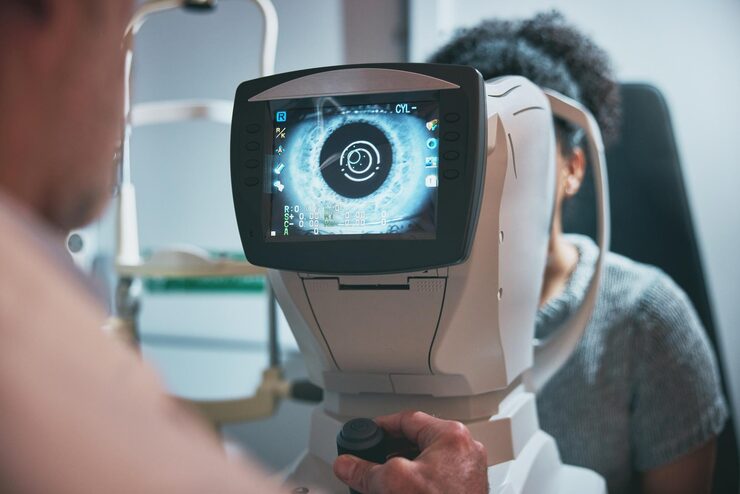
Before recommending ICL surgery, an ophthalmologist performs a detailed preoperative evaluation. Important tests include: Refraction testing: Confirms spectacle power and prescription stability. Anterior chamber depth measurement: Checks whether adequate space is available for the implant. Corneal endothelial cell count: Evaluates cells responsible for maintaining corneal transparency. Corneal topography: Examines corneal shape and identifies irregularities. Intraocular pressure measurement: Helps detect elevated eye pressure. Dilated retinal examination: Checks for peripheral retinal changes and other complications associated with high myopia. Additional lens-sizing measurements may also be necessary. These findings help determine whether implantation is suitable and which treatment approach should be considered.What happens if my spectacle power is beyond the available ICL range?
Having a prescription beyond the available implant range does not automatically mean that no vision correction options exist. Depending on the findings, the ophthalmologist may recommend continued use of spectacles or contact lenses, an alternative approved phakic lens, or another treatment approach. Some patients may need additional investigation or management of associated eye conditions before any elective procedure is considered. The aim should be an appropriate balance of visual improvement and surgical risk rather than pursuing complete spectacle independence at any cost.Does ICL surgery permanently remove the risks of high myopia?
No. ICL changes how light focuses within the eye but does not reverse the structural changes associated with high myopia. Patients with elongated eyeballs may remain at risk of retinal degeneration, retinal tears or retinal detachment. ICL surgery also carries potential risks, including elevated eye pressure, cataract formation, glare, inflammation, infection and corneal endothelial cell loss. Long-term follow-up is therefore important, even when postoperative vision is satisfactory.When should someone with very high myopia seek medical attention?
Patients with rapidly changing spectacle power, persistent blurred vision or difficulty tolerating corrective lenses should arrange an ophthalmic examination. Seek urgent medical attention if you experience sudden flashes, a sudden increase in floaters, a dark curtain across vision or sudden vision loss. These symptoms may indicate retinal complications and require prompt evaluation, regardless of whether ICL surgery has been performed.Where can patients in JP Nagar discuss ICL surgery for very high eye power?
Patients researching ICL surgery near me JP Nagar can seek an individualised refractive surgery assessment at Kiran Eye Hospital, located at Vishnu Towers, ITI Layout, 1st Phase, JP Nagar, Bengaluru. Dr. Kiran Kumar K, Medical Director and Chief Surgeon, holds MBBS, MD (AIIMS, New Delhi), DNB, FAICO (Cornea), FAICO (Refractive Surgery) and MNAMS qualifications. His published clinical expertise includes cornea and refractive surgery. A comprehensive consultation with Dr. Kiran Kumar K or the hospital’s ophthalmology team can help determine whether very high spectacle power can be managed with an implantable lens or whether another option is more appropriate.Frequently Asked Questions About ICL Surgery for High Myopia
1. Can ICL surgery correct -15 eye power completely?
Some ICL models are designed to correct myopia up to -15 D. However, the actual result depends on lens availability, eye measurements and individual suitability. Complete freedom from spectacles cannot be guaranteed.2. Is ICL surgery possible for -20 spectacle power?
Certain approved ICL models can reduce myopia up to -20 D in appropriately selected patients. The surgeon must assess the available lens power, expected remaining prescription and overall eye health.3. Is ICL safer than LASIK for patients with high myopia?
Neither procedure is universally safer. ICL may be considered when corneal laser correction is unsuitable, but implantation carries intraocular risks. A detailed examination is necessary to compare the options.4. Will high myopia return after ICL surgery?
ICL corrects the existing refractive error, but the eye may undergo further prescription changes over time. Some patients may require glasses or additional treatment later.5. Can I undergo ICL surgery if I have high myopia and retinal thinning?
Possibly, depending on the nature and severity of the retinal findings. A dilated retinal examination is important, and any significant retinal condition should be assessed before elective surgeryBook a Consultation
It’s easy and free!