Can ICL Surgery Correct Astigmatism? Understanding Toric ICL Astigmatism can cause blurred or distorted vision because the cornea or natural lens has an uneven curvature. People with both myopia (short-sightedness) and astigmatism may wonder whether one procedure can address both problems. Toric ICL for astigmatism is a vision correction option that uses a specially designed …

Can ICL Surgery Correct Astigmatism? Understanding Toric ICL
Astigmatism can cause blurred or distorted vision because the cornea or natural lens has an uneven curvature. People with both myopia (short-sightedness) and astigmatism may wonder whether one procedure can address both problems. Toric ICL for astigmatism is a vision correction option that uses a specially designed implantable lens to correct these refractive errors together. At Kiran Eye Hospital, JP Nagar, an ophthalmologist evaluates the eye’s measurements, corneal condition and refractive power before deciding whether a toric ICL is suitable.
What Is a Toric ICL and How Does It Correct Astigmatism?
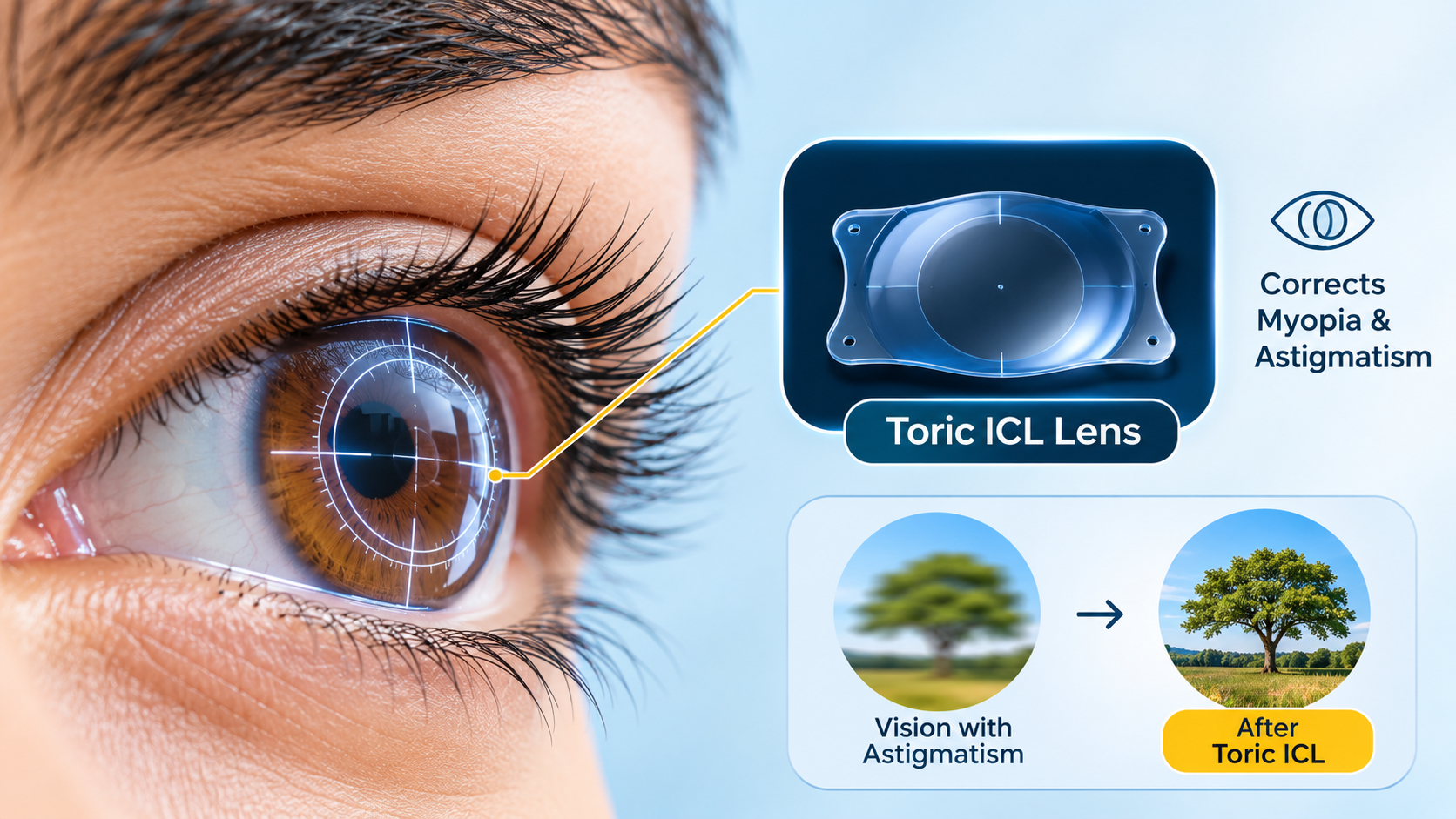
A toric Implantable Collamer Lens (ICL) is a type of phakic intraocular lens designed to correct myopia along with regular astigmatism.
Unlike a standard ICL, which primarily corrects spherical refractive error, a toric ICL has different optical powers in different meridians. This allows it to compensate for the uneven focusing caused by astigmatism.
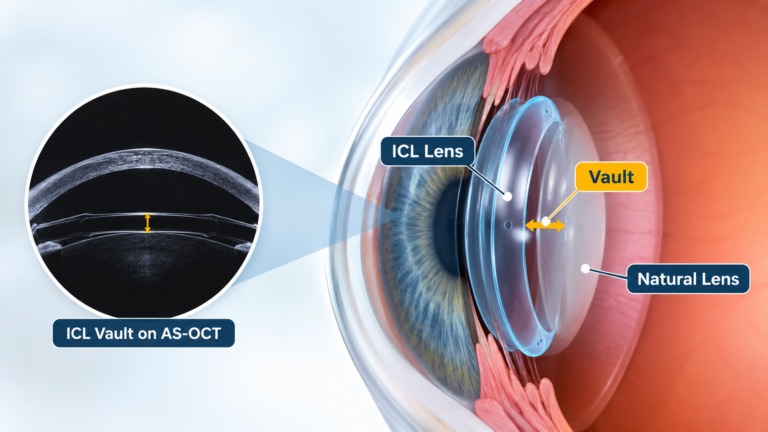
The lens is implanted inside the eye, behind the iris and in front of the natural crystalline lens. The natural lens is preserved.
A toric ICL has a specific orientation, or axis, that must be aligned with the patient’s astigmatism measurement. Correct positioning is important because rotation can affect the intended correction.
Can ICL Surgery Correct Both Myopia and Astigmatism?
Yes. A toric ICL can correct both myopia and regular astigmatism in appropriately selected patients.
For example, someone with a prescription of -7.00 dioptres of myopia and -2.00 dioptres of astigmatism may be evaluated for toric ICL correction.
The final lens power and axis depend on detailed measurements, not simply the spectacle prescription.
Patients with irregular astigmatism, unstable refractive errors or certain corneal conditions may need a different treatment approach.
The ophthalmologist evaluates the source and pattern of astigmatism before recommending surgery.
Who Is Suitable for Toric ICL Surgery in Bangalore?
Toric ICL surgery may be considered for patients who:
- Have myopia with regular astigmatism.
- Have a stable spectacle prescription.
- Are not suitable candidates for LASIK because of certain corneal characteristics.
- Have adequate anterior chamber depth.
- Have healthy corneal and internal eye structures.
- Meet the age and other eligibility requirements for the selected lens.
However, having a high spectacle power does not automatically make someone suitable for ICL surgery.
The doctor must also evaluate corneal health, eye anatomy, endothelial cell count and other factors before recommending the procedure.
What Tests Are Required Before Toric ICL Surgery?
Accurate measurements are essential because the toric lens must correct the refractive error while fitting appropriately inside the eye.
Common preoperative examinations include:
1. Refraction testing: Measures myopia and astigmatism, including the cylindrical power and axis.
2. Corneal topography and tomography: Maps the corneal surface and helps identify irregularities or conditions such as keratoconus.
3. Anterior chamber depth measurement: Evaluates the available space inside the front portion of the eye.
4. White-to-white measurement: Measures the horizontal visible corneal diameter and may contribute to ICL sizing calculations.
5. Endothelial cell count: Evaluates the health and density of the corneal endothelial cells.
6. Retinal examination: Checks the back of the eye, particularly in patients with high myopia.
These investigations help the ophthalmologist assess eligibility, calculate the lens power and select an appropriate implant.
Why Is the Toric ICL Lens Axis Important?
One important difference between a standard ICL and a toric ICL is the need for accurate rotational alignment.
The toric lens contains a cylindrical correction that must correspond to the measured astigmatism axis.
If the lens rotates away from its intended position, the effective cylindrical correction may decrease and residual astigmatism may remain.
For this reason, surgeons carefully plan the implantation axis and check the lens position during postoperative examinations.
If significant rotation occurs, the doctor may evaluate whether repositioning is necessary. Not every small change in position requires another procedure.
What Happens If a Toric ICL Rotates After Surgery?
Toric ICL rotation can affect how effectively the lens corrects astigmatism.
Patients may notice:
- Blurred or distorted vision
- Residual cylindrical power
- Reduced visual clarity
- Difficulty focusing on distant objects
However, these symptoms do not always indicate lens rotation. Dry eye, residual refractive error and other eye conditions can also cause blurred vision.
The ophthalmologist may perform refraction testing and examine the implanted lens using appropriate imaging methods.
If clinically significant rotation is confirmed, surgical repositioning may be considered depending on the amount of rotation, lens position and overall eye health.
How Is Toric ICL Different From LASIK for Astigmatism?
Both toric ICL and LASIK can correct certain types of myopia and astigmatism, but they work differently.
| Feature | Toric ICL | LASIK |
|---|---|---|
| Treatment method | Implantable lens placed inside the eye | Laser reshapes the cornea |
| Natural lens | Preserved | Preserved |
| Corneal tissue | Not removed to correct refractive power | Corneal tissue is reshaped |
| Suitable candidates | Selected patients based on eye anatomy | Selected patients based on corneal health and refractive error |
| Astigmatism correction | Built into the toric lens | Achieved through laser corneal reshaping |
Neither procedure is suitable for everyone. The choice depends on corneal thickness, refractive stability, eye anatomy, prescription and individual medical findings.
What Is the Recovery Process After Toric ICL Surgery?
After surgery, patients are given postoperative instructions and prescribed eye drops to support healing and reduce inflammation.
During the initial recovery period, some patients may experience:
- Mild irritation
- Temporary blurred vision
- Light sensitivity
- Watering
- Halos around lights
Patients should avoid rubbing their eyes, follow the prescribed medication schedule and attend follow-up appointments.
The surgeon checks visual acuity, eye pressure, lens position and toric alignment during postoperative examinations.
Seek prompt medical attention if you experience severe eye pain, increasing redness, sudden blurred vision, significant halos accompanied by headache or sudden loss of vision.
Where Can You Get an ICL Surgery Evaluation in JP Nagar?
If you have both myopia and astigmatism, a detailed refractive examination can help determine whether a standard ICL, toric ICL or another vision correction option is appropriate.
At Kiran Eye Hospital, JP Nagar, Bengaluru, patients can discuss ICL/IPCL surgery and undergo an evaluation of their refractive error and eye anatomy.
Dr. Kiran Kumar, Medical Director and Chief Surgeon, holds MBBS, MD (AIIMS, New Delhi), DNB, FAICO (Cornea), FAICO (Refractive Surgery) and MNAMS qualifications. His published professional profile identifies refractive surgery among his areas of clinical expertise.
The consultation helps establish whether the patient’s cornea, anterior chamber and overall eye health are suitable for the proposed procedure.
For patients exploring toric ICL for astigmatism, the important consideration is not simply correcting the spectacle prescription. Appropriate lens power, sizing and rotational alignment must all be considered before surgery.
Frequently Asked Questions
1. Is toric ICL better than regular ICL for astigmatism?
A toric ICL includes cylindrical correction and may be suitable for patients with myopia and regular astigmatism. A standard ICL may be considered when significant astigmatism correction is not required. The choice depends on individual measurements.
2. Can toric ICL correct high astigmatism?
Toric ICL may correct certain degrees of astigmatism, depending on the available lens powers and the patient’s eye measurements. The ophthalmologist must assess whether the prescription falls within the selected lens’s treatment range.
3. Can a toric ICL move or rotate inside the eye?
Yes. Some rotational movement can occur, but significant rotation may reduce the intended astigmatism correction. Postoperative examination helps assess lens alignment.
4. Will I still need glasses after toric ICL surgery?
Some patients may still require glasses for residual refractive error or specific visual tasks. The need depends on the surgical correction and individual visual requirements.
5. Is toric ICL surgery reversible?
Because the natural crystalline lens is preserved, an ICL can be surgically removed or exchanged when medically indicated. However, removal is another intraocular procedure and should not be considered risk-free or equivalent to reversing every effect of surgery.
Book a Consultation
It’s easy and free!