Can cataracts make me see two images with only one eye? Yes. Cataracts can cause double vision in one eye, a condition known as monocular diplopia. This happens when the eye's cloudy natural lens scatters or bends incoming light unevenly, creating a second image, shadow or ghost-like outline around an object. People experiencing double vision …


Can cataracts make me see two images with only one eye?
Yes. Cataracts can cause double vision in one eye, a condition known as monocular diplopia. This happens when the eye’s cloudy natural lens scatters or bends incoming light unevenly, creating a second image, shadow or ghost-like outline around an object.
People experiencing double vision due to cataract may notice overlapping letters, duplicated lights or a faint second image even when the other eye is covered.
At Kiran Eye Hospital, JP Nagar, Bengaluru, Dr. Kiran Kumar K and the ophthalmology team evaluate these symptoms to identify whether cataracts or another eye condition is responsible.
Why does a cloudy lens create two images instead of one?
The natural lens normally helps focus incoming light onto the retina.
When a cataract develops, portions of the lens become cloudy or develop irregular optical properties. Light may then pass through different areas of the lens and focus unevenly.
Instead of producing one well-defined image, the eye may create overlapping images or faint shadows.
Patients sometimes describe this as:
- Seeing a duplicate outline around letters.
- Noticing a shadow beside television subtitles.
- Seeing overlapping images of distant objects.
- Experiencing ghost images around lights.
- Finding that one eye produces a less distinct image.
The appearance may vary with lighting, pupil size and cataract characteristics.
How can I tell whether double vision comes from one eye or both eyes?
An important distinction is whether the double vision persists when only one eye is used.
A simple observation can help you describe your symptoms to the ophthalmologist.
While looking at a stationary object, cover your left eye and notice whether the image remains doubled through your right eye. Then repeat the process with your right eye covered.
If doubling remains when viewing through one particular eye, monocular diplopia may be present.
If double vision occurs with both eyes open but disappears when either eye is covered, it is more consistent with binocular diplopia.
Binocular diplopia may involve eye alignment, eye muscles, nerves or neurological conditions.
This observation cannot diagnose the cause. New double vision requires medical assessment.
Are ghost images at night always caused by cataracts?
No. Cataracts are one possible explanation, but several other eye problems can produce similar symptoms.
Dry eye disease can create an uneven tear film, causing fluctuating ghost images that sometimes improve after blinking.
Astigmatism may produce distorted or overlapping images because light does not focus evenly.
Corneal irregularities, including keratoconus, can also affect image clarity.
Some retinal conditions may cause visual distortion that patients describe as double vision.
Cataract-related symptoms are often gradual, whereas sudden changes deserve more urgent investigation.
Can double vision become worse as a cataract progresses?
It can, although the pattern varies.
As lens clouding changes, image distortion and glare may become more noticeable.
Some patients experience double vision only under particular lighting conditions.
Others notice associated symptoms such as blurred vision, sensitivity to headlights, reduced contrast or difficulty reading.
Interestingly, monocular double vision may sometimes change or become less noticeable as the cataract progresses, even while overall vision deteriorates.
Therefore, the severity of double vision alone does not reliably indicate cataract severity.
A comprehensive examination is necessary to understand the condition.
Which eye tests can identify the cause of monocular double vision?
The ophthalmologist first asks when the symptoms began, whether they are constant and whether they affect one or both eyes.
The assessment may include:
Visual acuity testing: Measures how clearly each eye sees.
Refraction testing: Identifies spectacle power changes or astigmatism.
Pinhole testing: Helps determine whether an optical focusing problem contributes to the doubled image.
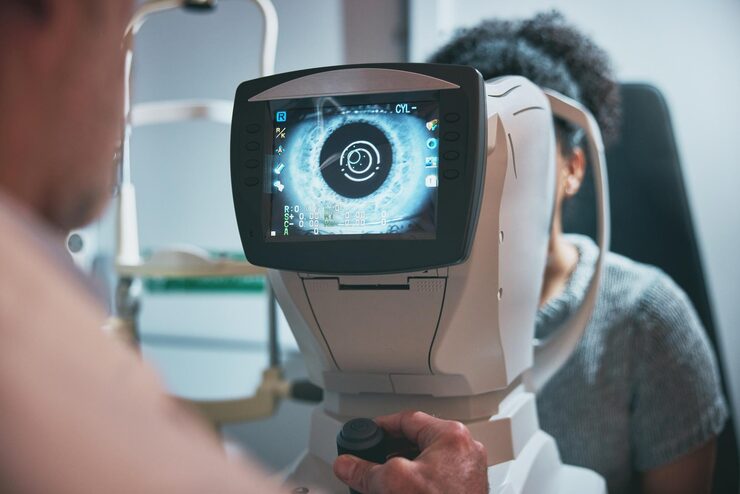
Slit-lamp examination: Allows detailed evaluation of the cornea and natural lens for cataracts.
Dilated retinal examination: Checks for retinal conditions that may affect image formation.
Corneal topography or OCT: May be recommended if corneal irregularities or retinal abnormalities are suspected.
Eye alignment and movement tests may also be necessary when binocular diplopia is suspected.
Can changing my glasses correct double vision caused by cataracts?
New spectacles may improve vision when refractive errors contribute to the problem.
However, glasses cannot remove cloudiness from the natural lens.
If the double vision is primarily caused by cataract-related optical distortion, a prescription change may provide limited improvement.
Dry eye treatment or other condition-specific management may help when the cataract is not the main cause.
An ophthalmologist may initially recommend monitoring a mild cataract if daily activities remain manageable.
The treatment decision should depend on the confirmed diagnosis and the effect on everyday vision.
Will cataract surgery remove the ghost image from my vision?
When cataracts are confirmed as the main cause, surgery may improve monocular double vision.
The procedure removes the cloudy natural lens and replaces it with a clear artificial intraocular lens.
However, surgery cannot guarantee that all double vision will disappear.
Persistent symptoms may occur when another condition, such as corneal irregularity, retinal disease or eye misalignment, is also present.
Patients can learn more about cataract surgery at Kiran Eye Hospital.
Understanding the underlying cause before surgery is important for establishing realistic expectations.
When should I seek urgent medical attention for double vision?
Arrange a prompt ophthalmic examination for any new or unexplained double vision, even if it affects only one eye.
Seek emergency medical care immediately if double vision begins suddenly with severe headache, drooping eyelid, unequal pupils, weakness, difficulty speaking, dizziness or loss of coordination.
Double vision following a head injury also requires emergency assessment.
Avoid driving while your vision is doubled or unreliable.
These symptoms should never be assumed to be caused by an ordinary cataract.
Where can I consult a cataract specialist in Bangalore?
Patients searching for a Cataract Surgery Specialist in Bangalore can consider evaluation at Kiran Eye Hospital, Vishnu Towers, ITI Layout, 1st Phase, JP Nagar, Bengaluru.
Dr. Kiran Kumar K, Medical Director and Chief Surgeon, holds MBBS, MD (AIIMS, New Delhi), DNB, FAICO (Cornea), FAICO (Refractive Surgery) and MNAMS qualifications.
His documented expertise includes cataract surgery, corneal conditions and refractive procedures.
A consultation with Dr. Kiran Kumar K or the hospital’s ophthalmology team can help determine whether double vision due to cataract is present, whether other investigations are needed and which treatment pathway may be appropriate.
Frequently Asked Questions About Cataracts and Double Vision
1. Can cataracts cause double vision even when one eye is closed?
Yes. Cataracts can cause monocular diplopia, where a doubled or ghost-like image remains visible through the affected eye even when the other eye is covered. Other conditions can cause similar symptoms, so an examination is necessary.
2. Why do I see a shadow next to letters when reading?
A shadow beside letters may result from cataracts, astigmatism, dry eye disease or corneal irregularities. An ophthalmologist can perform refraction, corneal and lens examinations to identify the likely cause.
3. Is double vision from cataracts permanent?
Not necessarily. When a cataract is the primary cause, cataract surgery may improve or resolve the symptom. However, results depend on other eye conditions, and complete resolution cannot be guaranteed.
4. Can cataracts cause double vision in both eyes?
Cataracts can produce monocular double vision in either eye, and both eyes may be affected independently. True binocular double vision, which disappears when either eye is covered, usually requires evaluation for eye alignment or neurological causes.
5. Should I get cataract surgery immediately if I have double vision?
Not always. The ophthalmologist must first determine whether cataracts are responsible. Surgery may be considered when the cataract significantly affects vision and daily activities, but sudden or unexplained double vision requires prompt evaluation.
Book a Consultation
It’s easy and free!